
India Has Adequate Sugar Stocks, Recent Price Rise Not Due to Any Structural Shortage: ISMA
ISMA said India has adequate sugar stocks and that the recent price firmness is due to temporary factors, including lower production, festive demand and firm global prices, rather than any structural shortage. With projected closing stocks of 35 LMT, early crushing, imports and stock controls, domestic availability is expected to remain comfortable.

 Join the RuralVoice whatsapp group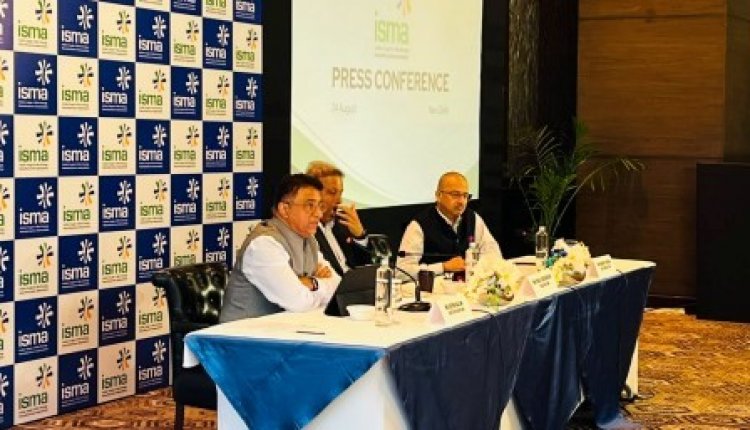
Sugar industry body, Indian Sugar & Bio-Energy Manufacturers Association (ISMA) has claimed that the recent firmness in sugar prices should not be construed as a shortage of sugar in the country. India’s sugar balance remains fundamentally comfortable, with net sugar production for 2025-26 estimated at around 279 lakh tonnes (LMT) against domestic consumption of around 280-285 LMT, and projected closing stocks of around 35 LMT.
It said that the recent increase in sugar prices is the result of a convergence of temporary factors, including lower-than-initially-expected production, heightened festive-season demand, market sentiment and firm international sugar prices. These factors have contributed to temporary price firmness, but do not point to any structural imbalance in domestic sugar availability.
In a press conference held in Delhi, the association also welcomed the Government measures to maintain orderly market conditions during the festive season- 10 LMT duty-free raw sugar import window, stockholding restrictions, physical verification of stocks, weekly disclosures supported by GST checks, and the advancement of the 2026-27 crushing season. A 400-tonne nationwide stock limit for dealers has been imposed, while ISMA has suggested that this may be further reduced to 200 tonnes to strengthen market discipline.
Niraj Shirgaokar, President, ISMA said, “India has adequate sugar availability and the measures being taken should be seen in that context. The Government and industry are acting ahead of the festive demand period to maintain orderly supplies and market stability. The import window, stockholding measures and advancement of the crushing season provide multiple levers to manage the temporary firmness we are seeing. With closing stocks estimated at around 35 LMT and fresh-season production being brought forward, we remain confident about domestic availability,” said Mr.
ISMA, along with NFCSF and sugar mills, is working towards advancing the commencement of the 2026-27 crushing season by 10-15 days, so that fresh domestic sugar becomes available earlier during the festive season.
“Advancing the crushing season by 10-15 days can make a meaningful difference at precisely the time the market needs additional supply. With special crushing already underway in Tamil Nadu and Karnataka, we expect October production to increase to around 10 LMT, compared with the usual 4 LMT. This additional domestic production, together with existing stocks and calibrated releases, should help ease the current pressure as festive buying normalizes,” said Mr. Madhav B. Shriram, Vice President, ISMA.
ISMA also claimed that the Ethanol Blending Programme is not responsible for the current increase in sugar prices. Sugar diversion towards ethanol is planned and assessed well in advance of the crushing season, based on the overall sugar balance and domestic consumption requirements.
The feedstock profile of the ethanol programme has undergone a significant transformation. Grain-based ethanol is estimated to account for 75% of total ethanol supply in 2025-26, compared with only 17% in 2021-22, while the share of sugar-based ethanol has declined to 25%. Total ethanol supply is estimated at around 1,197 crore litres in 2025-26, with the blending rate reaching 20%.
ISMA claimed that the ethanol programme has been a key factor in strengthening the financial position and liquidity of sugar mills, thereby enabling them to make timely cane payments to farmers. This is reflected in the fact that around 97% of the cane dues for 2025-26 had already been paid as of 20 August 2026. “Without the additional revenue and liquidity support provided by the EBP, the financial position of sugar mills and their ability to make timely cane payments would have been significantly more challenging,” it said.
Deepak Ballani, Director General, ISMA said, “Sugar diversion is determined only after assessing domestic requirements and the overall sugar balance. More importantly, the ethanol programme itself has changed significantly, with grains now accounting for an estimated 75% of supply. We should therefore look at the current sugar market through the actual supply-demand fundamentals rather than attribute a temporary price movement to ethanol.”
The association claimed that the present market situation is fundamentally different from that witnessed during the 2016-17 sugar season, when India faced a genuine drought-driven production shortfall, with production of around 203 LMT against demand of 245-250 LMT. “The current situation is markedly more comfortable, with around 279 LMT of net production and projected closing stocks of around 35 LMT,” it said.
It also said that due to the corrective measures taken by the Government, sugar prices have already started easing in the last few days and are expected to soften further as festive-season buying normalises and fresh domestic supplies increase, ensuring adequate availability of sugar at affordable prices during the festive season.
Sugar Prices Hit 16-Year High While Farmers Face Rs 16,087 Crore Dues: AIKS