India-EU Trade Deal: Why Strict EU Pesticide Rules Threaten Indian Agri Exporters
As the implementation of India-EU Free Trade Agreement nears, stringent EU pesticide residue limits, often dropping to a default 0.01 ppm, pose major barriers to Indian agricultural exports. Experts urge India to enforce equal import inspection standards, establish farm-to-port traceability, upgrade laboratories, and actively challenge non-scientific trade barriers in international forums like the WTO.

 Join the RuralVoice whatsapp group
As India moves closer to implementing its Free Trade Agreement (FTA) with the European Union, food safety standards are emerging as one of the most sensitive trade issues. While the agreement promises closer regulatory cooperation, the EU is pushing to abolish import tolerances for pesticides that are no longer authorised within Europe. This would automatically apply the bloc's default maximum residue limit (MRL) of 0.01 parts per million (ppm) to many imported agricultural products, even where the internationally recognised Codex Alimentarius standards allow significantly higher, science-based limits. The default threshold of 0.01 ppm is equivalent to just one gram of pesticide residue in 100 tonnes of food, a level that experts argue is extremely stringent and could create significant compliance challenges for Indian exporters.
Indian agricultural exports continue to face frequent rejections in Europe over pesticide residues, bacterial and fungal contamination, and certification and labelling deficiencies. According to the United Nations Industrial Development Organization (UNIDO), non-pesticide issues account for 81% of these rejections, while pesticide residues account for 19%. At the same time, imported food products often enter India with far less testing and inspection. A report by think tank Global Trade Research Initiative (GTRI) says, unless India strengthens its food-safety system and ensures fair enforcement of standards, the FTA could give European food products easier access to the Indian market while Indian exporters continue to face stringent regulatory barriers in Europe.
Food Safety and Trade
Food-safety regulations are essential for consumer protection. Fruits, vegetables, spices and grains naturally contain small quantities of pesticide residues used for crop protection, while processed foods may contain preservatives and additives. Governments establish Maximum Residue Limits (MRLs) and contaminant standards to ensure these substances remain within scientifically safe levels.
However, many countries increasingly use food-safety regulations as trade policy instruments. Instead of relying on tariffs, they impose stringent residue limits, certification requirements and inspection procedures that make exports from India more difficult. These measures often go well beyond internationally recognized Codex standards, significantly increasing compliance costs for exporters.
Indian Exports Under Pressure
India's exporters face growing food-safety actions overseas. In mid-2026, Japan suspended imports of India's Alphonso and Kesar mangoes after identifying deficiencies in approved fumigation and pest-control procedures. The European Union, the United Kingdom and other developed markets have repeatedly rejected Indian consignments of chilli, cumin, turmeric, sesame seeds, rice products, seafood, fruits, vegetables, herbal products and food supplements due to excessive pesticide residues, ethylene oxide contamination, aflatoxins, veterinary drug residues and heavy metals.
The scale of the problem is substantial. The European Union alone has issued 365 food-safety notifications against Indian products, resulting in border rejections, recalls, destruction or return of consignments and stricter import controls. Several Indian products, including sesame seeds, chilli peppers, curry leaves, okra and certain herbal products, are now subject to 20-50% physical inspections and laboratory testing at EU borders. These additional checks increase costs, delay deliveries and reduce the competitiveness of Indian exports. The repeated notifications expose weaknesses across India's food-safety ecosystem - from farm level pesticide management and traceability to laboratory capacity and regulatory enforcement.
Weak Checks on Imports
Ironically, while Indian exports face intensive scrutiny abroad, imported food products often receive comparatively little attention at Indian borders. This is particularly striking because developed country agriculture generally uses far more pesticides than India. The European Union has nearly 600 registered pesticides, compared with 372 in India. In 2023, EU farmers used approximately 300,000 tonnes of pesticides, while India used only 40,000 tonnes. On a per-hectare basis, pesticide use in the EU averages 2.67 kilograms, compared with just 0.24 kilograms in India - more than eleven times higher. Pertinently, the agricultural GVA of India is double that of EU-27 countries.
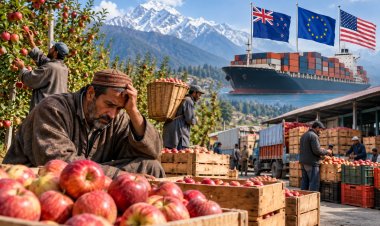
The difference is equally visible at the crop level. European farmers are permitted to use 256 pesticides on apple cultivation, whereas India permits only 54. The United States is also among the world's largest pesticide users. Yet imported European apples, California almonds and dates from West Asia rarely undergo the comprehensive residue testing that Indian exports routinely face overseas. This reflects weaknesses in India's surveillance, laboratory testing and border enforcement systems rather than evidence that imported food products are inherently safer.
EU Rules Become Tougher
The European Union's food-safety regime has become increasingly restrictive. A particularly controversial practice concerns pesticide residue limits. When a pesticide loses approval for domestic use, the EU frequently reduces the import MRL to a default 0.01 parts per million (ppm) - equivalent to one gram of residue in 100 tonnes of food. This means, to ingest 1 gm of a pesticide residue, one has to consume 100 tons of a food commodity- a lifetime impossibility.
Critics argue that this default is often imposed without a fresh scientific risk assessment and reflects a hazard-based regulatory philosophy rather than internationally accepted risk-assessment principles.
The controversy is illustrated by tricyclazole, a fungicide widely used in rice cultivation. In 2022, the European Food Safety Authority concluded that the MRL for tricyclazole in rice could safely be increased from 0.01 ppm to 0.09 ppm based on scientific evidence. Nevertheless, the European Parliament rejected that recommendation and retained the stricter, ideologically preferred 0.01 ppm limit, making exports more difficult for rice-producing countries, including India.
During discussions at the WTO SPS Committee, the EU acknowledged that it had not established the limit through a conventional scientific risk assessment but had instead relied on its default hazard-based approach.
FTA Alone Won't Help
The issue is becoming even more significant as the India-EU FTA approaches implementation. While the agreement promises greater regulatory cooperation, the EU has simultaneously proposed eliminating import tolerances for pesticides that are no longer approved within Europe. This would automatically impose the default 0.01 ppm residue limit on many imported products, even where internationally accepted Codex standards permit significantly higher scientifically justified limits.
Unless India strengthens its domestic compliance systems and actively challenges scientifically unjustified SPS measures, many of the export gains expected from the FTA may never materialise.
What India Should Do
Ajay Srivastava from GTRI and Shantwna Dixit from the Centre for Environment and Agriculture says, India needs a strategy that is both defensive and offensive. First, it should build a world-class domestic food-safety system through farm-to-port traceability, stronger farmer guidance on pesticide use, more internationally accredited laboratories/ stronger Indian originated accreditation system, routine residue monitoring and stronger enforcement by FSSAI, customs and plant and animal quarantine authorities.
Second, India should inspect imported food with the same rigour that Indian exports face abroad. Imported consignments should undergo risk-based sampling and laboratory testing, and shipments failing Indian standards should be rejected.
China offers a useful model. Between 2013 and 2019, Chinese authorities rejected or returned an average of 740 European Union food consignments every year for food-safety violations. China demonstrated that rigorous import enforcement can coexist with robust international trade. India should adopt a similarly science-based inspection regime.
Third, India should establish a dedicated Food-Safety Monitoring and Response Cell to track regulatory changes in export markets, provide early warnings to exporters and assist them in meeting evolving compliance requirements.
Finally, India must become far more proactive in defending its export interests. Food-safety measures lacking scientific justification should be challenged through bilateral consultations, FTA mechanisms and the WTO SPS Committee.