
India Needs a Unified Farm Policy and Research Focused on Small Farmers: Dr. R.S. Paroda
At the Rural Voice Agriculture Conclave and Awards 2025, Dr. R.S. Paroda called for unified agricultural policies, incentives instead of subsidies, and research tailored to small farmers. Prof. Ramesh Chand urged diversification beyond MSP crops and a shift toward holistic food systems. ICAR DG Dr. M.L. Jat emphasised innovation, market-driven farming, specialized zones, and wider use of bio-fertilizers to build self-reliant farmers

 Join the RuralVoice whatsapp group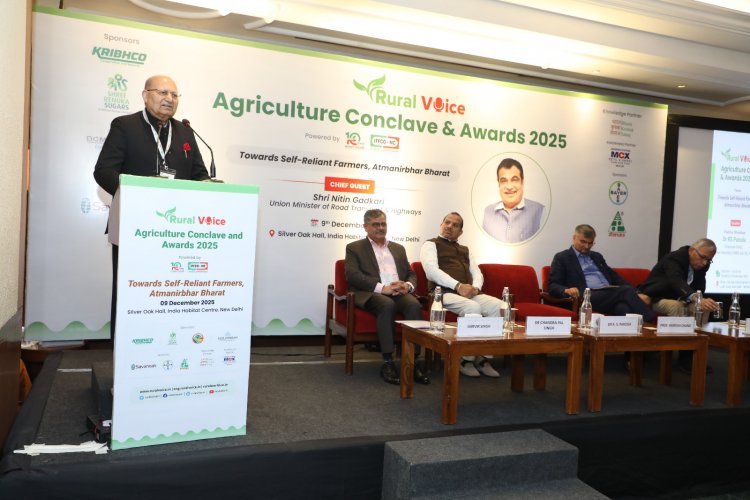
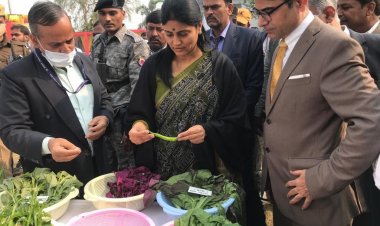
Dr. R.S. Paroda, Chairman of the Trust for Advancement of Agricultural Sciences (TAAS), has stressed the urgent need for policies and research specifically designed for small-holder farmers. Speaking at the ‘Rural Voice Agriculture Conclave and Awards 2025’ in New Delhi, held to mark the fifth anniversary of the media platform Rural Voice, Padambhushan Dr. Paroda, former Secretary, DARE, and former DG, ICAR, said that farmers must also explore new alternatives to achieve true self-reliance. Dr. Paroda also chaired the jury for this year’s Rural Voice Agriculture Awards.
He noted that although the number of agriculture-related ministries has grown to seven, coordination among them remains weak. India needs a unified agricultural and farmer welfare policy, he said, calling for the replacement of subsidies with incentives and stronger public–private partnerships. Strengthening the agricultural extension system is equally crucial.
Dr. Paroda emphasized the need for institutional mechanisms that genuinely listen to farmers. Farmers’ voices should not be heard only when they protest on the streets, he said. Since agriculture is a state subject, better coordination between the Centre and states is essential. He proposed creating an Agriculture Council on the lines of the GST Council.
Several key agricultural leaders addressed the conclave. NITI Aayog member and noted agricultural economist Prof. Ramesh Chand urged farmers to diversify into crops not covered under Minimum Support Price (MSP), noting that MSP crops have grown at just 1.8 percent over the past decade, compared to nearly 4 percent for non-MSP crops. He said farmers must take proactive steps rather than relying solely on government interventions if they want to become self-reliant.
Prof. Chand pointed out that while agricultural growth has been 4.6 percent over the past decade, domestic demand is rising at only about 2 percent. The resulting surplus must be converted into an opportunity. With a growing affluent consumer base, farmers can earn significantly more by producing crops tailored to market demand, provided the entire value chain is strengthened. Globally, he said, agricultural planning is shifting toward a holistic food systems approach that integrates seeds, production, value addition, marketing, and distribution.
ICAR Director General and, Secretary, DARE Dr. M.L. Jat said that self-reliant farmers are central to India’s vision of becoming a developed nation. He called for innovation, specialised farming zones, skill development, market linkages, incentives instead of subsidies, and the promotion of market-led agriculture. Innovation, he said, is essential for raising productivity and reducing costs.
Dr. Jat stressed that subsidies often limit farmers’ crop choices, whereas incentives encourage diversification and market integration. He proposed developing crop- and region-specific farming zones equipped with research institutions and processing facilities so that farmers receive better prices without depending on MSP. He also highlighted the need to expand the use of bio-fertilizers to reduce chemical dependence and protect soil health and biodiversity. Technologies exist, he said, but they must reach farmers through targeted delivery and enhanced skills.