India–US Interim Trade Pact Opens Farm Gates as Tariff Relief for Exports Comes at a Rural Cost
India has agreed to address long-standing U.S. concerns over food and agricultural imports and to determine, within six months of the agreement entering into force, whether U.S.-developed or international standards and testing requirements will be accepted for U.S. exports in identified sectors

 Join the RuralVoice whatsapp group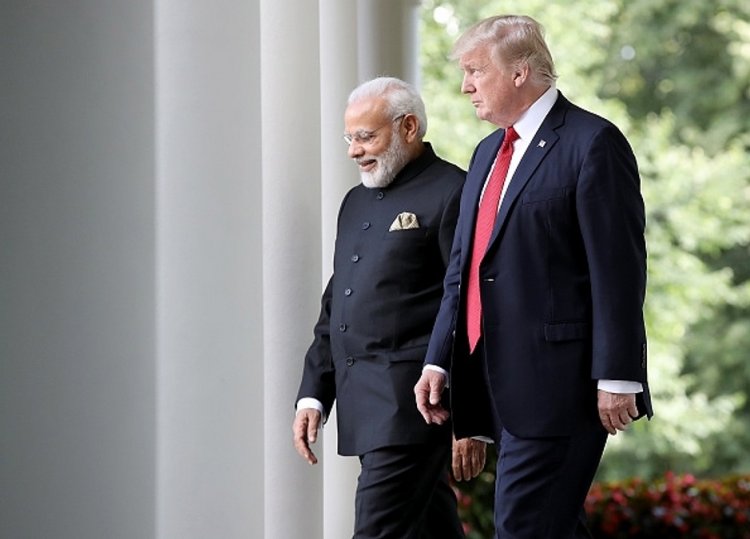
India’s interim trade agreement framework with the United States delivers immediate tariff relief to Indian exporters but does so by sharply widening access for U.S. agricultural products, a trade-off that analysts warn could expose Indian farmers to import competition while offering only limited and conditional gains in return.
The framework, announced in a joint statement on February 6, commits India to eliminate or reduce tariffs on a wide range of U.S. food and agricultural products—including tree nuts, fresh and processed fruits, soybean oil, wine and spirits, dried distillers’ grains (DDGs) and red sorghum for animal feed—marking one of the most significant openings of India’s farm market to the United States outside a full free trade agreement.
“This agreement reflects our shared commitment to reciprocal and balanced trade,” the joint statement said, describing the interim deal as a step toward a comprehensive Bilateral Trade Agreement (BTA).
But trade economists say the agricultural concessions are neither modest nor symmetrical.
Agriculture bears the heaviest adjustment
While the United States has agreed to reduce punitive “reciprocal” tariffs on about 55% of Indian exports—cutting rates from as high as 50% to 18%—Washington has not reduced its core most-favoured-nation (MFN) tariffs on any agricultural product.
India, by contrast, has agreed to permanently lower MFN tariffs on multiple U.S. farm and food items, many of which directly compete with domestic producers.
“From an agriculture standpoint, this is a one-sided opening,” said Ajay Srivastava, founder of the Global Trade Research Initiative (GTRI). “The U.S. has offered tariff relief from measures it imposed unilaterally, while India has agreed to structural changes that affect farmers, processors and state procurement systems.”
Tariff reductions on imported apples, almonds, walnuts and other fruits are expected to impact growers in Himachal Pradesh, Jammu and Kashmir and parts of the Northeast. Lower duties on soybean oil—already one of India’s most politically sensitive imports—could intensify pressure on domestic oilseed farmers and complicate the government’s push for self-reliance in edible oils.
Feed imports and livestock implications
The inclusion of DDGs and red sorghum for animal feed signals a deeper U.S. push into India’s livestock and poultry value chains.
“These are not niche products,” Srivastava said. “Once you liberalise feed imports, you affect cost structures across dairy, poultry and meat, even if those sectors are formally excluded.”
U.S. farm lobby groups welcomed the framework. U.S. Agriculture Secretary Brooke Rollins called the deal “a major victory for American farmers,” saying it would “expand exports of U.S. agricultural products to India’s vast market and help close the agricultural trade gap.”
Indian officials, however, have sought to play down the risks. Commerce Minister Piyush Goyal said sensitive sectors would remain protected. “India’s core farmer interests have been safeguarded, and any market access will be calibrated,” he said.
The framework, however, does not specify tariff-rate quotas, safeguard triggers or exclusion lists for agriculture, leaving key details to subsequent negotiations.
Standards and certification: a quiet but crucial shift
Beyond tariffs, analysts say the more consequential agricultural concessions lie in non-tariff measures.
India has agreed to address long-standing U.S. concerns over food and agricultural imports and to determine, within six months of the agreement entering into force, whether U.S.-developed or international standards and testing requirements will be accepted for U.S. exports in identified sectors.
“This is where the real shift happens,” Srivastava said. “If U.S. sanitary and phytosanitary certifications are accepted as equivalent, Indian regulators lose discretion over food safety, residues and labelling.”
Similar provisions in recent U.S. trade deals have allowed American agricultural products to enter partner countries based largely on U.S. certifications, without reciprocal recognition.
“Once standards are harmonised downward, it is extremely difficult to reverse them,” Srivastava added.
Strategic alignment and future pressure
The agreement also commits India and the U.S. to closer “economic security alignment,” including cooperation on supply chains and responses to non-market policies of third countries.
Analysts warn this could further complicate India’s agricultural trade with countries such as Russia and China, particularly if future U.S. sanctions or trade actions extend to food, fertilisers or agricultural inputs.
“This creates a pathway for trade policy pressure to spill into food security decisions,” Srivastava said.
Export relief masks rural exposure
The tariff rollback offered by the U.S. will benefit Indian exporters of textiles, leather, chemicals and handicrafts, sectors that employ large numbers of workers. Finance Minister Nirmala Sitharaman said the agreement would support MSMEs and export-led growth.
But economists note that the gains are concentrated in manufacturing and services, while the adjustment costs fall disproportionately on agriculture.
“In effect, Indian farmers are underwriting export relief for other sectors,” Srivastava said. “That is a political and economic choice, not a neutral trade outcome.”
A familiar fault line
Prime Minister Narendra Modi described the framework as “great news for India–U.S. economic ties,” but farm groups are expected to scrutinise the fine print as negotiations move toward a full BTA.
With agriculture employing nearly half of India’s workforce, analysts say the interim agreement reopens an old fault line in India’s trade policy: whether export competitiveness should be bought at the cost of farm protection.
“As a temporary truce, the deal reduces pressure,” Srivastava said. “As a precedent, it shifts the burden of adjustment onto Indian agriculture. That is where the real political test will lie.”