
India’s Sustainable Castor Output Hits 1.70 Lakh Tonnes as Project Pragati Scales in Gujarat
Sustainable castor seed production in India has reached 1.70 lakh tonnes under Project Pragati and i-Pragati in Gujarat. With over 13,500 farmers certified and higher yields alongside lower water use, the initiative is boosting farmer incomes, strengthening supply chains, and enhancing women’s participation in climate-resilient agriculture.
 Join the RuralVoice whatsapp group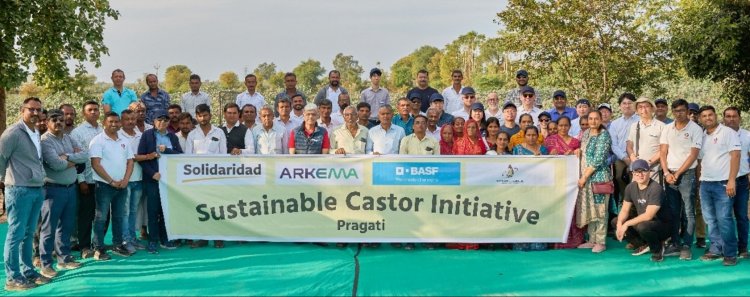
Sustainable castor seed production in India has reached a major milestone, touching 1.70 lakh tonnes, as farmer-led initiatives in Gujarat continue to scale up responsible agriculture practices. Spearheaded by Jayant Agro-Organics Limited through its flagship Project Pragati, the initiative has completed nine years, emerging as a global model for sustainable and traceable castor supply chains.
Launched in 2016 in partnership with Arkema and BASF, along with development organisation Solidaridad, the programme has significantly expanded its footprint. Alongside, Project i-Pragati, driven by Ihsedu Agrochem Pvt Ltd, has further deepened outreach among farmers.
By 2025, the combined initiatives have certified over 13,500 farmers and brought more than 16,000 hectares under the SuCCESS® sustainability code. The programmes have cumulatively produced around 1.70 lakh tonnes of certified castor seeds, strengthening India’s position in global specialty chemical supply chains.
Farm-level impact has been substantial. Farmers associated with the programme reported yields 32% higher than government benchmarks, while demonstration plots recorded nearly 30% lower water consumption compared to conventional practices. The steady increase in sustainable acreage reflects growing farmer confidence in castor as a climate-resilient and profitable crop, particularly suited to semi-arid regions.
According to Abhay V. Udeshi, Chairman of Jayant Agro Group, the initiative highlights how sustainability can enhance farmer incomes while ensuring a reliable supply chain for global industries. The rising number of certified farmers indicates increasing trust in this model, reinforcing India’s leadership in sustainable castor cultivation.
The programme, rooted in Gujarat, India’s key castor-producing region, has evolved from a baseline study of 1,000 farmers into a scalable global framework. Participating farmers have reported tangible benefits, including 20-25% reduction in cultivation costs and improved crop productivity through better practices and certified seeds.
Beyond productivity, the initiative focuses on farmer resilience. Over 450 training sessions were conducted during the year, and more than 500 lead farmers were trained to mentor others. Additionally, over 10,000 safety kits were distributed and 150 medical camps organised, benefiting thousands of rural households.
The programme is also advancing gender inclusion. In its third phase, more than 1,150 women have been trained in sustainable practices, along with digital and financial literacy, strengthening their role in farm decision-making and improving rural livelihoods.