Managing India’s Input-Intensive Agriculture Under the Disruptions of Supply Chain Caused by the Strait of Hormuz Crisis
India’s input-intensive agriculture faces major risks from the Strait of Hormuz crisis, which disrupts fertilizer imports and raises energy costs. Heavy dependence on imported urea, DAP, and natural gas threatens Kharif productivity and food security. The article urges boosting domestic fertilizer production, renewable energy, soil health, and resource efficiency to build long-term resilience.

 Join the RuralVoice whatsapp group
With 2.4 per cent of the global land area and 4 per cent of water resources, India is home to 18 per cent of the world human population and one-third of livestock. India’s agricultural accomplishments are example of a global success story. Between 1947 and 2020, India’s food grain production increased by a factor of 6, horticulture by 10, milk by 9 and fish by 13. Grain exports have been at 20 million tons (mt) /yr (US $40 billion), grain buffer stock stands at 50 mt and poverty is reduced from 70 to 20 per cent. Whereas the net sown area is about 140 mha, gross sown area is ~200 mha, net irrigated area at ~70 mha, and fertilizer nutrient use at 26 mt, along with the use of miracle crop varieties. To sustain this production, India imports about 40 per cent of urea, and phosphate fertilizers used every year.
In FY 2025, India imported 10.2 mt of urea valued at US$ 6.52 billion. Over 60 per cent of India’s urea imports and 80 per cent of its ammonia are from the Gulf region, much of it passing through the Strait of Hormuz. The Kharif (summer) planting season, beginning in June with onset of monsoons, is critical for planting rice, cotton, soybean, sorghum, millets and pulses. Thus, productivity of summer crops may be severely compromised by the current Hormuz crisis and lack of fertilizers. Although India’s potential for food grain production is estimated at about 550 mt per year, this remains largely theoretical—since, as Dr. Norman Borlaug noted, ‘no one can eat potential.’ Moreover, such potential cannot be fully realized under the current challenging biophysical conditions and complex political and institutional constraints.”
Hence, India’s agrarian revolution may be severely threatened by disruption in agricultural supply chain with ongoing instability in the Strait of Hormuz leading to elevate energy prices and, in turn, logistics and input costs., It is true that fertilizer does not get as much attention as fossil fuel (oil or natural gas) but it is of a critical importance to sustaining agronomic productivity and nutritional quality of food. The price of fertilizer has already risen by 20 to 30 per cent since onset of the Crisis. The most abundant input of resources in producing liquid ammonia is the energy from natural gas to break apart H2O molecule and combine H with N at temperature of 400°C and pressure of 200 atmospheres with Fe as a catalyst (The Haber Bosch Process). Indeed, 70 to 80 per cent of the cost of making urea is the natural gas.
Similar to input of natural gas for production of urea, India also imports 60 per cent of the Diammonium phosphate [(NH4)2 HPO4) containing 18% N and 46% P2O5)] mostly from Saudi Arabia and Middle East. Furthermore, DAP also requires liquid ammonia (NH3) which is based on natural gas and sulfuric acid (H2SO4) made from sulfur which is also imported. Above all, India has no commercially available potash reserves, and it must also be imported. Fossil energy (natural gas) along with solar is also used to lift water for irrigation.
The Hormuz crisis is a major challenge for India in its quest to achieve food and nutritional self-sufficiency, given its wide- ranging direct (onsite), indirect (off-site) and the human dimension impacts (Figure 1). Disruptions in supply chain, an indirect and off-site adverse effect, is already affecting India’s economy and can have severe setback on food and nutritional security leading to issues affecting the mere fabric of life. Indeed, any war adversely affects body, mind, soul and spirit or the whole person. India remains especially vulnerable to such off-site effects, which can exacerbate existing structural and socio-economic vulnerabilities. In this context, it is imperative for India to enhance its preparedness, not only to mitigate the current crisis but also to build resilience against future anthropogenic disruptions.
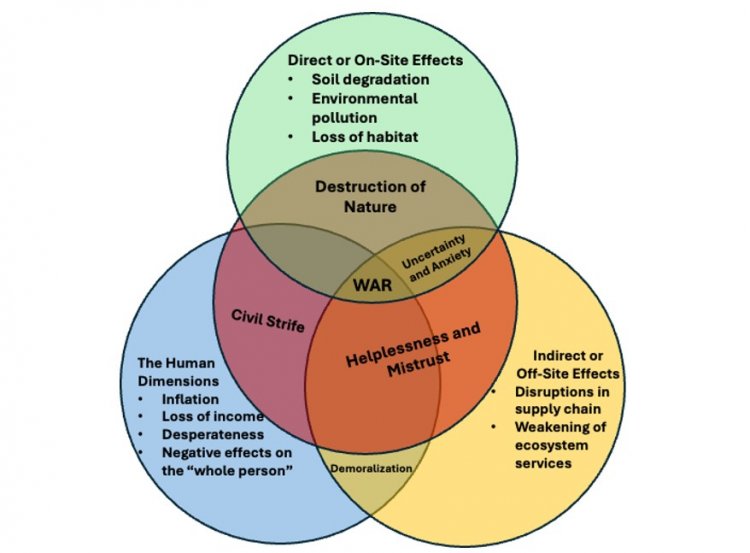
Figure 1. Indirect, direct and human dimension adverse effects of war on soil and environmental degradation.
Way Forward
While diplomatic efforts must continue to restore peace and stability in West Asia, India must also develop a robust strategy to expand domestic fertilizer production. This includes leveraging local resources to manufacture nitrogen-based fertilizers through the Haber–Bosch process, as well as increasing the production of phosphatic fertilizers such as DAP. Ensuring reliable and sustainable energy sources to power these processes is equally critical. In this context, immediate and focused attention is required on the following priorities:
1. Identifying alternate sources of energy (e.g., solar, wind, hydro, geo, nuclear, bio), and by installing solar panels on residential, industrial, academic official buildings and abandoned /degraded lands, for domestic and industrial uses but especially for irrigation pumps.
2. Installing wind farms for energy use in agriculture.
3. Increasing production of bioenergy from unusable agricultural by-products (e.g., rice husk, sugarcane bagasse, coconut shells, oil palm kernels, food waste, water Hyacinth).
4. Enhancing use-efficiency of fertilizer nutrients and irrigation water (from 30 % to 60 % or more) by restoring soil health and sustainable land use.
5. Farming carbon on agricultural landscapes and its commodification by generating revenue for land managers.
6. Rewarding land managers for adoption of resource- conservation technologies of producing more from less.
7. Encouraging the use of biofertilizers including compost, green manure, biological N fixation, bio-stimulants for restoring soil health.
8. Protecting ecologically-sensitive ecosystems (e.g. water, prime soil, wildlife habitats, native vegetation) against urban and industrial encroachment, war and civil strife so that these precious regions are also off-limits to armed conflicts by delineating these as “peace parks”.
9. Educating general public about adopting human-planetary health diet, advocating the “One Health” concept, and reducing food waste at all levels.
10. Strengthening respect and dignity for farmers and all farming professions by implementing policies that are agriculture-focused, environmentally sustainable, and genuinely supportive of farmers’ livelihoods and well-being.
Urgent Action Needed
India, Africa and other developing countries are likely to suffer the most from disruptions in the Strait of Hormuz. As a leading democracy and a fast-growing economy, India must focus on developing innovative plan to be self-sufficient in energy need for manufacturing of fertilizers, uplifting of irrigation water, recycling of nutrients and reducing the use of pesticides by creating disease-suppressive soils. There is “no waste in nature” and all by-products must be recycled by using innovative processing systems.
India must also play a significant role in South-South cooperation by sharing practical, scalable solutions with regions such as Sub-Saharan Africa, Central America, and the Caribbean. Implementation of prudent and inclusive policies can be of crucial importance in the present era of Kaliyuga or Anthropocene (mistrust, selfishness, egoism, expansionism, and disrespect for laws). Policies must ensure that no farmer is left behind, and no one goes to bed hungry. These are the basic principles of the ancient civilization which are relevant even more now than ever before.
This anthropogenic crisis in the Strait of Hormuz highlights the urgency and must be taken as a challenge to enhance respect for the food-energy-water-soil (FEWS) nexus of inter-connectedness. India has an excellent track record in making agriculture a success and promoting peace and harmony in the world. This era is the test of India’s resolve and will-power to bring itself and lead the rest of humanity out of this situation, as was done by ancient sages and philosophers: Gautam Buddha, Ashoka, Mahanbir, Guru Nanak, Akbar, Viveka Nanda, and Mahatma Gandhi. Together and united, nothing is impossible; and such unity can foster a more resilient and cooperative world order
“Jai Kheti, Jai Kisan”
(Prof. Rattan Lal is Director at Center of Carbon Management and Sequestration and Distinguished University Professor of Soil Science at The Ohio State University. He is also 2020 World Food Prize Laureate)