
Lumpy Skin Disease Returns After Four Years; 28 States and UTs on Alert, Wildlife Also Reportedly Affected
Lumpy Skin Disease is spreading across several Indian states, with a September 2026 NADRES alert identifying 219 districts at risk across 28 states and Union Territories. Suspected cases have been reported across the country, raising concerns over livestock losses, declining milk production, and the effectiveness of disease prevention measures.

 Join the RuralVoice whatsapp group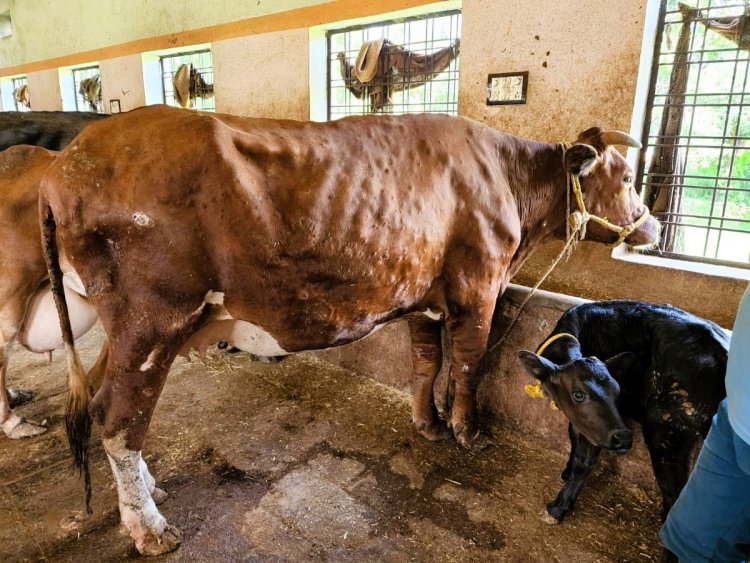
The outbreak of Lumpy Skin Disease (LSD) among cattle and other bovines across several states in India is emerging as a growing concern for livestock farmers. The threat is no longer confined to a few states such as Rajasthan, Uttar Pradesh, and Haryana, but is spreading across a large part of the country. Under the National Animal Disease Referral Expert System (NADRES), an LSD risk alert has been issued for September 2026 covering 28 states and Union Territories.
Lumpy Skin Disease first spread across India in 2019. In 2022, the country witnessed a large-scale outbreak that resulted in the deaths of a large number of cattle and caused substantial economic losses to livestock farmers. The outbreak also led to a decline in milk production.
Four years later, a similar threat is once again emerging. Concerns are growing over what livestock experts describe as inadequate preparedness and preventive measures at both the central and state government levels. Official reporting of LSD cases also appears to be limited this time. However, given the way the disease is spreading, livestock farmers could face significant economic losses, while milk production is also likely to be adversely affected.
A senior scientist associated with veterinary research told Rural Voice that the disease has spread beyond cattle to 13 animal species, including camels, horses, and mules. According to the expert, the LSD virus has also reached wildlife, increasing the challenges associated with controlling the disease.
Following the 2022 LSD outbreak, the government placed considerable emphasis on the One Health approach. However, the expert said there has been some slackening in vaccination drives and other preventive measures against LSD, contributing to the renewed spread of the disease.
In Uttarakhand, 180 suspected LSD cases have been reported across six districts. Following the reports, surveillance and vaccination have been intensified across all districts, while samples from affected animals have been sent to the ICAR-Indian Veterinary Research Institute (IVRI), Bareilly, for testing.
In view of the disease threat, the Uttarakhand government has temporarily restricted the inter-state and inter-district movement of livestock. The highest number of suspected cases has reportedly been recorded in Pauri, while cases have also been reported from Haridwar, Nainital, Udham Singh Nagar, and Rudraprayag.
In Himachal Pradesh, dozens of animals have reportedly been infected and several animals have died in Hamirpur and Solan districts, prompting the Animal Husbandry Department to intensify surveillance and vaccination in the affected areas. Authorities are also focusing on preventing the spread of the disease in border areas adjoining Punjab and Haryana, where livestock movement could increase the risk of transmission.
In Uttar Pradesh, reports of animals falling ill with LSD are emerging from several villages across districts including Meerut, Baghpat, Muzaffarnagar, Shamli, and Saharanpur.
Affected animals have reportedly shown symptoms such as fever, skin nodules, and weakness. In view of the disease threat, the Animal Husbandry Department has also ordered the closure of weekly livestock markets at several locations. Veterinarians and field staff have been directed to increase surveillance and visit villages to monitor animals for suspected cases.
In Haryana, a total of 1,356 suspected LSD cases have been reported in Kurukshetra, Panchkula, Rewari, and Yamunanagar. Samples from Bhiwani, Hisar, Jhajjar, Kurukshetra, Panchkula, Rewari, Rohtak, and Sirsa districts have been sent to Lala Lajpat Rai University of Veterinary and Animal Sciences (LUVAS), Hisar, for confirmation.
219 Districts Identified for LSD Risk
According to the September 2026 NADRES Vet-Alert issued by ICAR-NIVEDI, LSD risk areas include Kerala, Madhya Pradesh, Rajasthan, Tamil Nadu, Sikkim, Odisha, Bihar, Assam, Jharkhand, Karnataka, Gujarat, Chhattisgarh, Tripura, Uttar Pradesh, Uttarakhand, West Bengal, Himachal Pradesh, Manipur, Haryana, Maharashtra, Jammu and Kashmir, Andhra Pradesh, Punjab, Lakshadweep, Puducherry, Arunachal Pradesh, Delhi, Goa, and Telangana.
NADRES has identified 219 districts as being at risk of LSD in September and has put the accuracy of its LSD risk forecasting model at 98.9%. The alert represents a forecast of the potential risk of disease spread and does not necessarily indicate confirmed cases in all the identified districts.
Lumpy Skin Disease
Lumpy Skin Disease (LSD) is a viral disease affecting cattle and water buffaloes. It is characterized by distinctive skin nodules and systemic symptoms that can significantly affect livestock productivity. The disease is caused by Lumpy Skin Disease Virus (LSDV), a member of the Capripoxvirus genus under the Poxviridae family. The virus is closely related to the sheeppox and goatpox viruses.
Primary Symptoms
-
Fever: 40–41°C, lasting 4–14 days.
-
Skin nodules: 2–5 cm in diameter, appearing on the head, neck, limbs, udder, and perineum.
-
Edema and swelling: Particularly in the limbs, brisket, and genitalia.
Secondary Symptoms
-
Nasal and ocular discharge and excessive salivation.
-
Enlarged lymph nodes: Particularly the subscapular and precrural lymph nodes.
-
Reduced milk production: A decline in milk yield in lactating cows.
Reproductive Impact
-
Infertility and abortion.
-
Reduced weight gain in affected animals.
Preventive Measures
Vaccination
-
Live-attenuated vaccines based on the Neethling strain of LSDV.
-
Sheeppox- and Goatpox-virus-based vaccines.
-
Commonly used in endemic regions.
Vector Control
-
Control biting insects such as mosquitoes, flies, and ticks.
-
Use appropriate insecticides and repellents.
-
Maintain proper environmental management around livestock premises.
Quarantine and Movement Control
-
Restrict the movement of infected animals.
-
Quarantine exposed animals.
-
Impose movement restrictions in affected areas.
Biosecurity Measures
-
Maintain proper sanitation and disinfection.
-
Isolate infected animals from healthy animals.
-
Follow regular disinfection protocols on livestock premises.
Surveillance and Early Detection
Prompt reporting of suspected cases, active monitoring, and early intervention are crucial for controlling outbreaks. The removal or culling of severely affected animals may be considered under appropriate veterinary and animal-health protocols to limit disease spread.