
Monsoon Revival, Bringing Relief to Kharif Sowing, but Uneven Rainfall Remains a Concern
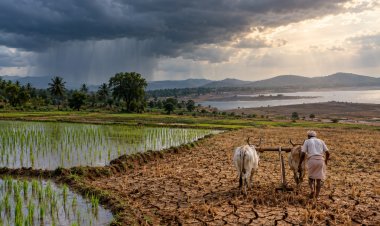
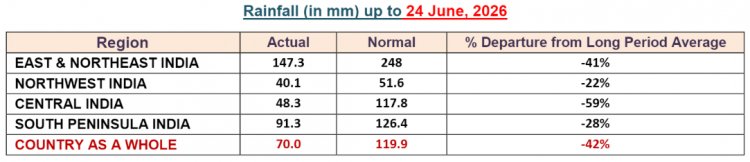
The southwest monsoon has regained momentum, offering relief to farmers as kharif sowing gathers pace. Even so, India recorded a 42 percent rainfall deficit between June 1 and 24, with Central India witnessing the sharpest shortfall.

 Join the RuralVoice whatsapp group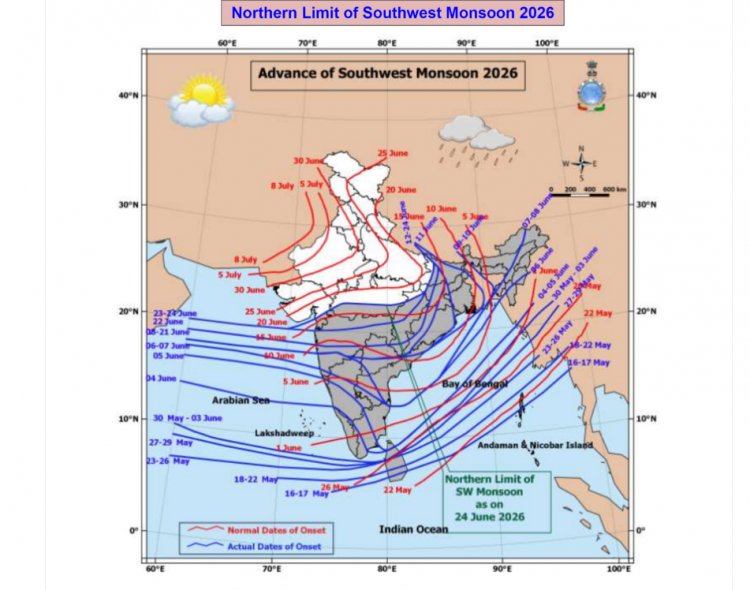
After a nearly two-week lull, the southwest monsoon has advanced further into Gujarat, Madhya Pradesh and Jharkhand, bringing much-needed rainfall to key agricultural regions and raising hopes for faster kharif sowing.
According to the India Meteorological Department (IMD), the monsoon has now covered the entire state of Maharashtra and advanced into additional parts of Chhattisgarh. Conditions are favourable for its further advance into more parts of Gujarat, Madhya Pradesh, the remaining parts of Chhattisgarh, Jharkhand and Bihar, as well as some parts of Uttar Pradesh over the next two to three days.
The IMD has forecast heavy to very heavy rainfall (7-20 cm) along the west coast, over Northeast India, and across Sub-Himalayan West Bengal and Sikkim during the week, with extremely heavy rainfall expected over Sub-Himalayan West Bengal and Sikkim on June 27 and 28. Meanwhile, heatwave conditions are likely to persist over eastern Uttar Pradesh during the next four to five days and over northeastern Madhya Pradesh and Bihar during the next two to three days.
The recent rainfall is expected to improve kharif sowing prospects in cotton, soybean, paddy and pulse-growing regions after an unusually weak start to the season. However, the continued heatwave conditions over eastern Uttar Pradesh, northeastern Madhya Pradesh and Bihar indicate that the distribution of monsoon rainfall remains uneven, posing a risk to agricultural activities.
During the period from June 1 to June 24, 2026, the country recorded a 42 percent rainfall deficit compared with the Long Period Average (LPA). Central India received 59 percent below-normal rainfall, while East and Northeast India recorded 41 percent below-normal rainfall during the same period.
The arrival of widespread rains is expected to accelerate the sowing of major kharif crops, including paddy, soybean, cotton, maize, pulses and groundnut. Farmers in several states had delayed planting due to inadequate soil moisture during the initial phase of the monsoon. The improved rainfall is now expected to facilitate field preparation, nursery transplantation and direct sowing.
The Union government has prepared district-level contingency plans for 315 vulnerable districts as rainfall remains about 42–43% below normal. More than 100 districts with low irrigation coverage have been identified as high-risk areas. States have been advised to promote short-duration crops, pulses, millets and oilseeds while strengthening water conservation measures.
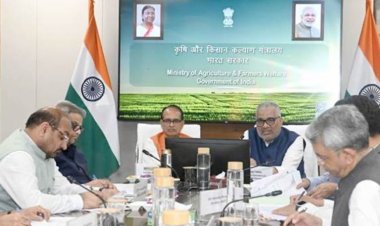
The Centre has already directed states to remain prepared for possible rainfall deficiencies in vulnerable districts. Union Agriculture Minister Shivraj Singh Chouhan recently instructed officials to ensure that contingency plans are in place, including the availability of drought-tolerant seed varieties, timely input supplies and district-specific crop advisories to minimise the impact of delayed or erratic rainfall.
The government has now operationalized an El Niño Monitoring Cell and a Crop Weather Watch Group to track rainfall, sowing progress, and crop stress in real time. Authorities have mapped 315 vulnerable districts, including 111 high-risk districts, as the June rainfall deficit remains around 42–43% below normal.
With the monsoon now advancing across much of the country, the next two to three weeks will be crucial for completing kharif sowing and determining the outlook for India's agricultural production in the 2026-27 crop year.