Cold Rooms in Local Markets: Securing Farmers, Delivering Nutrition
To leverage an integrated regional economy, India can invest in a network of hyper-local cold rooms operating as businesses. This would systematically expand the existing networks


 Join the RuralVoice whatsapp group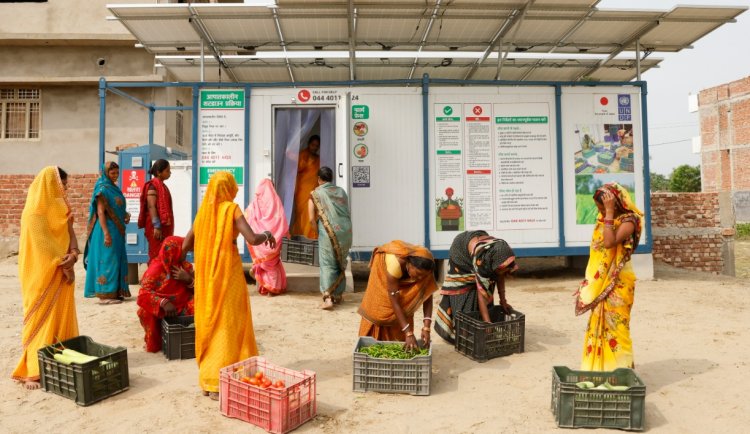
India is the world’s second-largest producer of fruits and vegetables, with horticulture output reaching a record 367.7 million tonnes in 2024–25. However, this seeming abundance is undercut by post-harvest losses. From the moment that a fruit or vegetable is harvested, it enters a race against time. Inappropriate storage, transportation and handling wipe out over 16 percent of every harvest before it reaches the market, often forcing farmers to sell at throwaway prices. Hit hardest by the lack of cold storage are small and marginal farmers – 86 percent of India’s agriculturalists – who already suffer poverty and debt.
Between 2020 and 2022, India lost an estimated Rs 1.53 trillion (USD 18.5 billion) each year due to the absence of proper cold storage facilities. 90-95% of existing cold chain infrastructure is owned by private companies, but most Indian farmers cannot afford to pay for the facilities. Ironically, the operating costs of large scale cold chains in India – approximately USD 60 per cubic metre per year – are almost double the costs in Western countries. Publicly-funded cold chain facilities often suffer obsolescence and inadequate connectivity, drastically reducing their utility. Unreliable power supply and the need for back-up generators further raises costs.
Economic growth is linked both with metropolitan centres which offer concentration of services sector jobs and thick labour markets as well as the ubiquitous combination of small and medium towns, farms and agricultural logistics and processing clusters, where local populations are involved with farming as well as manufacturing, trading, transport and logistics activities. Metropolitan food supply chains are increasingly served by large companies but the districts, where new growth and demand is emerging, are underserved.
To leverage an integrated regional economy, India can invest in a network of hyper-local cold rooms operating as businesses. This would systematically expand the existing networks, such as the cold chain infrastructure created through Operation Flood and, since 1974, Delhi’s Mother Dairy and Safal booths and other state-specific franchises. Cold room networks would give farmers and farmer producer organisations (FPOs) full and direct access to regional markets and would supply local consumers with fresh and nutritious food. By maintaining optimal temperatures, cold rooms preserve nutrients and freshness, ensuring that consumers, especially low income households, get healthier produce. This directly addresses India’s paradox of chronic food surplus alongside persistent malnutrition (we rank 105 out of 127 on the Global Hunger Index, with 13.7 percent undernourished).
Solar-powered cold rooms of 5–30 MT capacity, treated as rural or urban infrastructure, can protect the farmer and vendor from market risk, giving farmers confidence to time their sales to fetch best price for their produce rather than offloading produce in distress at harvest time. Cold rooms can serve as a platform for farmers and FPOs to diversify into doorstep supply and food processing businesses. They would also cushion rural incomes by dampening the impact of retail price fluctuation and easing food inflation. Additionally, they would lower carbon emissions and build resilience to climate shocks.
Cold rooms have been piloted in several states of India. In 2023, the Government of Bihar received the support of UNDP and the Government of Japan to establish 15 solar powered cold storage units in the state. Since the units were launched, 5,000 women have joined similar collectives, stored 300 tonnes of produce and prevented nearly $25,000 worth of spoilage. The Government of Meghalaya has also established solar-powered cold rooms at several locations under its basin management and renewable energy programmes.
In 2021-22, the Rourkela Municipal Corporation received support from Bloomberg Philanthropies’ Global Mayor’s Challenge to support local women vendors and SHGs to install 5 MT solar powered cold rooms in local markets to improve farmer’s livelihoods. In its first year, food waste fell by 31 percent while participating farmers saw average incomes climb 26 percent. The cold rooms, operating at a minimal user fee of Rs 3 per 15 kg, helped SHG revenues jump 62 percent thorough diversification of income streams: storage fees, and bulk supply of fruits and vegetables to institutions and homes. Encouraged by the results, the city has decided to expand the model to five more locations.
Cold rooms offer an opportunity to reimagine India’s food supply chain in the service of national priorities: economic growth, improved farmer’s incomes and resilient food systems. The sensible economics of the cold room fits the purpose of giving small and marginal farmers better access to quality small-scale cold storage that integrates them with markets. Advanced AI-driven agri-tech and agri-finance solutions have proliferated in India but small-scale agri infrastructure has not achieved the necessary ubiquity and penetration. India can converge funding from various sources, such as infrastructure funds, climate and green funds, impact bonds, public private partnership and CSR and new food-processing enterprises, to fund cold rooms at scale.
Cold rooms are not mere refrigerated boxes but the micro-hubs of resilient food systems, helping to achieve consistent quality supply, stable prices and growth in local commerce — the ingredients of sustainable rural-urban growth, which can improve incomes for women-led SHGs and deliver nutrition to low-income families. Cold rooms show how small infrastructure can rewrite the fortunes of the Indian farmer.
(Writers are Research Associate at The Infravision Foundation. Views expressed are of the writers)