
The Fear of Pests: Why Farmers in Punjab Still Burn Crop Residue?
A study by the Council on Energy, Environment and Water (CEEW) found that one-third of Punjab farmers continue partial stubble burning despite access to machinery. Fear of pest attacks, tight sowing deadlines, and ineffective government communication remain major reasons. Researchers say rebuilding trust and improving farmer outreach are crucial.
 Join the RuralVoice whatsapp group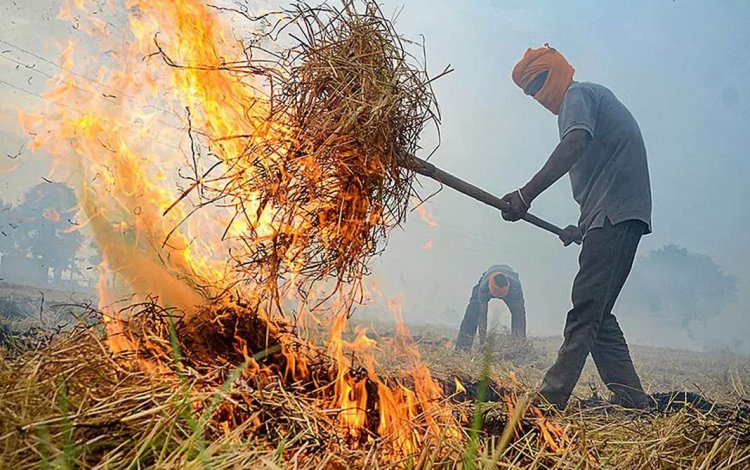
Snehil Chaubey
Every winter, we see thick smoke choking Delhi and the surrounding areas. We read the news blaming farmers in northwest India for burning crop residue. The government spends massive amounts of money to stop this problem. Since 2018, the central government distributed over 4237 crore rupees through the crop residue management scheme. Authorities supplied more than 3.53 lakh specialized machines and established over 43535 custom hiring centers across the states.
Satellites show a general drop in massive fires. We often assume the problem is solved. The air remains toxic anyway. Smoke from farm fires accounts for 30 to 35 percent of PM 2.5 pollution in Delhi during October and November.
A recent study from the Council on Energy, Environment and Water gives a surprising answer. The crisis is not just about giving farmers machines. The crisis is about human psychology, deeply rooted fears, and government communication failures.
The Partial Burning Trap and Hidden Fires
We assume that a farmer with a machine stops burning stubble. This assumption is wrong. The research found that 63 percent of surveyed farmers completely stopped burning their residue. Only 6 percent engage in complete burning.
The real problem sits in the middle. Exactly 31 percent of farmers fall into a category called partial burners. This means one in three farmers actively rents or owns the right machinery. They run the heavy equipment over their fields. Then they strike a match and burn the leftover loose straw anyway.
Official satellite data misses a lot of these fires. An analysis by the Indian Space Research Organisation reveals that farmers increasingly change the timing of their fires. They ignite their fields outside the satellite detection windows to avoid government monitoring. Lower reported fire counts do not accurately reflect the reality on the ground.
The Fear of Insect Attacks
Why do farmers continue to burn the straw? They fear insects. Among farmers who continue to burn residue, 67 percent say they burn the straw to prevent pest attacks on their next wheat crop.
Here is the shocking part. Exactly 57 percent of those farmers admit they never actually witnessed an insect infestation on their own fields. They base their farming decisions entirely on peer narratives and hearsay.
Farmers operate businesses with razor-thin margins. A single rumour about a neighbour losing a crop to pests easily overrides logical government directives. They burn the straw just to feel safe.
The True Cost of Fire
We often ignore the physical damage happening beneath the soil. Burning crop residue destroys the land. Burning one tonne of paddy straw destroys 5.5 kilograms of nitrogen, 2.3 kilograms of phosphorus, 25 kilograms of potassium, and 1.2 kilograms of sulfur. The extreme heat from the fire kills beneficial soil bacteria and fungal populations.
The overall cost of air pollution from stubble burning in India reaches an estimated 30 billion dollars annually. Farmers lose valuable soil nutrients, and the nation loses billions in healthcare and economic disruptions.
The 15-Day Harvest Panic
We must also understand the brutal time pressure on the farming community. A water conservation law called the Punjab Preservation of Subsoil Water Act legally delays the sowing of paddy crops until the monsoon season. This law successfully saves groundwater.
However, it pushes the entire harvest schedule late into the year. This delay leaves the farmer with a brutally narrow window of just 10 to 15 days between harvesting the paddy and sowing the winter wheat crop.
Waiting for crop residue to decompose naturally takes too long. Any delay in sowing wheat severely reduces the final crop yield. The farmer faces extreme time pressure. Fire clears a field in a few hours. The farmer chooses the fastest method available to protect their income.
A Massive Communication Failure
The government tries to stop these fears with basic awareness campaigns. These campaigns fail completely. The state treats farmers like criminals instead of partners. Government materials use a regulatory tone and warn farmers about environmental fines. Farmers reject this approach. They make decisions based on crop yield and soil health. They want practical advice on agronomic benefits.
The state budget numbers reveal a massive disconnect. For the 2024 to 2025 financial period, the Punjab government allocated 375 crore rupees to the Crop Residue Management scheme. Out of this total, the state dedicated only 4.5 crore rupees to actually communicating with farmers. This is barely 1.3 percent of the entire scheme budget.
|
Budget Category |
Financial Allocation |
|
Total Scheme Budget |
375 Crore Rupees |
|
Communication Budget |
4.5 Crore Rupees |
|
Printed Pamphlets |
6.15 Percent of Communication Budget |
|
Field Demonstrations |
6.59 Percent of Communication Budget |
The state wastes money on printed pamphlets. But the survey data proves that pamphlets rank lowest in farmer engagement.
The government launched a digital app called Unnat Kisan to help farmers rent machines. A staggering 86 percent of surveyed farmers never even heard of it.
The government runs training sessions for the heavy machinery. Yet 78 percent of farmers remain completely unaware of any training schedules. The farmers who do attend report a deep dissatisfaction. Exactly 73 percent of attendees describe the training as entirely lecture-based. Farmers cannot learn to operate a complex machine on their land by sitting in a classroom.
The Social Norms Gap
We need to look at how social influence drives behaviour in rural communities. The research exposes a massive contradiction in what farmers believe versus what they do. Exactly 90 percent of surveyed farmers personally disapprove of stubble burning. They understand the environmental damage and the health risks.
However, 73 percent of these exact same farmers report seeing their neighbours burn crop residue. The high visibility of neighbouring farm fires normalizes the practice. This visual proof destroys collective action. A farmer will not invest time and money into sustainable practices if the entire surrounding village continues to set their fields on fire.
Rebuilding Trust
We cannot solve an agricultural crisis with bad communication. When farmers need a machine, they bypass the complex government portals. Exactly 56 percent of renting farmers get their equipment directly from a neighbour. Only 34 percent utilize formal government custom hiring centers.
Farmers trust each other. They also trust local agriculture officers. Direct visits by agriculture extension officers hold the trust of 62 percent of farmers.
The government must act on this data. Officials need to stop funding generic printed posters. They need to redirect funds toward physical field camps and practical demonstrations. They must run these campaigns in August, before the panic of the narrow harvest window begins.
Instead of broadcasting a single message across the entire region, the government must launch targeted campaigns. Areas with high burning rates need aggressive face-to-face intervention to break entrenched habits. Areas with partial burners need strict technical reassurance about pest control.
The state must show farmers that the machines work and that the pest threats are unfounded. We have to rebuild this trust and address the real fears of the farmer. Until we change the communication strategy, the winter skies will stay gray.
(Snehil Chaubey is a 2nd year Master's Student in Public Policy and Governance at Dr. B.R. Ambedkar University Delhi. Currently interning with Ruralvoice)