
Weak Monsoon and Global Uncertainties Raise Agricultural Risks: What Else Does RBI Say?
India’s agriculture faces risks from deficient monsoon rainfall, low reservoir levels, possible El Niño conditions and volatile global agricultural commodity markets. RBI says rural resilience is improving as irrigation, crop diversification, allied activities and non-farm employment reduce monsoon dependence. Record foodgrain and horticulture output provide some cushion against these risks.

 Join the RuralVoice whatsapp group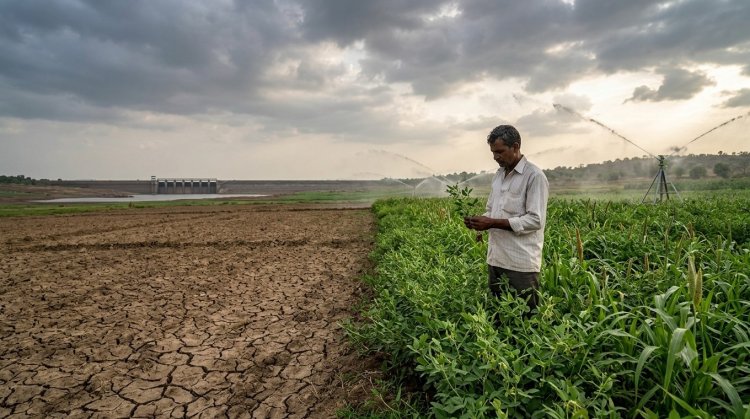
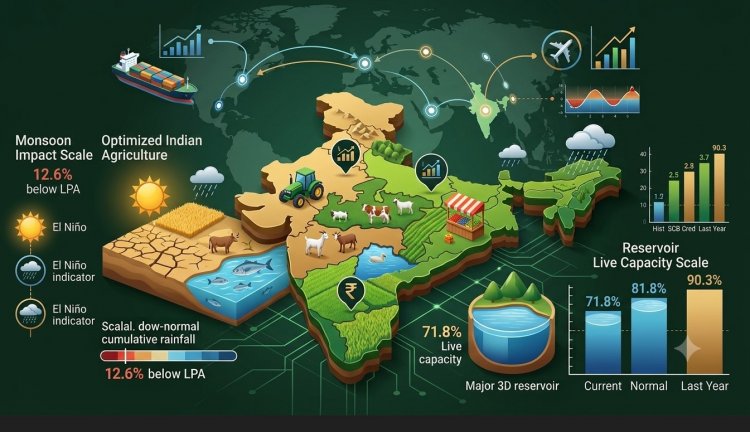
India’s agricultural sector is facing a combination of domestic weather risks and uncertain global agricultural commodity trends, even as the rural economy is becoming less dependent on crop production. According to the Reserve Bank of India’s assessment in its October 2026 Monetary Policy report, the southwest monsoon remained uneven during the season. After a weak June, rainfall covered the entire country by July 9, while July rainfall was 1 per cent above the long-period average. However, cumulative rainfall by September 30 was 12.6 per cent below normal, with deficient rainfall across all regions. The production-weighted rainfall index stood at 90 per cent.
Low reservoir storage adds to the concern. Water levels in major reservoirs on October 1 were at 71.8 per cent of capacity, well below the normal level of 81.8 per cent and last year’s 90.3 per cent. Kharif sowing as of October 2 was 1 per cent lower than a year earlier, although it remained 1 per cent above the normal area. Rice, sugarcane and cotton acreage declined, while pulses, coarse cereals and oilseeds recorded higher sowing.
The outlook for the rabi season could also face headwinds from low reservoir levels, above-normal temperatures and the possibility of El Niño conditions.
Global agriculture adds another layer of uncertainty
Global agricultural commodity markets are also facing a mixed outlook. Weather disruptions in major producing regions, geopolitical tensions, changing trade policies and fluctuations in input and energy prices are influencing the global supply-demand balance. Developments in major exporting and importing economies could affect international prices of cereals, edible oils and other agricultural commodities, with implications for India’s farmgate prices, trade and food inflation.
The global commodity environment is particularly relevant for India because movements in international prices can transmit to domestic markets through imports, exports and input costs. A combination of weather-related production losses in major exporting countries and trade restrictions could tighten global supplies, while weaker demand or improved production could exert downward pressure on prices.
Against this backdrop, India’s agricultural performance remains relatively strong. The third advance estimate for 2025-26 puts foodgrain production at a record 3,766 lakh tonnes, 5.3 per cent higher than the previous year. All major crops except cotton recorded an increase. Horticulture production is estimated at 3,778 lakh tonnes, 1.9 per cent above the final estimate for 2024-25, supported by higher output of banana, mango, potato, tomato and non-TOP vegetables.
It says that the government has increased MSPs by 0.1-8.8 per cent for kharif crops for the 2026-27 marketing season and by 1.0-10.3 per cent for rabi crops for the 2027-28 marketing season, partly aimed at encouraging crop diversification and addressing demand-supply imbalances.
Rural economy becoming less monsoon-dependent
RBI’s analysis in ‘Indian Agricultural Sector amidst Weather Shocks’ suggests that the broader rural economy is becoming more resilient to rainfall shocks. Among households with landholdings of up to one acre, wages account for more than 55 per cent of household income, while crop production and livestock together contribute about 36 per cent.
The analysis shows that in years when rainfall deficiency exceeds 7 per cent, non-agricultural activities become the predominant contributor to rural economic growth. RBI’s regression analysis for 1994-95 to 2025-26 finds a statistically significant negative relationship between rainfall shortfalls and agricultural and allied growth, with a coefficient of -0.40. Rainfall variations explain around 39 per cent of the variation in agricultural growth, while the coefficient for the non-agricultural component is statistically insignificant.
Greater irrigation coverage, weather-resilient crop varieties, diversification towards less water-intensive crops and the expansion of livestock, fisheries and other allied activities have reduced the rural economy’s dependence on rainfall.
However, weather conditions remain a major risk to food inflation. A weak monsoon, possible El Niño effects and disruptions in global agricultural commodity markets could put pressure on food supplies and prices. The RBI’s assessment therefore points to a rural economy that is becoming more diversified and resilient, but an agricultural sector that remains exposed to both domestic weather shocks and increasingly interconnected global commodity markets.