
From Tomatoes to Tur: India’s Food Deflation Drives CPI to Six-Year Low
The Consumer Food Price Index (CFPI) registered a year-on-year decline of -1.06% in June 2025, a significant shift from May's 0.99% food inflation. This marks the lowest rate for food prices since January 2019, according to provisional government data released Monday

 Join the RuralVoice whatsapp group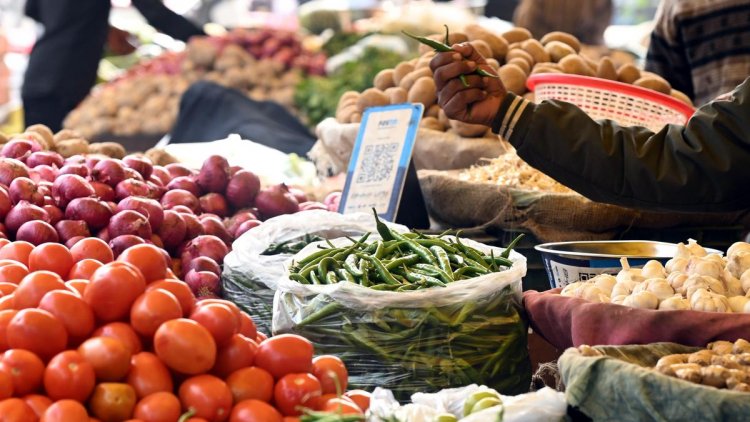
India's retail inflation plummeted to its lowest point since January 2019 in June, driven overwhelmingly by a dramatic decline in food prices, a trend that could reopen discussions about further interest rate cuts.
The Consumer Food Price Index (CFPI) registered a year-on-year decline of -1.06% in June 2025, a significant shift from May's 0.99% food inflation. This marks the lowest rate for food prices since January 2019, according to provisional government data released Monday. Consequently, the broader Consumer Price Index (CPI), which includes food, eased to 2.10% year-on-year, down sharply from 2.82% in May.
Food Deflation: A Key Driver
The substantial downturn in food prices was largely attributed to a favorable base effect and falling costs across key staples. Sankar Chakraborti, MD & CEO of Acuité Ratings & Research Limited, highlighted that the "correction in food inflation is broad-based and largely driven by steep price declines in high weight categories."
Notably, vegetables alone saw prices contract by nearly 19% year-on-year, with tomatoes plunging by 31.5% and onions by 26.6%. Pulses like tur also experienced a significant 25.1% deflation. This broad-based decline across essential food items exerted strong downward pressure on the overall inflation rate.
The disinflationary trend was evident nationwide. Rural food inflation dropped to -0.92% in June from 0.95% in May, while urban food inflation saw an even steeper decline to -1.22% from 1.01%. This directly contributed to the overall decline in headline inflation for both sectors, with rural headline inflation easing to 1.72% and urban to 2.56%.
Implications for Monetary Policy
The surprisingly low inflation print has fueled speculation about the Reserve Bank of India's (RBI) next move. Aditi Nayar, Chief Economist at ICRA Ltd., noted the CPI inflation easing for the eighth consecutive month to a "softer-than-expected 2.1%," reaching its lowest level since January 2019. "We are not ruling out the possibility of a final 25 bps rate cut in the August 2025 meeting," she said, suggesting a continuation of the "front-loading" seen in June.
However, not all economists are convinced a cut is imminent. Madan Sabnavis, Chief Economist at Bank of Baroda, said the number "will not have any impact on the policy decision and hence a status quo can be expected." He pointed out that while food articles (which have a 46% weight) saw a drop of 0.20% over a high base, inflation for edible oils and fruits remained high.
Joe Maher, Assistant Economist at Capital Economics, acknowledged the "larger-than-expected fall" but remained cautious. "The fact that the RBI delivered a sizeable 50bp cut in June and in its communications hinted that the easing cycle was now over... suggests to us that the bar to a resumption in the easing cycle is high," Maher stated, maintaining a view that policy settings will likely remain on hold in August.
Underlying Pressures and Outlook
Despite the significant food deflation, some underlying inflationary pressures persist. Nayar highlighted that core-CPI inflation inched up to 4.6% in June from 4.3% in May, driven by miscellaneous items. Similarly, Chakraborti pointed out that education (4.37%), health (4.43%), and transport & communication (3.90%) continue to show "sticky" inflation. Furthermore, some commodities like coconut oil (+97.2%), gold (+36.0%), and silver (+17.8%) exhibited sharp price increases.
On the wholesale front, the Wholesale Price Index (WPI) also dipped into negative territory for the first time this year at -0.13% in June, marking a 14-month low. This, too, was primarily driven by deflation in food articles, fuel and power, and basic metals.
Looking ahead, economists are watching monsoon performance closely. Kharif sowing is up by a robust 6.6% as of July 11, which augurs well for containing future food prices. However, ICRA remains "watchful of the episodes of heavy rainfall and flooding across some states... that could damage crops."
Acuité Ratings projects headline CPI inflation to remain under 3.5% until December 2025, revising their FY26 inflation forecast down to 3.5% from 3.8%, assuming normal monsoon conditions. ICRA expects headline CPI inflation to recede further and bottom out at around 1.9% in July 2025.