
IMD Cuts Monsoon Forecast to 90% of Normal, Raising Concerns Over Crops and Inflation
India Meteorological Department (IMD) has revised its 2026 southwest monsoon forecast downward to 90 per cent of the Long Period Average, citing the growing likelihood of El Niño conditions. The weaker rainfall outlook raises concerns over crop production, food inflation, and rural incomes, while several regions are also expected to face above-normal temperatures and more heatwave days.

 Join the RuralVoice whatsapp group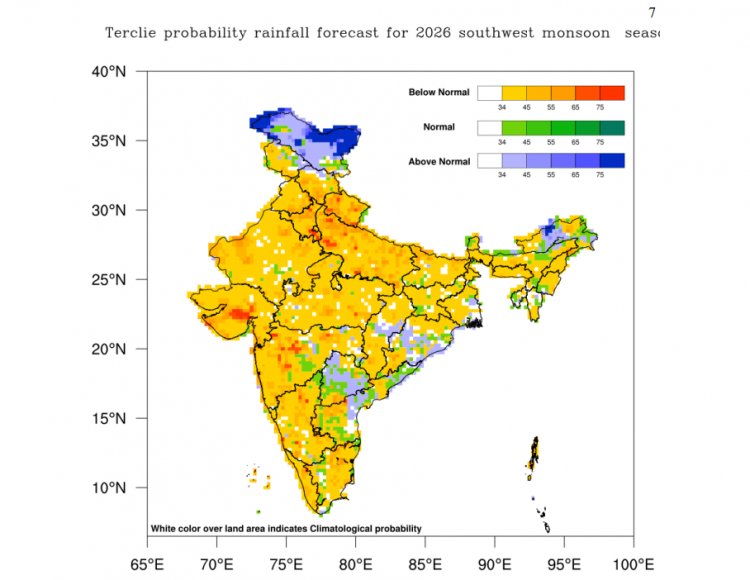
India has lowered its forecast for the 2026 southwest monsoon, projecting rainfall at 90 per cent of the long-period average (LPA), raising concerns about agricultural production, rural incomes, and food inflation at a time when farmers are already grappling with rising input costs linked to geopolitical tensions in West Asia.
The revised forecast, issued by the India Meteorological Department (IMD) in its second-stage long-range outlook on Friday, marks a downward revision from the 92 per cent rainfall estimate announced in April. The forecast carries a model error margin of ±4 per cent.
Addressing a press conference, IMD Director General of Meteorology Dr Mrutyunjay Mohapatra said the country is expected to receive 90 per cent of the LPA during the June-September monsoon season. “We are providing the second-stage update for the June-September monsoon. Quantitatively, we expect 90 per cent of the LPA, with a 4 per cent model error,” Mohapatra said.
The southwest monsoon is critical for India's economy, contributing nearly 70 per cent of the annual rainfall required for agriculture, groundwater recharge, and reservoir replenishment. A weak monsoon could affect sowing of key kharif crops such as rice, pulses, oilseeds, cotton, and sugarcane.
The IMD defines normal monsoon rainfall as 96-104 per cent of the 50-year average rainfall of 87 cm during the four-month season. At 90 per cent of the LPA, this year's forecast falls in the below-normal category and could mark the first below-average monsoon in three years.
Regional Variations Expected
According to the IMD, Northeast India is likely to receive normal rainfall, ranging between 94 and 106 per cent of the LPA. However, Central India, Northwest India, South Peninsular India, and the Monsoon Core Zone are expected to experience below-normal rainfall.
The Monsoon Core Zone includes major rain-fed agricultural regions that account for a significant share of India's foodgrain production. Reduced rainfall in these areas could affect crop yields and farm incomes if rainfall deficits persist through the season.
June Likely to Be Drier and Hotter
For June, the weather office expects rainfall across the country to remain below normal, at less than 92 per cent of the LPA. Some parts of Northwest India, Northeast India, and the southern peninsula may receive normal to above-normal rainfall.
Alongside lower rainfall, the IMD has forecast above-normal temperatures across most parts of the country during June and warned of an above-normal number of heatwave days in Uttar Pradesh, Haryana, Punjab, Bihar, Odisha, Chhattisgarh, Gujarat, and Andhra Pradesh. Parts of Maharashtra, Telangana, and Tamil Nadu are also expected to witness increased heatwave activity.
Maximum temperatures will be above normal for most of the country, except for parts of Central, Northwest and East India. Minimum temperatures are also expected to remain mostly above normal.
El Niño Threat Looms Large
A key factor behind the weaker rainfall outlook is the increasing probability of an El Niño event developing during the monsoon season.
According to the IMD, neutral ENSO (El Niño-Southern Oscillation) conditions are gradually transitioning toward El Niño. The probability of El Nino conditions is expected to rise to 82 per cent by June and exceed 90 per cent during July and August.
El Niño occurs when sea surface temperatures in the central and eastern Pacific Ocean rise above normal levels, often resulting in hotter and drier weather across South and Southeast Asia. Historically, several El Niño years have been associated with drought-like conditions in India, adversely affecting agricultural output and triggering food price pressures.
In contrast, neutral Indian Ocean Dipole (IOD) conditions are expected to prevail throughout the monsoon season.
Concerns for Agriculture and Economy
The weaker monsoon forecast comes at a challenging time for India's farm sector. Rising fertilizer, energy, and transportation costs linked to the ongoing conflict involving Iran and broader tensions in West Asia have already increased production costs for farmers.
A below-normal monsoon could further pressure agricultural output, potentially affecting food prices and rural demand. Economists closely monitor monsoon performance because agriculture remains a key driver of rural consumption and overall economic growth.
Monsoon Progressing Ahead of Schedule
Despite the subdued seasonal outlook, the southwest monsoon has made an early start. It advanced into the Andaman and Nicobar Islands on May 16, four days ahead of its normal onset date. It has since progressed into parts of the South Arabian Sea and Lakshadweep.
The IMD said conditions remain favorable for the monsoon's onset over Kerala and further advance into northeastern states during the coming week.
Meanwhile, rainfall activity in May has remained encouraging. The weather office reported that rainfall during the month was 4 per cent above normal, while cumulative rainfall up to May 27 stood 1 per cent above the seasonal average.
However, meteorologists cautioned that an early onset does not necessarily translate into a strong monsoon season, particularly when large-scale climate factors such as El Niño begin to strengthen during the core monsoon months of July and August.