
India Must Turn Genetic Wealth into an Agricultural Powerhouse: Dr. Paroda
India must transform its vast plant genetic wealth into a strategic engine for climate resilience, food security, farmer prosperity and agricultural innovation, Dr Raj S. Paroda said. At NBPGR’s Golden Jubilee, he identified four transformative forces and proposed seven national priorities, including gene bank modernisation, digital genetic information and global governance leadership.

 Join the RuralVoice whatsapp group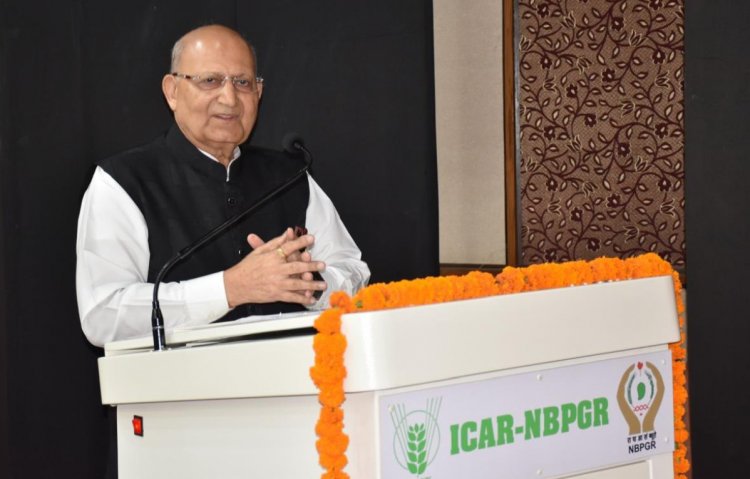
India’s next agricultural revolution may not begin in the field but inside the gene bank. As climate change, digital agriculture and gene-editing technologies reshape farming, the country must move beyond merely conserving its rich plant genetic resources and turn them into climate resilience, better nutrition, higher farm incomes and global leadership, said Padma Shri Dr Raj S. Paroda, Founder Chairman of Trust for Advancement of Agricultural Sciences (TAAS).
Speaking at the Golden Jubilee Foundation Day of ICAR-National Bureau of Plant Genetic Resources (NBPGR), Paroda said the institution’s 50-year journey had created one of India’s most important strategic assets -its genetic wealth. But he cautioned that the next 50 years cannot follow the traditional model of simply conserving biological material.
“The future of Indian agriculture will depend not merely on conserving biodiversity, but on converting it into a national asset through science, innovation and effective governance,” he said.
Paroda said NBPGR’s journey represents a recognition that the future of agriculture depends on preserving the genetic diversity accumulated over generations. India now has one of the world’s largest collections of plant genetic resources, with more than 4.6 lakh accessions. These collections contain valuable traits for tolerance to drought, heat, floods, salinity and other stresses, besides nutritional qualities. However, the changing agricultural landscape requires a fundamental shift in how these resources are managed and used.
Four forces to reshape genetic resource management
Paroda identified climate change, digital agriculture, molecular biology and genome editing, and institutional transformation as four major forces that will determine the future of plant genetic resources.
Climate change, he said, is changing not only temperatures but also the genetic requirements of future crops. Varieties capable of withstanding drought, heat, floods, salinity, frost and emerging pests will become increasingly important.
Traditional landraces, crop wild relatives and underutilised crops could provide many of these traits. Therefore, every accession conserved today could become an “insurance policy” against future climate uncertainties.
The second major transformation is the growing importance of Digital Sequence Information (DSI). Genetic resources are increasingly being represented and shared through digital genetic information rather than only physical samples.
Paroda stressed that countries that help shape international rules governing DSI will increasingly influence agricultural innovation and ownership. India, therefore, should play a proactive role in developing international rules that are scientifically progressive, legally fair and equitable, particularly for developing countries.
Innovation must work with conservation
Paroda also argued for closer integration of genetic resource conservation with modern technologies such as genome editing, artificial intelligence and synthetic biology. These technologies, he said, should not be viewed as threats to agrobiodiversity. Instead, when properly governed, they can help unlock the potential contained within India’s genetic collections.
He called for stronger public-private partnerships to accelerate innovation while ensuring clear systems for access and benefit sharing. The bigger institutional challenge, however, is to bridge the traditional gap between conservation and utilisation.
“A National Genebank’s success should not be measured merely by the number of accessions stored, but by the number of farmers whose livelihoods improve because those genetic resources are effectively utilised,” Paroda said.
Every conserved accession, he added, should ultimately contribute to developing crop varieties with better nutrition, greater resilience and higher income potential for farmers. His central message was that conservation without utilisation amounts to preservation, while conservation combined with innovation can become an engine of national development.
India has the potential to lead globally
Paroda said India is uniquely placed to emerge as a global leader in plant genetic resources because of its enormous crop diversity, scientific capabilities, agricultural research network and strong farming community.
India has more than 4.6 lakh accessions and a large network of scientific institutions and trained plant breeders and biotechnology experts. The country also has strong political support for conserving and using genetic resources for food and nutritional security.
He cited the Rs 500-crore funding support announced by the Prime Minister last year for a Duplicate Safety Genebank as evidence that India’s biological heritage is increasingly being treated as a strategic national asset.
But the proposed second gene bank, Paroda said, should not simply duplicate the existing facility. It should become a digital, climate-smart and globally networked centre, integrating genomics, artificial intelligence, cryobiology, phenomics and real-time information systems. He suggested that the facility should aspire to standards comparable with, or better than, the Svalbard Global Seed Vault.
Seven national priorities
Looking ahead, Paroda outlined seven national priorities for India’s plant genetic resource strategy.
First, the country should complete the collection of all available crop wild relatives, which could become critical sources of climate resilience and other valuable traits.
Second, the National Gene Bank should be modernised to meet emerging scientific and climate challenges.
Third, India should establish a dedicated Digital Sequence Information platform to strengthen its role in the emerging digital genetic resource economy.
Fourth, greater emphasis should be placed on DNA fingerprinting and cryo-conservation to secure genetic material and improve its scientific characterisation.
Fifth, India should promote community seed banks and on-farm conservation, ensuring that genetic diversity remains connected with farming communities.
Sixth, Paroda proposed a National PGR Evaluation Mission to systematically assess the characteristics and potential uses of conserved genetic resources.
Finally, India should seek to position itself as a global leader in international governance of plant genetic resources, helping shape rules around access, innovation, digital genetic information and benefit sharing.
Seeds as a strategic national asset
Concluding his address, Paroda said seeds should be viewed as much more than biological material. They represent the accumulated products of evolution, farming traditions, culture, resilience and human knowledge.
The challenge for the next 50 years, he said, is to transform the genetic wealth conserved by NBPGR into practical outcomes - climate-resilient agriculture, food and nutritional security, higher farmer prosperity and global scientific leadership. He expressed confidence that NBPGR, with its scientific leadership and dedicated workforce, would remain at the centre of this national effort.
Looking towards the institution’s centenary, Paroda said future generations should be able to look back at 2026 as the point when India developed the vision to transform its genetic wealth into a powerful engine of agricultural growth and national development.
“The future of Indian agriculture is hidden inside the seeds that we conserve today,” he said, stressing that the national responsibility is to unlock that potential for farmers, citizens and generations to come.