
India-UK CETA: A Costly Trade-Off That Sacrifices Policy Sovereignty for Illusory Gains
India’s newly signed Comprehensive Economic and Trade Agreement (CETA) with the UK is drawing strong criticism from civil society groups for compromising vital national policy tools in health, digital data, and public procurement. Experts warn that the marginal export gains promised under the deal come at the cost of weakening India's development agenda, regulatory autonomy, and long-standing trade positions.

 Join the RuralVoice whatsapp group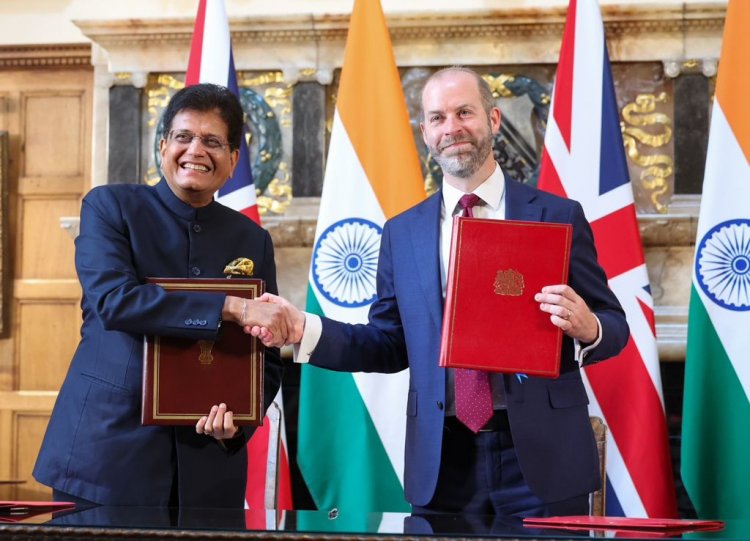
On 24 July 2025, India and the United Kingdom formally signed the Comprehensive Economic and Trade Agreement (CETA), with both governments touting the deal as a milestone for bilateral trade. However, a coalition of over 100 civil society organisations and trade researchers under the Forum for Trade Justice has voiced grave concerns about the agreement’s deeper implications. Far from being a balanced trade deal, critics say the CETA marks a drastic departure from India’s previous free trade commitments and severely compromises the country’s ability to protect public welfare, national data sovereignty, and inclusive economic development.
One of the most troubling aspects, according to trade experts, is how CETA undermines India’s hard-won flexibility under the WTO's TRIPS Agreement. The deal prioritises voluntary licensing over compulsory licensing for medicines, a move that erodes the Doha Declaration of 2001 which upheld public health over corporate patent rights. By allowing reduced patent transparency and encouraging harmonization with developed-country patent norms, the agreement makes it harder for India to ensure access to affordable medicines - putting millions of lives at risk and potentially violating citizens’ constitutional right to health.
“This agreement weakens our position in multilateral forums and dilutes the very principles India once championed on global platforms,” said Biswajit Dhar, former professor at Jawaharlal Nehru University. He pointed out that the shift towards voluntary technology transfers, as endorsed in CETA, also dilutes India’s calls for mandatory tech-sharing at WTO and UN climate forums.
Shocking surrender
The CETA also presents a turning point in India's digital economy policy. It curtails India’s regulatory authority by barring it from demanding access to source codes of imported software - an essential tool for cyber regulation, law enforcement, and national security. “This is a shocking surrender of digital sovereignty,” said Sadhana Sanjay from IT for Change. She emphasized that the clause doesn’t just apply to mass-market software but covers all digital imports, raising serious concerns over unchecked AI development and data misuse.
Moreover, India has agreed to open access to data held by government institutions to ‘interested stakeholders’, with no restrictions on reproduction or commercial use. “This is an extraordinary surrender of our data sovereignty,” said Parminder Jeet Singh, a researcher on digital society. “Data is not just a resource—it’s a critical pillar of national security and economic competitiveness.”
Non-discriminatory participation
The agreement has equally alarming consequences for India’s government procurement policies. “The central government procurement market, a key tool for supporting MSMEs and marginalised communities, is now open to non-discriminatory participation from the UK,” said Professor Abhijit Das, an independent trade expert.
Even under the “Make in India” Order, UK suppliers will now receive the same treatment as domestic Class 2 suppliers. This effectively weakens India’s flagship self-reliance initiatives while offering little reciprocal access - since the UK’s foreign procurement historically remains below £10 billion annually.
Unresolved non-tariff barriers of UK
While India has protected some critical agricultural sectors, significant tariff reductions in the automobile and whisky industries are expected to hurt domestic manufacturers. For example, car tariffs will drop from 110% to 30% in the first year of implementation and decrease further over time. Whisky tariffs will be reduced from 150% to 75% initially and to 40% within a decade - threatening jobs and growth in both sectors. Despite projections of export growth due to UK tariff eliminations, trade experts like Ranja Sengupta caution that unresolved non-tariff barriers, such as the UK’s Geographical Indications and Carbon Border Adjustment Tax, will offset any meaningful gains.
In the services sector too, India appears to have made deep concessions. The liberalisation of financial services is locked in at current levels, meaning India cannot reintroduce tighter regulations in the future, even for national security concerns. Additionally, the much-publicised Double Contributions Convention - which was expected to benefit Indian workers in the UK - is still under negotiation, rendering its advantages speculative at best.
Acceptance of developed country standards
Another major shift is India’s acceptance of developed country standards in non-trade issues like labor, gender, and environment. Commitments made under CETA can now be reviewed by UK-appointed committees, which may later evolve into mechanisms for trade sanctions in case of perceived non-compliance - raising concerns about sovereignty over domestic regulation.
Who gains more
Perhaps the most damning indictment of the CETA is its asymmetry. As per the UK Department of Business and Trade, India is projected to gain a modest £3.7 billion in annual exports by 2040 - just 0.44% of its current exports - while the UK is expected to gain nearly 1.5 times more. “For these paltry gains, India has compromised far too much of its policy space,” said Dinesh Abrol, former professor at the Institute for Studies in Industrial Development.
Forum for Trade Justice warns that the CETA sets a dangerous precedent for India’s future trade negotiations. The European Union is already eyeing similar concessions. Analysts also worry that this agreement may weaken India’s hand against aggressive demands from the United States, effectively facilitating - rather than countering - Western trade dominance.
Lack of transparency and public consultation
What has compounded the outrage is the lack of transparency and public consultation in the negotiation process. While the UK Parliament will subject the agreement to scrutiny under its CRaG Act, there has been no such move from the Indian side. “In a parliamentary democracy, trade agreements of this magnitude must be debated,” said Shalini Bhutani, an independent legal expert.
In conclusion, while the India-UK CETA has been celebrated in official corridors as a landmark deal, civil society sees it as a high-cost bargain with minimal returns. The Forum for Trade Justice has called for a serious reassessment before the agreement takes full effect, urging the Indian government to prioritize national interests and democratic accountability over diplomatic spectacle.