
India's Edible Oil Imports Rise 7 pc in Eight Months Despite Sharp June Decline; Palm Oil Share Rises to 48 Percent
India's edible oil imports rose 7 per cent to 10.39 million tonnes during the first eight months of the 2025-26 oil year, even as June imports fell 29 per cent year-on-year. Palm oil strengthened its dominance, accounting for 48 per cent of total edible oil imports, while higher global prices, biofuel policies and a weaker rupee continued to influence import trends.

 Join the RuralVoice whatsapp group
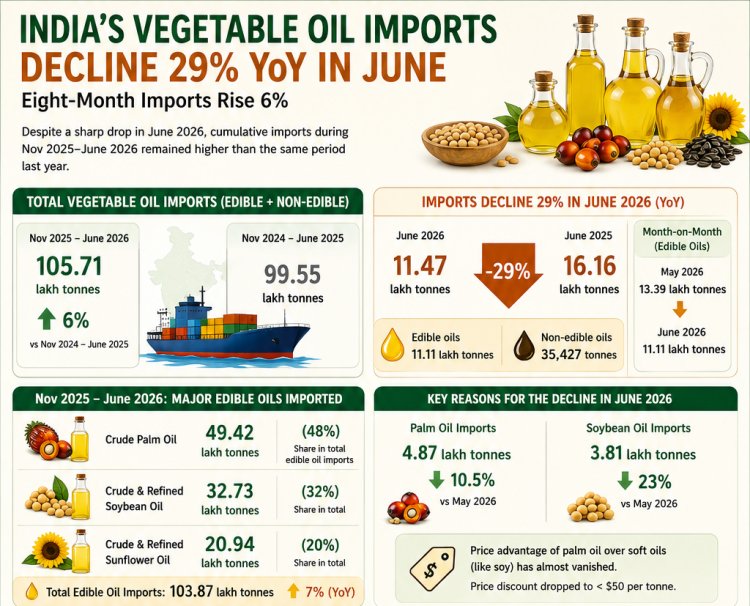
India's dependence on imported edible oils remained high during the current oil year, with cumulative imports continuing to grow despite a sharp decline in June. Total vegetable oil imports (edible and non-edible) increased 6 per cent year-on-year to 105.71 lakh tonnes during the first eight months of the 2025-26 oil year (November 2025-June 2026). However, imports in June alone fell 29 per cent to 11.47 lakh tonnes, signalling a slowdown in buying.
According to data released by the Solvent Extractors' Association of India (SEA), cumulative edible oil imports rose 7 per cent to 103.88 lakh tonnes during November 2025-June 2026 from 97.29 lakh tonnes in the corresponding period of the previous oil year. Crude palm oil remained the largest imported edible oil at 49.42 lakh tonnes, followed by crude and refined soybean oil at 32.73 lakh tonnes and crude and refined sunflower oil at 20.94 lakh tonnes.
Palm Oil Gains Market Share
Palm oil imports increased to 50.12 lakh tonnes during the first eight months of the current oil year from 42.94 lakh tonnes a year earlier. As a result, palm oil's share in India's edible oil imports rose to 48 per cent from 44 per cent.
In contrast, imports of soft oils—primarily soybean and sunflower oils—declined marginally to 53.76 lakh tonnes from 54.35 lakh tonnes in the same period last year. Consequently, the share of soft oils fell to 52 per cent from 56 per cent.
June Imports Drop 29%
India's vegetable oil imports (edible and non-edible) declined by 29 per cent year-on-year to 11.47 lakh tonnes in June 2026 from 16.16 lakh tonnes in June 2025. The June imports comprised 11.11 lakh tonnes of edible oils and 35,427 tonnes of non-edible oils.
On a month-on-month basis, edible oil imports declined from 13.39 lakh tonnes in May to 11.11 lakh tonnes in June, indicating lower arrivals during the month.
The decline was mainly driven by weaker palm oil demand. Palm oil imports fell to 4.88 lakh tonnes in June, down 10.5 per cent from May. Soybean oil imports also dropped sharply by 23 per cent, declining to 3.81 lakh tonnes from 4.94 lakh tonnes.
SEA attributed the slowdown to the narrowing price advantage of palm oil over soft oils such as soybean oil. The price discount of palm oil fell to below US$50 per tonne, reducing its competitiveness in the Indian market.
SEA said India's lower purchases are also linked to biofuel blending mandates introduced by Indonesia, Malaysia and the United States. These policies are diverting millions of tonnes of vegetable oils from the food sector to fuel production, tightening global supplies and pushing up international spot prices.
Nepal Continues Refined Oil Exports
Nepal continued to export significant volumes of refined edible oils to India. Between November 2025 and April 2026, Nepal exported about 3.39 lakh tonnes of refined oils, including 2.98 lakh tonnes of refined soybean oil, 19,911 tonnes of refined sunflower oil, 18,295 tonnes of RBD palmolein and 3,081 tonnes of rapeseed oil.
Exports were estimated at around 54,000 tonnes in May 2026 and 32,000 tonnes in June, consisting mainly of refined soybean oil along with smaller quantities of sunflower oil and RBD palmolein. These shipments enjoy zero import duty under the South Asian Free Trade Area (SAFTA) agreement.
Domestic Edible Oil Stocks Decline
As of 1 July 2026, edible oil stocks at Indian ports were estimated at 9.06 lakh tonnes, while pipeline stocks stood at 11.03 lakh tonnes, taking total available stocks to 20.09 lakh tonnes. This was down from 22.16 lakh tonnes a month earlier, reflecting lower imports during June.
Shift Towards Crude Oil Imports
India continued to import significantly more crude edible oils than refined oils. Refined edible oil imports dropped to 3.69 lakh tonnes during November 2025-June 2026 from 15.00 lakh tonnes a year earlier. Meanwhile, crude edible oil imports increased to 100.19 lakh tonnes from 82.29 lakh tonnes.
As a result, refined oils accounted for only 4 per cent of total edible oil imports compared with 15 per cent a year earlier, while crude oils' share rose to 96 per cent from 85 per cent, largely due to higher crude palm oil imports.
Argentina Tops Supplier List
Argentina remained India's largest edible oil supplier during November 2025-June 2026, exporting 23.39 lakh tonnes, mainly crude soybean oil and sunflower oil.
Malaysia supplied 19.81 lakh tonnes of palm oil, followed by Indonesia with 19.04 lakh tonnes. Russia, Brazil, Thailand, Ukraine, China, Nepal and the UAE were among the other major suppliers, reflecting India's diversified sourcing strategy.
Higher Global Prices and Weaker Rupee
Global edible oil prices remained elevated in June 2026. Compared with a year earlier, crude palm oil prices increased 17 per cent, RBD palmolein 18 per cent, soybean oil 14 per cent and sunflower oil 19 per cent. At the same time, the Indian rupee depreciated by more than 11 per cent against the US dollar over the past year, further increasing the cost of edible oil imports.