
India’s Q1 GDP Growth Accelerates to 7.8%, But Agriculture Slows Down
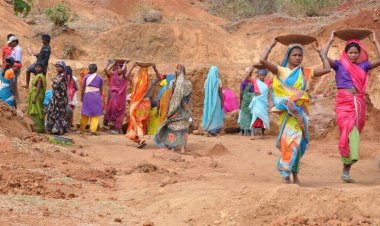
India’s Q1 FY2026-27 GDP growth accelerated to 7.8% from 6.9% a year earlier, driven by services, manufacturing, investment and exports. However, agriculture and allied activities slowed to 3.6%, while mining contracted 2.4%. The primary sector grew just 2.9%, highlighting a widening gap between overall economic momentum and farm-sector performance.

 Join the RuralVoice whatsapp group
India’s Gross Domestic Product (GDP) grew by 7.8 percent in the April-June quarter of the current financial year 2026-27. The growth rate was 6.9 percent in the first quarter of 2025-26. However, growth in both agriculture and mining, which are part of the primary sector, declined. In the latest quarter, growth in agriculture and allied activities fell to 3.6 percent from 4.4 percent a year earlier. Growth in the mining sector plunged to -2.4 percent from 12.4 percent.
According to the latest quarterly estimates released by the Ministry of Statistics and Programme Implementation (MoSPI) on Monday, the acceleration in overall economic growth was led primarily by the secondary and tertiary sectors. The tertiary sector registered 10 percent growth at constant prices, while the secondary sector grew 8.6 percent. In contrast, the primary sector grew only 2.9 percent during the quarter.
Agriculture growth slows despite higher output
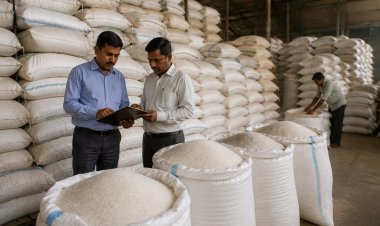
Agriculture, livestock, forestry and fishing together recorded 3.6 percent growth in Q1 of 2026-27, compared with 4.4 percent in the corresponding quarter of 2025-26. The sector's real GVA increased from Rs 11.97 lakh crore in Q1 of 2025-26 to Rs 12.41 lakh crore in the latest quarter.
The slowdown in agricultural growth comes even as foodgrain production-related indicators continued to show positive growth. Total foodgrain growth was 4.8 percent in Q1, compared with 5 percent a year earlier. Rice production growth stood at 6.2 percent, although this was lower than 10.6 percent in the corresponding period. Wheat growth also slowed sharply, from 3.1 percent to 0.5 percent.
Agriculture and allied activities remained the principal contributor to the primary sector, but their growth was insufficient to offset the sharp decline in mining and quarrying.
Mining swings from strong growth to contraction
The mining and quarrying sector recorded the sharpest deterioration among the major sectors. Its real GVA contracted 2.4 percent in Q1 of 2026-27, compared with a robust 12.4 percent growth in the same quarter of the previous financial year. Real GVA from mining and quarrying declined from Rs 1.59 lakh crore to Rs 1.55 lakh crore.
The indicators also show weakness in mining-related activity. The Index of Industrial Production for mining and quarrying declined 1.2 percent in Q1, compared with 3.5 percent growth a year earlier. The index for fuel minerals fell 4.5 percent, while natural gas consumption declined 2.6 percent.
Services remain the biggest growth engine
The strongest performance came from the tertiary or services sector, which expanded 10 percent at constant prices. Within services, financial, real estate, ownership of dwelling, IT and professional services recorded particularly strong growth of 12.1 percent. Trade, hotels, transport, communication and services related to broadcasting and storage grew 8.5 percent, while public administration, defence and other services grew 7.5 percent.
The secondary sector also performed strongly, growing 8.6 percent compared with 6.1 percent in Q1 of 2025-26. Manufacturing expanded 9.2 percent, electricity, gas, water supply and other utility services grew 8.9 percent, while construction recorded 7.7 percent growth.
Overall real GVA at basic prices increased 8.2 percent during the quarter, compared with 7 percent a year earlier. This was faster than the 7.8 percent growth in real GDP. Nominal GVA grew 11.5 percent, while nominal GDP increased 10.3 percent. Real GDP at constant prices rose from Rs 75.46 lakh crore in Q1 of 2025-26 to Rs 81.36 lakh crore in Q1 of 2026-27.
Investment emerges as a major support
On the expenditure side, investment activity showed significant strengthening. Gross Fixed Capital Formation (GFCF), an indicator of investment in fixed assets, grew 11.9 percent in real terms during Q1, more than twice the 5.8 percent growth recorded in the year-earlier quarter.
Private Final Consumption Expenditure (PFCE), which reflects household consumption demand, grew 7.1 percent at constant prices compared to 6.8 percent. Government Final Consumption Expenditure grew 4.3 percent, slightly slower than the 4.5 percent recorded a year earlier.
Exports provided another significant boost. Real exports grew 12 percent during the quarter, compared with 6 percent in Q1 of 2025-26. In contrast, imports contracted 1.1 percent in real terms after growing 5.3 percent a year earlier.
At current prices, however, both exports and imports recorded much higher growth, at 25.8 percent and 30.9 percent respectively. Private consumption grew 9.9 percent at current prices, while GFCF increased 20.4 percent.
Manufacturing indicators show broad improvement
The quarterly indicators released by MoSPI also point to stronger industrial activity in several segments. Capital goods production grew 15.2 percent in Q1 compared with 8.8 percent a year earlier. Manufacturing of electrical equipment grew 27 percent, against 9.7 percent previously, while manufacturing of computer, electronic and optical products grew 12.4 percent compared with 8.8 percent.
Sales of commercial vehicles increased 18.3 percent, compared with a contraction of 0.3 percent a year earlier. Three-wheeler sales grew 29.7 percent. Household vehicle registrations increased 15.9 percent.
Infrastructure-related indicators also remained positive. Cement production growth increased to 8.9 percent from 7.3 percent, while finished steel consumption grew 8.3 percent compared with 8 percent a year earlier.
New GDP series and revisions
The latest estimates have been prepared under the new GDP series with 2022-23 as the base year. MoSPI said the new series incorporates updated data from administrative sources, a new series of the Output Producer Price Index and an updated Index of Industrial Production.
For manufacturing GVA, the new series uses a Double Deflation approach, under which output and intermediate consumption are separately deflated using granular Producer Price Indices. MoSPI said this provides a more robust measure of real value added by capturing changes in prices of both output and intermediate consumption.
The ministry has also cautioned that the quarterly estimates are subject to revisions as improved data coverage and revisions in input data from source agencies become available. The next quarterly GDP estimates, covering July-September 2026, are scheduled to be released on November 30, 2026.