
Monsoon Deficit Reaches 14 pc by August End; Nearly Half of India’s Districts See Below-Normal Rainfall
With El Niño adding to monsoon concerns and subdued rainfall forecast over Peninsular India, September rains will be crucial for kharif crops and water resources.

 Join the RuralVoice whatsapp group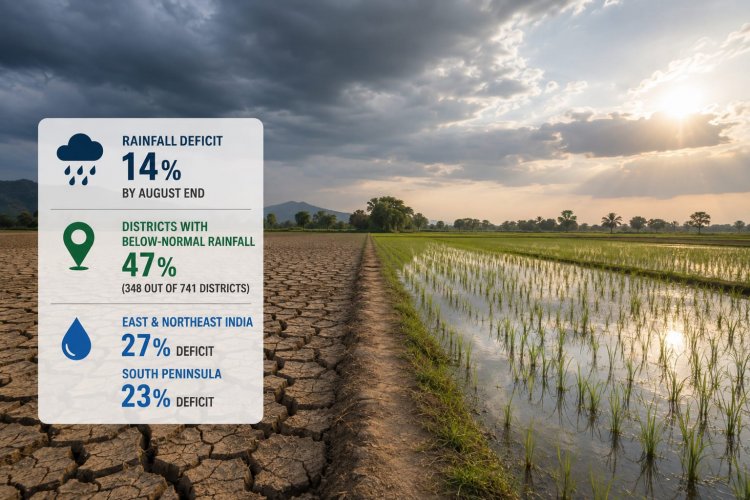
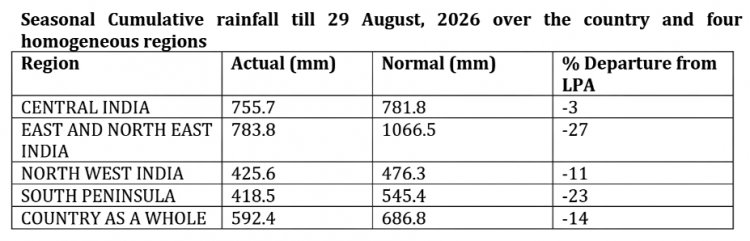
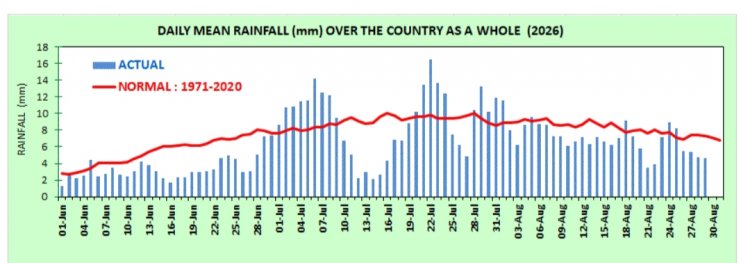
India’s southwest monsoon remained weak and highly uneven through the end of August, with the country receiving 592.4 mm of rainfall between June 1 and August 29, 2026, against the normal 686.8 mm. This represents a 14% deficit from the Long Period Average (LPA).
The overall deficit, however, masks significant regional disparities. While Central India has received rainfall close to normal, East and Northeast India and the South Peninsula have recorded deficits of more than 20%.
The latest India Meteorological Department (IMD) forecast also points to subdued rainfall activity over Peninsular India during the coming week.
East and Northeast India worst hit
East and Northeast India has recorded the largest rainfall deficit among the four homogeneous regions. The region received 783.8 mm of rainfall against a normal of 1,066.5 mm, marking a 27% deficit as of August 29.
The South Peninsula received 418.5 mm against a normal of 545.4 mm, resulting in a 23% deficit. North-West India recorded 425.6 mm of rainfall against a normal of 476.3 mm, a deficit of 11%.
Central India has performed relatively better, receiving 755.7 mm compared with the normal 781.8 mm, leaving the region with only a 3% deficit.
47% of districts facing deficient rainfall
The uneven distribution is also evident at the district level. Of the 741 districts covered by the IMD's data as of August 29, total 309 districts, or about 42%, were in the deficient rainfall category. Another 39 districts were in the large deficient category.
Taken together, 348 districts, or around 47% of the districts, had rainfall below the normal range. In contrast, 292 districts recorded normal rainfall and 81 received excess rainfall, while 13 districts were in the large excess category.
June deficit not fully recovered
The monsoon began on a weak note this year. The country received 35.4% less rainfall than normal in June. Rainfall improved sharply in July, when the country as a whole recorded rainfall about 1% above normal, helped by strong activity over Central India.
However, the improvement was uneven across regions, and rainfall activity weakened again in August. As a result, the cumulative national deficit remained at 14% by August 29.
The rainfall statistics also show the contrasting monthly performance across regions. Central India, for instance, recorded a 33% surplus in July, which helped offset some of the deficit accumulated earlier in the season. However, rainfall in the South Peninsula remained deficient, while East and Northeast India continued to face a substantial shortfall.
El Niño adds to monsoon concerns
El Niño has emerged as an important climate factor behind the weaker monsoon conditions. The IMD had initially forecast the 2026 monsoon at 92% of LPA before subsequently lowering its forecast to 90% of LPA, with the possible development of El Niño among the factors influencing the outlook.
A weak El Niño developed over the equatorial Pacific in June and subsequently strengthened to moderate intensity. A stronger El Niño influence during the later part of the monsoon season could add to concerns over rainfall performance, particularly in areas that have already accumulated significant deficits.
Peninsular India faces further rainfall weakness
The IMD's latest forecast provides little immediate relief for the already rainfall-deficient South Peninsula. Subdued rainfall activity is likely to continue over Peninsular India during the next week.
This is significant because the region had already recorded a 23% rainfall deficit by August 29. A weak start to September could further widen the gap and put additional pressure on soil moisture and rain-fed crops.
At the same time, rainfall activity is expected to increase over parts of eastern India due to a developing low-pressure system over the northwest Bay of Bengal and adjoining West Bengal–north Odisha coast.
Rainfall imbalance poses risks for kharif crops
The combination of deficient and highly concentrated rainfall presents a complex challenge for agriculture. Areas with prolonged rainfall deficits face risks from inadequate soil moisture, while regions receiving intense rainfall can experience waterlogging, erosion and crop damage.
The 14% national rainfall deficit is therefore only part of the picture. The much larger shortfalls in East and Northeast India and the South Peninsula, along with nearly half of India's districts recording below-normal rainfall, point to considerable regional stress.
With El Niño adding uncertainty and the IMD forecasting subdued rainfall over Peninsular India in the coming week, the final phase of the 2026 monsoon will be critical for kharif crops, water resources and the broader rural economy.