
$100 Billion Agri Export Goal Possible, But Paradigm Shift Needed: Experts at IIFT-Rural Voice Roundtable
Focused on the theme "Realising $100 Billion Agri Export Goal", roundtable conference discussed the challenges and possibilities and way forward to doubling India's agricultural exports by the year 2030. Policy makers, industry representatives, experts from foreign trade and agriculture sector participated in the conference.

 Join the RuralVoice whatsapp group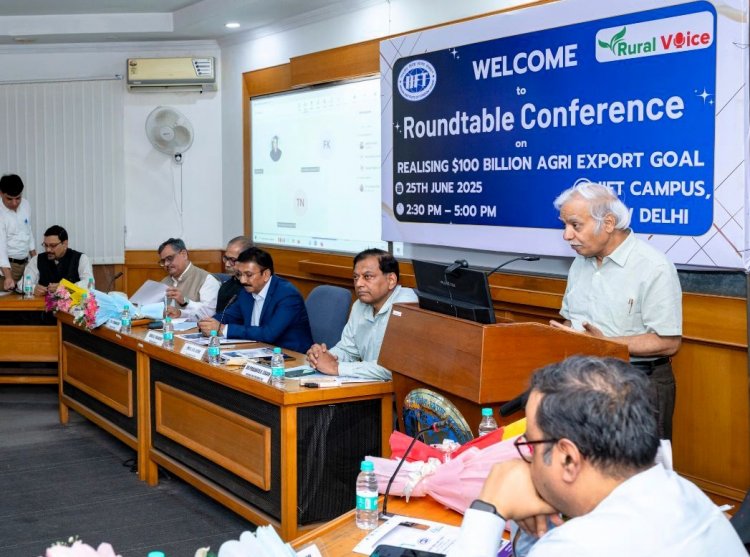
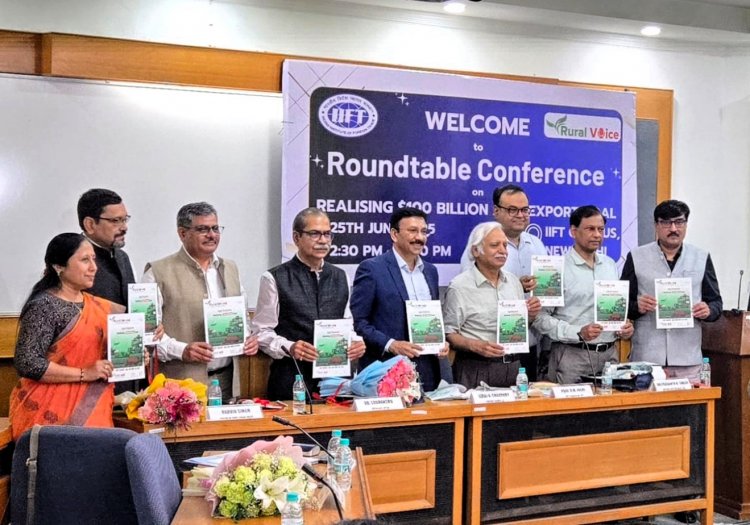
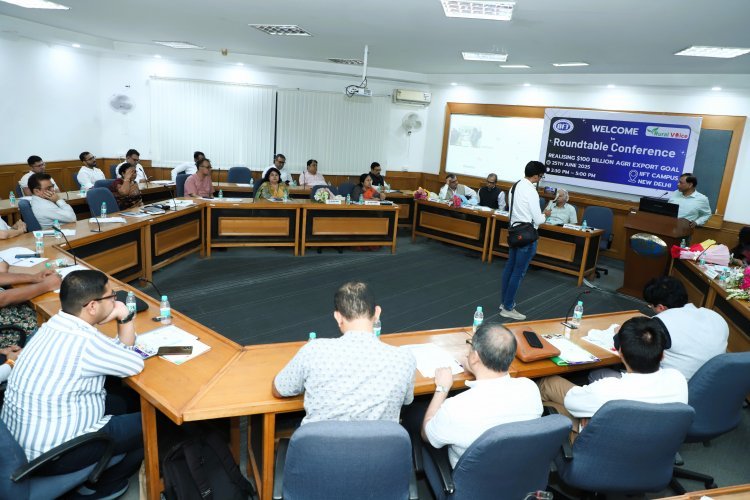
The Indian Institute of Foreign Trade (IIFT), in collaboration with Rural Voice Media Platform, organized a Roundtable Conference on "Realising the $100 Billion Agri Export Goal" at the IIFT campus in New Delhi on Wednesday. Focused on this theme, the conference deliberated on the challenges, possibilities, and the way forward to doubling India's agricultural exports by 2030.
In his welcome address, IIFT Vice Chancellor Prof. Rakesh Mohan Joshi said that connecting to the global export market is not a one-day task. It requires continuous effort and become competitive in the global marketplace. Prof. Joshi added that while India has significantly increased agricultural production, this success now needs to be replicated in agricultural exports. However, India is also importing large quantities of apples, cashews, almonds, and various fruits and vegetables. To boost agricultural exports, along with enhancing production, attention must also be paid to improving product quality. Additionally, stability in export-related policies is essential.
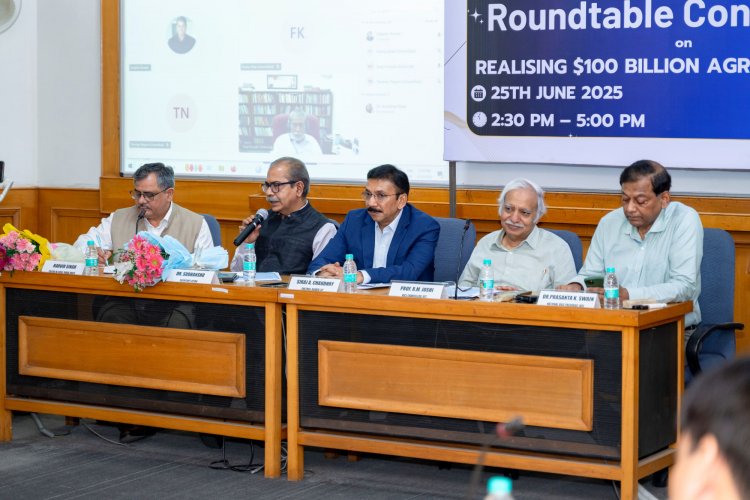
The first session of the conference focused on the topic “Challenges and Opportunities in Agricultural Exports.” In this session, APEDA Secretary Dr. Sudhanshu emphasized that to increase exports, all stakeholders must be organized as an integrated value chain. Several challenges exist at the production level, and adopting Good Agricultural Practices (GAP) is crucial. Farmers are being trained to produce according to the demand and quality requirements of export markets. Citing an example, Dr. Sudhanshu shared that efforts are underway to increase the shelf life of litchi by 12–15 days. Banaras has been developed as an agri-export hub, where exporters have been connected with FPOs alongside export facilities. Currently, about 1,000 tonnes of fruits and vegetables are being exported from Banaras. Similarly, other landlocked areas are being developed as export hubs. He also mentioned the development of a sea protocol for bananas and other fruits.

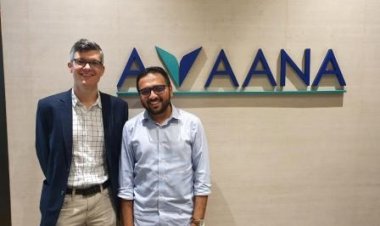
Agri-business expert and AgVaya Partner Siraj A. Chaudhary pointed out that India often exports based on its surplus rather than on the needs of importers. As a result, only a limited number of products are exported consistently. He emphasized the importance of identifying products where India has a competitive advantage, particularly those of high value. Siraj noted that earlier India was a major exporter of soyameal, sugar, wheat, maize, and cotton, but this list is shrinking. There is a need to create a clear list of products where India can become a major exporter in the long run. He highlighted countries like Brazil, Malaysia, Indonesia, and Vietnam, which have successfully aligned their production to serve global export markets. India, too, must identify sectors where it can become a globally dominant player — products like shrimp, buffalo meat, fruits, vegetables, and seeds hold significant potential. Siraj also suggested setting product-based export targets and formulating strategies to promote exports across various sectors and commodities.
Dr. P.K. Swain, National Vice President of the Indian Rice Exporters Federation, stated that improving productivity requires providing farmers with better seeds, advanced technology, and adequate financial resources. In addition, there is a need to focus on export-oriented varieties. Most fruits and vegetables produced in India are table varieties, suited for domestic consumption, as Indians prefer fresh produce. However, exports demand an integrated cold chain infrastructure, which remains a challenge. Dr. Swain also highlighted the significant potential in the dairy sector, but inadequate infrastructure and non-tariff barriers are major obstacles to India's agricultural exports.
Moderating the session, Rural Voice’s Chief Editor Harvir Singh emphasized that agricultural exports are a critical component for enhancing farmers’ incomes. He stressed the importance of ensuring that the benefits of export-related opportunities are passed on to farmers. On this occasion, a special edition of Rural World — a print publication of Rural Voice Media, focused on the theme “Realising the $100 Billion Agri Export Goal” — was also released. Concluding the session, Harvir Singh thanked all the panel speakers and participants, reiterating his commitment to continuing a series of meaningful dialogues on key issues related to agriculture and the rural economy.