
Onion Buffer Procurement Price Raised by 24% to Rs 15.80 per kg; Pulse Stocks Hit Record 43 Lakh Tonnes
After agitation by farmers in Maharashtra, the government has increased the onion procurement price for buffer stocks by 24.4% to Rs 15.80 per kg to support farmers and strengthen market intervention efforts. Meanwhile, pulse buffer stocks have surged to a record 43 lakh tonnes, helping reduce import dependence and bolstering domestic food security.

 Join the RuralVoice whatsapp group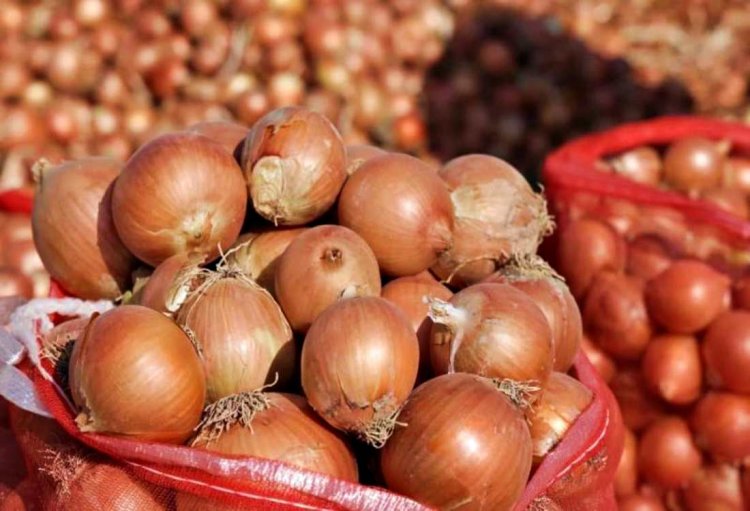
After agitation by farmers particularly in Maharashtra, the government has increased the procurement price of onions under its buffer stock programme by 24.4 per cent to Rs 15.80 per kg from Rs 12.70 per kg.
Announcing the decision at an inter-ministerial briefing on Monday, Anupam Mishra, Additional Secretary in the Ministry of Consumer Affairs, Food and Public Distribution, said the revised procurement price reflects current market realities and the government's commitment to ensuring remunerative returns to onion growers.
Onion procurement for the current season began on May 15, while the revised procurement rate was notified on May 22. Buffer stocks are maintained every year under the Price Stabilisation Fund (PSF) to enable timely market interventions and contain excessive price volatility. For the current season, the government has set a procurement target of 2 lakh tonnes of onion, lower than the 3 lakh tonnes procured during 2025-26.
Pulse Buffer Stocks Reach Historic High
The government also highlighted significant gains in pulse procurement and stock-building efforts. Buffer stocks of pulses have reached a record 43 lakh tonnes in May 2026, more than doubling from 18 lakh tonnes in May 2025 and substantially exceeding the 21 lakh tonnes recorded in May 2024.
Under the Price Support Scheme (PSS), which is activated when mandi prices fall below the Minimum Support Price (MSP), procurement has so far reached 5.34 lakh tonnes of tur (arhar) and 20.35 lakh tonnes of chana.
According to officials, higher domestic production has helped reduce India's dependence on imports. Total pulse imports declined by nearly 30 per cent to 60 lakh tonnes in 2025-26 from 73 lakh tonnes in the previous year. Chana imports registered an even sharper decline of 51 per cent, falling from 15.06 lakh tonnes in 2024-25, despite the continuation of the government's free import policy for pulses.
It was informed during the meeting that total pulses production in 2025-26 is estimated at a record 274.09 LMT; an increase of 6.7% over previous year’s 257 LMT, and about 13% rise from 242 LMT during 2023-24. Between 2024-25 and 2025-26 production of all major pulses witnessed an increase. Chana production rose significantly by 12.6% to 125.14 LMT over previous year’s 111 LMT. Moong production increased by around 6% to 44.92 LMT from 42.44 LMT. Lentil production grew by approximately 7%, reaching 17.62 LMT from 16.54 LMT, reflecting broad-based growth across major pulse crops.
West Asia Tensions Pose Limited Risk to Pulse Supplies
The inter-ministerial briefing was held against the backdrop of recent geopolitical developments in West Asia and focused on assessing potential implications for India's food and fertiliser security.
Mishra noted that most of India's major pulse-supplying countries, including Myanmar, Tanzania, Malawi, Mozambique, Canada, Australia and Brazil, remain unaffected by the ongoing tensions in West Asia. As a result, the risk of supply disruptions in pulses remains limited, providing reassurance on the availability of essential food commodities in the coming months.