
India’s 2026 Monsoon Ends With 13% Rainfall Deficit, Weakest in Over a Decade
El Niño impacts rainfall; Several states face drought conditions as government lowers 2026–27 foodgrain production target

 Join the RuralVoice whatsapp group
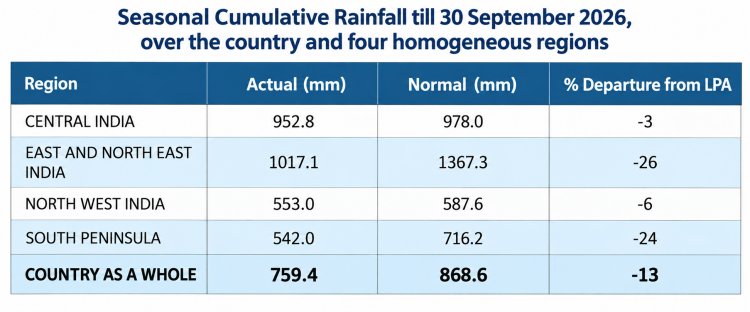
India’s southwest monsoon ended on 30 September with rainfall around 13% below normal, making 2026 the country’s weakest monsoon in more than a decade. The June–September season recorded 759.4 mm of rainfall against the long-period average (LPA) of 868.6 mm.
The last time India’s seasonal rainfall fell below 90% of the LPA was in 2015, when rainfall was 12.7% below normal. That year, too, was marked by a strong El Niño event in the equatorial Pacific, as is the case this year.
According to the India Meteorological Department (IMD), the impact of the deficient monsoon varied considerably across the country. East and Northeast India recorded 26% below-normal rainfall, followed by South Peninsular India with a 24% deficit and Northwest India with a 6% deficit. Central India recorded a relatively smaller rainfall deficit of 3%.
East and Northeast India Worst Affected
IMD data show that East and Northeast India experienced the largest rainfall deficit during the 2026 monsoon. The region received 1,017.1 mm of rainfall against its normal of 1,367.3 mm, a shortfall of 26%.
South Peninsular India received 542 mm against the normal of 716.2 mm, resulting in a 24% deficit.
Northwest India recorded 553 mm of rainfall compared with the normal of 587.6 mm, while Central India received 952.8 mm against the normal of 978 mm, leaving a 3% seasonal deficit.
The distribution of rainfall was also uneven across meteorological subdivisions. Of the country’s 36 meteorological subdivisions, 18 received normal rainfall, covering 53% of the country’s area. Seventeen subdivisions recorded deficient rainfall, covering 42% of the area, while one subdivision received excess rainfall.
El Niño Raises Concerns
El Niño has been identified as one of the key factors behind the weak monsoon this year. The weather department had forecast the development of El Niño during the monsoon season.
El Niño is characterised by abnormal warming of surface waters in the equatorial Pacific Ocean and has historically been associated with weaker southwest monsoon performance in India. In contrast, La Niña, which involves cooler-than-normal Pacific waters, generally tends to support stronger rainfall over India.
During the 2026 monsoon season, El Niño strengthened from weak to moderate levels in July, with meteorological agencies warning that the phenomenon could intensify further.
Drought Conditions in Five States
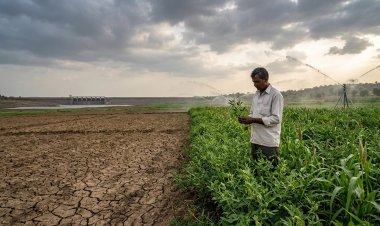
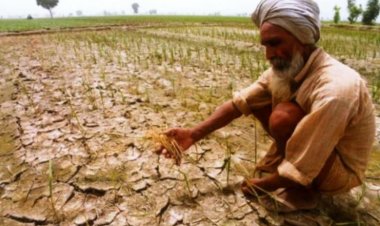
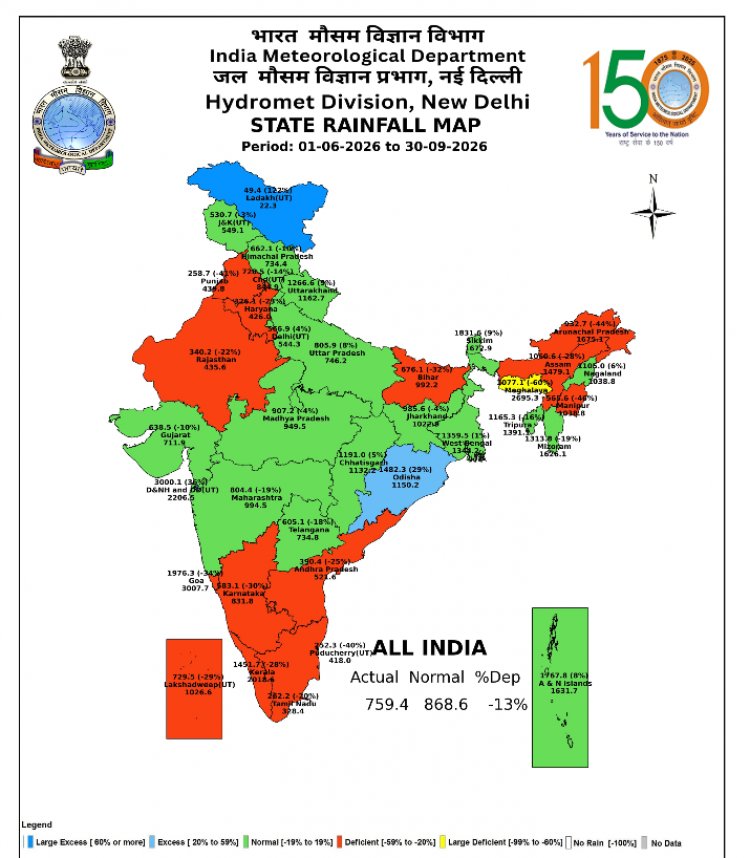
The rainfall deficit has affected agricultural conditions and water availability in several parts of the country. Drought conditions have been reported in Karnataka, Maharashtra, parts of Andhra Pradesh, Telangana and Rajasthan.
Some of these regions have faced a combination of deficient rainfall and damage caused by heavy rain and floods during the season. Preliminary assessments indicate that around 6.11 lakh hectares of cropped area have been affected.
A central team is scheduled to visit Karnataka on 3 October to assess the drought situation. The Agriculture Minister has also indicated that a central assessment team will be sent to Maharashtra.
Paddy Area Declines During Kharif
Despite the uneven distribution of rainfall, the overall area sown under kharif crops declined by around 1%. Paddy acreage, however, fell by around 16.32 lakh hectares.
The area under maize, soybean and cotton also declined, while acreage under crops such as urad, pearl millet, sorghum, sesame, sunflower and pigeon pea increased.
The shift in crop acreage assumes significance as farmers in several regions adjust cropping patterns to changing rainfall and water availability.
Foodgrain Production Target Cut
Against the backdrop of deficient rainfall and concerns over El Niño, the Union Government has set a foodgrain production target of 373.93 million tonnes for the 2026–27 crop year.
The target is 2.63 million tonnes below the actual foodgrain production of 376.56 million tonnes recorded in 2025–26. However, it remains higher than the target set for the previous crop year. Of the 373.93 million-tonne target, 196.21 million tonnes has been allocated to the 2026 kharif season, while the target for the rabi season has been set at 177.72 million tonnes.
The lower target reflects concerns over rainfall, water availability and soil moisture as the country enters the rabi season. The government has indicated that crop planning will take regional variations in rainfall and water availability into account, with greater emphasis on crops requiring less water in areas facing moisture stress.
With the southwest monsoon now withdrawn, the focus will shift to the rabi season, particularly wheat, pulses and oilseeds. Reservoir levels, residual soil moisture and the evolution of El Niño conditions will remain important factors for crop planning and agricultural production over the coming months.