
India’s Banana Sector Faces Growing Threat from Hard-to-Control TR4 Fungus
Scientists have warned that Tropical Race 4 (TR4), a destructive soil-borne fungal disease affecting bananas, could pose a serious threat to India’s Rs 50,000 crore banana economy. The disease has already spread across several states, threatening the widely cultivated Grand Naine variety and raising concerns over production losses and farmer incomes.
 Join the RuralVoice whatsapp group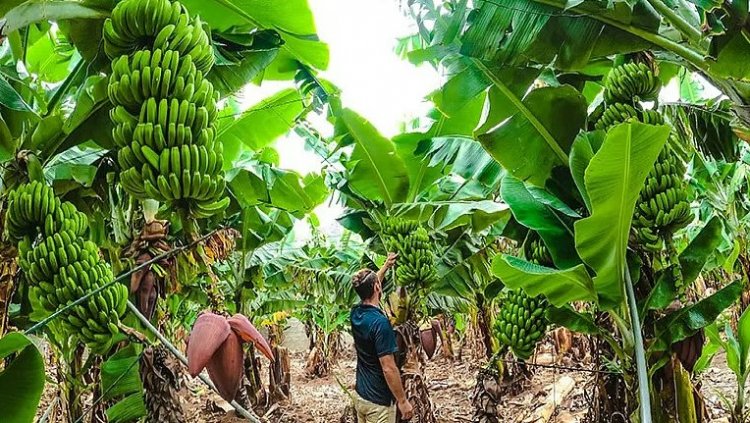
Abhash Anand
- Scientists Warn Rapid Spread of TR4 Could Devastate Banana Production in India
A highly destructive disease affecting banana plantations across several countries is now emerging as a major concern for India’s banana sector as well. The disease, known as Tropical Race 4 (TR4), is a soil-borne fungal infection that attacks banana plants internally and gradually destroys them.
Scientists at the Tiruchirapalli-based ICAR-National Research Centre for Banana have warned that a rapid spread of TR4 could lead to serious losses for banana growers across the country. India is the world’s largest producer of bananas, with annual production estimated at around 35 to 37 million tonnes. A significant share of this output comes from the Grand Naine, or G-9 variety, which is widely cultivated using tissue culture plants.
The disease initially attacks the roots of the banana plant, disrupting its ability to absorb and transport water and nutrients. As the infection progresses, leaves begin to turn yellow, the plant weakens and eventually dies.
Researchers at NRCB-ICAR said the fungus poses a particularly serious threat because it is extremely difficult to eradicate. Once it enters the soil, it can survive for several years, making infected farmland unsuitable for banana cultivation for a long period.
According to Dr. R. Selvarajan, Director of the National Research Centre for Banana (NRCB-ICAR), the disease was first detected in Bihar in 2015 and has since been reported in Uttar Pradesh, Gujarat, Madhya Pradesh and West Bengal. He warned that the biggest threat is to the Grand Naine variety, which is cultivated extensively across India and also dominates the global banana trade. If the disease spreads rapidly, the scale of damage could be enormous, he cautioned.
Dr. Selvarajan explained that tissue culture cultivation has significantly boosted banana production by providing uniform, high-yielding plants. However, this uniformity also creates vulnerability, as genetically similar plants can become susceptible to the same disease simultaneously, allowing infections to spread quickly across large plantations.
Scientists at NRCB-ICAR are actively working on disease management strategies, with field trials currently underway in affected areas of Madhya Pradesh, Uttar Pradesh and Gujarat. Dr. Selvarajan noted that the widespread use of tissue culture plants has increased the risk of disease transmission across states, as infected planting material can easily carry the pathogen to new regions.
To contain the spread, he emphasized the need for strict quarantine measures, including restrictions on the movement of infected plants from affected to disease-free regions. He warned that if Tropical Race 4 (TR4) spreads widely, India’s banana sector could face severe economic and production losses.
India’s banana economy is estimated to be worth nearly Rs 50,000 crore. The vulnerability of farmers can be understood from the experience of growers like G. Karikalan from Tamil Nadu’s Trichy district.
Karikalan said banana cultivation requires substantial investment, with farmers typically spending between Rs 1 lakh and Rs 1.5 lakh per acre on inputs and crop management. Under normal conditions, one acre can yield around 25 to 30 tonnes of bananas. At the current market price of nearly Rs 32 per kilogram in his region, farmers can generate gross returns of around Rs 8 lakh to Rs 9.6 lakh per acre before accounting for production expenses.
Banana cultivation involves continuous expenditure on labour, fertilizers, irrigation and planting material, leaving farmers highly exposed to crop losses. Karikalan described the market situation this year as “stable” compared to previous periods of severe price volatility. He noted that banana prices can sometimes fall sharply to Rs 10-15 per kilogram during weak market phases. If a disease outbreak coincides with such low-price conditions, many farmers could face serious financial distress.
Experts say the TR4 threat is not merely a plant disease issue but also a warning about the risks of excessive dependence on a single crop variety. Scientists and government agencies are intensifying research and awareness efforts, but experts believe that early intervention, strict surveillance and rapid containment of infected areas will be critical to preventing the disease from escalating into a larger national crisis.
For millions of banana growers, the challenge extends beyond protecting a crop. It is fundamentally about safeguarding farm incomes, rural livelihoods and the stability of India’s large banana economy.