
Fasal Bima: Why Farmers Face Low Payouts and Claim Rejections
PMFBY remains India’s largest crop insurance programme, but farmers continue to face low payouts, claim rejections and delays. The area-based assessment system can create gaps between actual and compensated losses. Experts advocate digital yield estimation, satellite imagery, drones, AI and parametric insurance, alongside better awareness and faster data and subsidy processes.

 Join the RuralVoice whatsapp group
Dinesh Wagh's pigeon pea crop in Maharashtra's Solapur district was destroyed by an intense heatwave in 2024. He expected his crop insurance to cushion at least a part of the financial blow. Instead, after completing all formalities, he received just Rs 6,670. Had the crop survived, he says, it would have fetched him Rs 70,000-80,000. The experience was disappointing enough for him to skip insurance for his five-acre banana crop this year. Ironically, when storms later flattened nearly half of his banana plantation, he was left with no compensation at all.
Wagh's experience reflects a wider pattern across India's farming landscape. Farmers frequently complain that insurance payouts are either too small to compensate for actual losses or are rejected despite visible crop damage. Yet, on paper, the Pradhan Mantri Fasal Bima Yojana (PMFBY) remains the world's largest crop insurance programme, covering millions of farmers every season. Government data also show that insurance companies have retained a surplus exceeding Rs 10,000 crore annually since 2019 (see box), raising fresh questions over whether the scheme is truly delivering on its promise.
Industry leaders that the Rural World spoke to, however, argue that the issue is far more complex than it appears. The scheme is based on scientific yield estimation, predefined operational guidelines and actuarial principles, not individual loss assessment. The challenge, they say, lies in bridging the gap between farmers' expectations and how crop insurance actually works.
Area-Based Insurance, Not Individual Compensation
Perhaps the biggest misconception about PMFBY is that it compensates farmers for the exact loss suffered on their own fields.
According to Subrata Mondal, Managing Director & CEO of IFFCO-Tokio General Insurance, PMFBY primarily follows an area approach. "Crop insurance claims are mainly decided by looking at the average crop yield of a notified Insurance Unit rather than measuring losses in every individual farmer’s field," says Mondal.
Before every season, the government fixes a Threshold Yield for each notified insurance unit. At harvest, the Actual Yield is determined through Crop Cutting Experiments (CCEs). If actual production falls below the threshold, every insured farmer within that insurance unit becomes eligible for compensation.
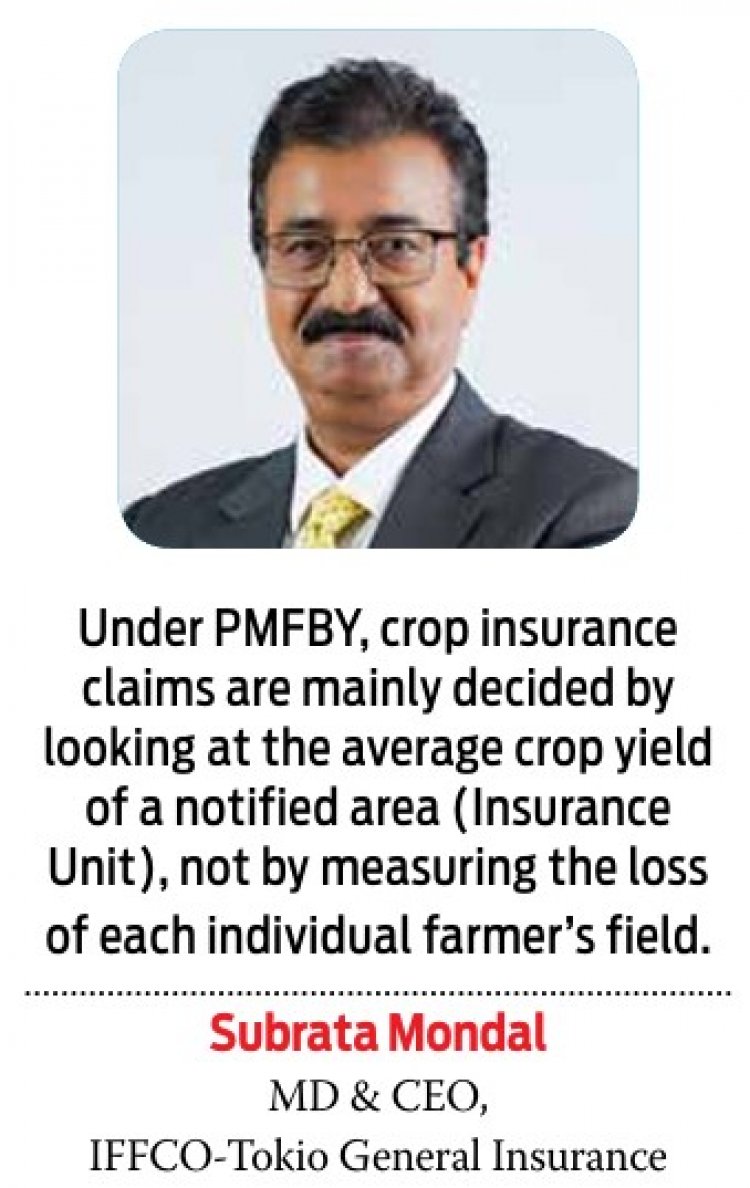
The compensation amount depends on how much the yield has fallen and the insured area of the farmer. Since the calculation is based on the average loss of the entire Insurance Unit, a farmer whose individual crop loss is much higher than the average loss of the insurance unit may receive compensation that appears disproportionately small.
Krishnamoorthy Rao, Managing Director & CEO of Generali Central Insurance Company Ltd., agrees that this ‘basis risk’ is inherent in the area approach. He explains that PMFBY provides multiple layers of protection - including prevented sowing, mid-season adversity, localized calamities and post-harvest losses - but the basic indemnity cover is still calculated at the notified insurance unit level. Consequently, there can be a mismatch between an individual farmer's actual loss and the compensation determined for the larger area.
When Claims Are Denied
Another frequent grievance among farmers is that visible crop damage does not always translate into insurance compensation. Insurance companies insist that crop damage alone does not automatically qualify for claims. Subrata Mondal explains that compensation depends entirely on whether losses fall within the provisions of PMFBY and the specific notifications issued by state governments for each season.
Claims may be rejected for several reasons. In certain cases, claims may not be admissible, such as when the crop or land is not covered, information provided is incomplete or inaccurate, enrollment or loss reporting is delayed, or the loss is due to risks not covered under the scheme.
He suggests, “Farmers can help ensure smooth claim processing by enrolling on time, providing correct details, and reporting eligible losses within the prescribed timelines.”
Krishnamoorthy Rao says delayed reporting is among the most common reasons for rejection. “Localized claims must be reported within 72 hours of the event. Late reporting results in automatic rejection.” He advises farmers to report losses immediately through the Krishi Rakshak Portal, the Crop Insurance App, banks or agriculture officers.
Damage caused by preventable factors (e.g., poor farming practices, stray animals, or general theft) instead of notified perils, is also a factor. Rao suggests to verify sowing declarations, “Ensure that the common service center (CSC) or banks updates the correct crop name on the portal if sowing plans change, which is also a provision in the guidelines.”
The Trigger Debate
Farmers also question the trigger conditions built into crop insurance. Dinesh Wagh says farmers in his district were told that heat-related claims become payable only when temperatures exceed 45°C. Since Solapur rarely crosses that threshold, severe crop damage often goes uncompensated. Similarly, another farmer, Dattatray Mule Patil, says wind-speed thresholds can determine whether storm damage qualifies for claims. Insurance companies acknowledge such concerns but point out that these parameters are defined under scheme guidelines rather than by insurers themselves.
Subrata Mondal admits that farmers may sometimes suffer substantial losses without receiving compensation because the notified insurance unit as a whole has not crossed the claim threshold.
To reduce this mismatch, insurers say technology-based assessment is gradually improving field-level accuracy. “Technologies are helping in improving the accuracy and timeliness of crop loss assessment, provide better insights at the farm level, and support faster and more transparent claim settlement,” says Mondal.
Krishnamoorthy Rao reveals that the government is already examining possible reforms. He says, “Ministry of Agriculture and Farmer Welfare is already reviewing these concerns and are deliberating upon changing the Indemnity level (Yield Benchmark calculating factor) from 70%, 80% and 90% to giving an option of selecting a variable indemnity level as per State’s view towards the risk for every crop at different insurance unit.”
He also suggests, “Parametric Insurance can be bundled with Basic Indemnity coverage for faster and predefined claim calculation under the add-on coverages which are survey dependent at this point of time.”
Why Claim Settlements Get Delayed
Delayed claim settlement remains another major criticism of PMFBY. Insurers say many bottlenecks lie outside their control. Subrata Mondal notes, delays often arise because Crop Cutting Experiment results are submitted late. Government premium subsidies are also sometimes released behind schedule. Errors in Aadhaar details, land records, enrolment data or bank account information can further delay payments.
Mentioning delayed CCE data submission an operational challenge Krishnamoorthy Rao says that it postpones the calculation of actual yield. He suggests complete digitization and real-time upload of CCE results via mobile apps and adoption of more Tech based yield estimations. He explains that satellite-based monitoring now tracks vegetation health through indices such as NDVI, helping verify crop stress objectively.
He also recommends automatic financial pooling mechanisms to ensure timely release of state government subsidy shares. He says, “To abide with 64 VB, an insurer should receive 100% premium subsidy for claims settlement. The Central Government has already aligned themselves with advance premium subsidy payment to Insurers based upon historical insurance coverage.”
Improving Transparency
Many farmers complain that they never fully understand policy conditions or the reasons behind deductions. Insurance companies say transparency has improved considerably in recent years.
Subrata Mondal explains, insurers, state governments and other stakeholders now conduct “regular awareness campaigns through Bima Pathshalas, village meetings, and print, electronic, and social media to educate farmers on enrolment, coverage, claims, and reporting timelines.”
Farmers can also access policy and claim information through the National Crop Insurance Portal (NCIP), insurance companies, banks, CSCs, and Agriculture Department offices.
Krishnamoorthy Rao says the recently introduced DigiClaim Module automatically sends SMS updates at every stage - from premium subsidy receipt to claim approval and payout disbursement. The centralized Krishi Rakshak Portal, PMFBY chatbot and toll-free number 14447 now serve as integrated grievance redressal platforms.
Can Technology Fix the Gap?
Technology is rapidly transforming India’s crop insurance ecosystem. Satellite imagery, drones, AI, geo-tagging and mobile applications are replacing many manual processes.
Subrata Mondal says, timely submission of yield and enrolment data, accurate digital records, and prompt release of government subsidies are critical for efficient and transparent claim processing.
To enhance the speed and reliability of claim settlement, PMFBY is increasingly leveraging technology-based solutions such as satellite imagery, drones, remote sensing, Artificial Intelligence (AI), and mobile-based CCE applications. These tools help improve the accuracy, transparency, and timeliness of crop loss assessment.
Meanwhile, the government's YES-TECH (Yield Estimation System based on Technology) initiative aims to standardize yield estimation and reduce human intervention. Following floods, hailstorms and other localized disasters, drones are increasingly deployed to capture high-resolution images for faster assessment.
Climate risks are also a factor that is forcing insurers to rethink crop insurance itself. Frequent droughts, floods, heatwaves and unseasonal rainfall are making historical yield patterns less reliable.
Subrata Mondal says insurers are “increasingly adopting advanced technologies such as satellite imagery, remote sensing, drones, Artificial Intelligence (AI), GIS, and data analytics to monitor crop conditions, build robust risk databases, predict loss patterns, and improve risk assessment models.”
Weather-based parametric insurance products are also gaining momentum. These products use predefined weather parameters, such as rainfall or temperature, as triggers for claim payments, enabling faster and more transparent loss assessment and quicker claim settlement.
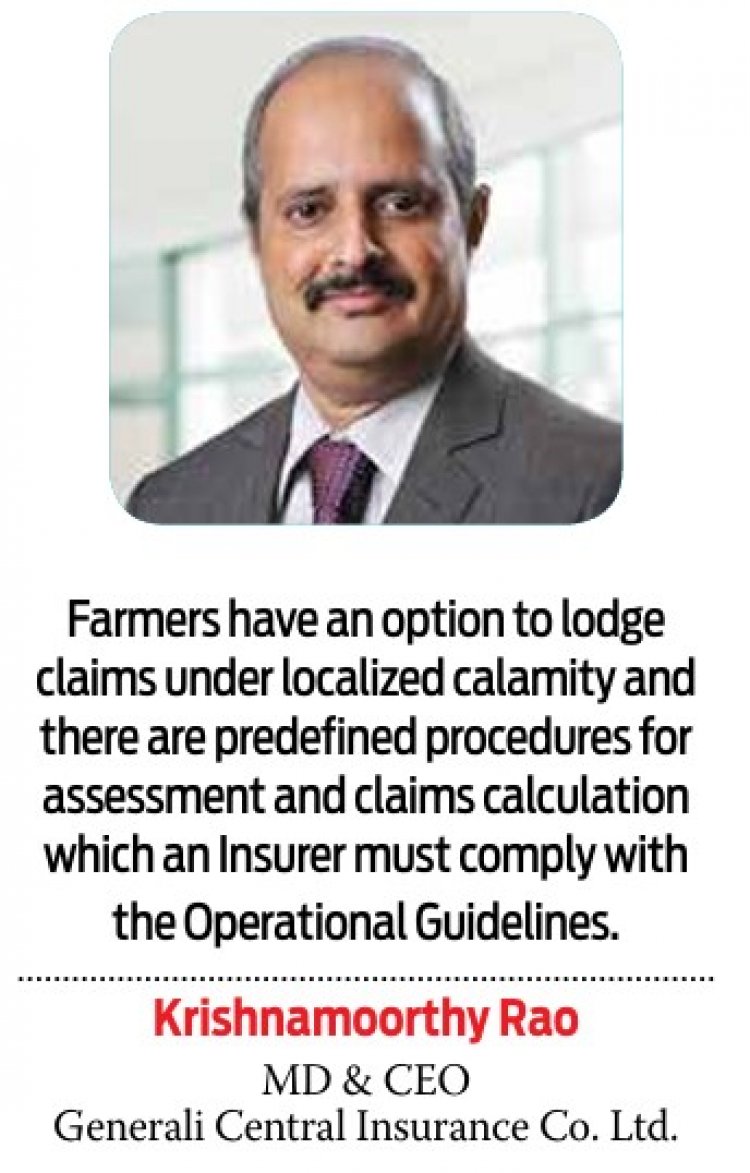
Krishnamoorthy Rao believes insurers must move beyond historical yield averages towards forward-looking climate models that incorporate changing weather patterns. He advocates hybrid insurance products combining conventional yield insurance with parametric coverage for faster settlements.
A Scheme That Continues to Evolve
India introduced its first crop insurance programme in 1985, while PMFBY replaced earlier schemes in 2016. Scheme guidelines were revised again from the Kharif 2023 season after incorporating recommendations from various studies.
The scheme currently provides insurance against drought, floods, cyclones, hailstorms, heavy rainfall, pests and diseases. PMFBY is implemented through 20 empanelled insurance companies, including five public sector insurers.
Farmers pay 2% premium for Kharif foodgrain and oilseed crops, 1.5% for Rabi crops and 5% for commercial and horticultural crops, while the remaining premium is shared by the Centre and state governments. For Northeastern and Himalayan states, the sharing ratio is 90:10, while for other states it is 50:50.
The Road Ahead
Few government schemes have expanded crop insurance coverage as dramatically as PMFBY. Yet the debate has shifted from enrollment to effectiveness. Farmers want compensation that reflects actual losses. Insurers argue that scientific, area-based assessment remains essential for keeping the programme financially viable. The future of PMFBY will therefore depend on narrowing this perception gap.
Greater use of satellite imagery, drones, AI, digital yield estimation and parametric insurance could make assessments more precise and settlements faster. Better awareness among farmers about policy conditions and reporting timelines will also be equally important.
PMFBY has undoubtedly become the backbone of India's crop risk management system. But as climate change intensifies and farming becomes increasingly uncertain, the scheme will need to evolve from being merely the world's largest crop insurance programme into one that is also seen by farmers as the most responsive and trustworthy.