
Crop Nutrients: Bio-Fertilizers as a Potential Source for Sustainable Nutrient Supply
Decades of research on biofertilizers at the Division of Microbiology, IARI and other ICAR institutes and State Agricultural Universities have proven beyond a doubt that biofertilizers can easily fix or mobilize 25% of the recommended doses of the major nutrients such as nitrogen (N), phosphorus (P), and potash (K) to crops. Such researched products developed by these institutions are readily available for upscaling production.

 Join the RuralVoice whatsapp group
Decades of research on biofertilizers at the Division of Microbiology, IARI, New Delhi, and other ICAR institutes and State Agricultural Universities have proven beyond a doubt that biofertilizers can easily fix or mobilize 25% of the recommended doses of the major nutrients such as nitrogen (N), phosphorus (P), and potash (K) to crops. Such researched products developed by these institutions are readily available for upscaling production. All these biofertilizers can provide 20-30 kg N/ha, enhance yields by 12-20%, and significantly improve soil fertility. Pusa Mycorrhiza, in particular, offers a sustainable solution by supplementing 30-35% P, further reducing the need for chemical fertilizers and promoting eco-friendly agricultural practices for diverse crops, starting from nursery-grown plants. The use of these biofertilizers can effectively lead to an estimated 10-25% reduction in chemical fertilizer input, resulting in significant cost savings for farmers.
What Should Be Done?
1. Biofertilizers should be made an integral part of Natural/Organic farming: The nutrient supply in natural/organic farming is based on the presumption of exploiting the power of the microbiome in the form of Beejamrit, Jeevamrit, Ghanjeevamrit, etc. However, none of these products are scientifically validated. In contrast, the biofertilizers developed by different institutions are based on decades of research and harness the potential microbiome consisting of the most efficient strains available in nature, including those sourced from soil, cow dung, and urine. Therefore, using these biofertilizers in organic/natural farming would be much more effective.
2. Biofertilizers should also be made an integral part of the inorganic farming system: Since biofertilizers are capable of meeting 25% of respective nutrients, they should also be an integral part of the inorganic farming system. In spite of the recommendation, large-scale use of biofertilizers has not happened in practice.
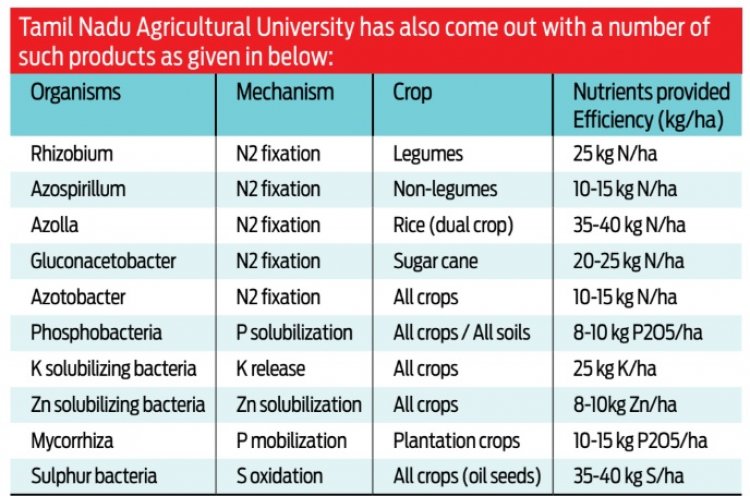
Several researched bio-fertilizers are available from different ICAR institutes and State Agricultural Universities; some of them are described below.
Pusa Biofertilizers
The Division of Microbiology at ICAR-IARI, New Delhi, has a long and distinguished history in biofertilizer research and development, dating back to the early 1980s. The Division pioneered the development of a wide range of biofertilizers with solid carrier-based single bacterial inoculants, including early innovations such as Rhizobium for pulses, Azotobacter for vegetables and cereals, and Azospirillum for cereals and millets. The Division also developed cyanobacteria-based biofertilizers specifically designed for paddy cultivation.
Over the years, the Division has made significant progress, creating multi-microbe/multi-nutrient and multi-functional carrier-based and liquid formulations suitable for diverse crops. These formulations not only fortify plants and their produce, but they also enrich and increase the availability of macro- and micronutrients, stimulating plant growth and yields significantly. Notable examples include multi-nutrient products such as:
1. Pusa Sampoorn: A consortium of beneficial microbes providing NPK (Nitrogen, Phosphorus, Potassium).
2. Pusa Biofort: A consortium of native bacteria, along with newer formulations of Azospirillum, Azotobacter, and formulations that solubilize essential nutrients like phosphorus, potassium, and zinc.
3. Pusa Mycorrhiza: A mycorrhizal biofertilizer for enhancing nutrient and water uptake, improving soil structure, and increasing plant resilience to diseases and environmental stresses.
4. Pusa Cyanonutricon, Pusa Cyanofort, Pusa Cyanobiocon: Novel multifunctional cyanobacterial formulations for use across various crops like legumes, vegetables, cotton, and cereals like wheat and maize. These have also been developed and tested across diverse agro-ecologies; they improve organic carbon, in addition to nitrogen and micronutrient availability in the soil and their translocation to the produce, along with 25-30 kg N/ha savings.
Likewise, other ICAR institutes and SAUs have a wide array of biofertilizers developed with decades of research; their production is being undertaken by respective institutes on small scales, and some of these have also been licensed for production to small companies.
Constraints: The unavailability of quality biofertilizers at a reasonable price and in the required quantity has been a major constraint to their limited use. The reason is that, by and large, the production and supply of biofertilizers have been in the hands of unscrupulous people who have no research-based biofertilizers under production. The production, storage, and transportation conditions and the supply chain are not well-developed. Often, biofertilizers are procured and supplied under subsidies with no quality control; many times, the packets contain only ash (a carrier) with no live microbes. This has been one of the most important reasons for biofertilizers not becoming effective.
What Needs to Be Done?
In addition to small players with strict quality control, the major responsibility for the production of biofertilizers with a complete supply chain should be given to major fertilizer manufacturers such as IFFCO, KRIBHCO, NFL, and Nagarjuna, etc. It should be made mandatory that these companies must produce 25% of their total nutrient production in the form of biofertilizers. They may be allowed to use their CSR funds for this activity.
The Impact
Promoting the use of biofertilizers will help reduce chemical fertilizer use by 25% and result in a corresponding reduction in greenhouse gas emissions. The total N2O emission from agriculture in India is 0.3 million tons, of which 20% is contributed by synthetic fertilizer. Using biofertilizers will reduce emissions by 25% of 20%, i.e., 15,000 tons of N2O, while also reducing the cost of cultivation for farmers. In addition, large-scale demonstrations of these products on farmers’ fields are necessary to build their confidence in bio-fertilizers.
(Writer is former Director, Indian Agricultural Research Institute. Views expressed in this article are personal)