
The Rs 3.85 Lakh Crore Mirage: Why 80% of Specialist Posts in Rural Health Centres Sit Empty
Despite government health expenditure rising to ₹3.85 lakh crore and lower out-of-pocket spending, India's rural healthcare system remains crippled by an 80% shortage of specialist doctors, inadequate infrastructure, and growing dependence on private hospitals. The gap between impressive health statistics and poor ground-level services continues to undermine equitable healthcare access.
 Join the RuralVoice whatsapp group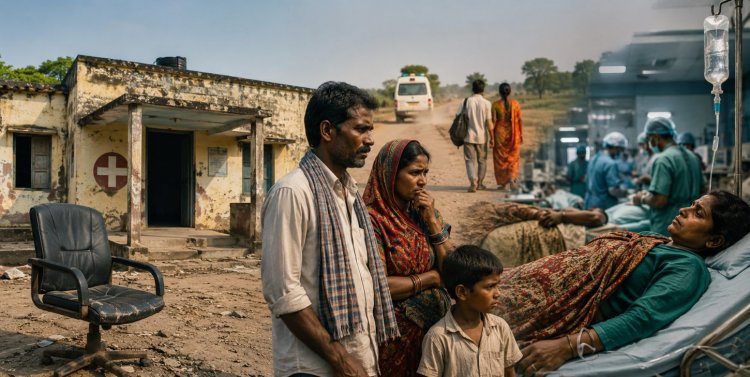
Snehil Chaubey
India’s healthcare system currently presents a profound epidemiological, administrative, and fiscal paradox. On a macroeconomic and statistical level, the nation has registered unprecedented triumphs that suggest a rapidly expanding and financially secure health ecosystem. However, a granular examination of grassroots service delivery mechanisms, human resource deployment, and patient-level financial outcomes reveals a starkly contrasting reality. The quantitative expansion of physical infrastructure and the allocation of massive budgetary outlays have not translated into qualitative clinical care or the alleviation of medical vulnerabilities for the rural demographic, birthing a system that often functions as a "paper fortress.”
The Macroeconomic Illusion vs. Ground Reality
According to the National Health Accounts 2022-23 estimates, India's Government Health Expenditure (GHE) has witnessed a historic ascent, surging nearly threefold over a decade to reach Rs 3.85 lakh crore. Consequently, GHE as a share of the Gross Domestic Product (GDP) rose to 1.43%. The most celebrated derivative of this increased public financing is the reported plunge in Out-of-Pocket Expenditure (OOPE), which dropped significantly from 64.2% of Total Health Expenditure in 2013-14 to 43.4% in 2022-23. Concurrently, institutional deliveries reached an impressive 90.6% nationally.
However, looking deeper into the data reveals a public-to-private shift. Despite the surge in overall institutional deliveries, the proportion of births occurring in public facilities has actually decreased from 61.9% to 58.6%. This raises the critical question of why rural families are actively choosing to bypass free government clinics.
Vinod Shende, a health activist with SATHI (Support for Advocacy and Training in Health Initiatives), an action Center of ANUSANDHAN TRUST, offers a vital ground-level perspective. He notes that while public awareness is rising, government investment remains primarily focused on medical colleges, large urban hospitals, and public-private partnerships. The strengthening of primary and preventive healthcare is being neglected. As a result, citizens are forced to turn to private healthcare services due to inadequate diagnostic facilities, vacant staff positions, and medicine shortages within the public system, causing the actual financial burden to fall directly on citizens.
The Structural Void and Regional Contrasts
The physical infrastructure of rural healthcare is currently paralyzed by a severe human resource deficit. According to the Health Dynamics of India 2023-24 report, there is a staggering 79.9% vacancy rate for specialist doctors in rural Community Health Centres (CHCs). Furthermore, the government's focus on expansion often masks an "infrastructure illusion," as more than 31% of rural sub-centres still do not possess their own dedicated buildings, calling into question the emphasis on rebranding over fixing basic brick-and-mortar needs.
The Hindi Heartland bears the brunt of this systemic crisis. Madhya Pradesh faces a 94% specialist shortage, Bihar 80.9%, Rajasthan 80.3%, and Uttar Pradesh 74.4%. The situation in Madhya Pradesh has become so dire that the state government recently approved a pilot project to hand over the management of 18 CHCs in Rewa, Guna, and Dewas districts to private operators. This outsourcing decision was driven by an extreme vacancy crisis; out of 1,320 sanctioned specialist positions in the state's operational CHCs, a mere 113 are actually filled.
This North-South divide is corroborated by Dr. Regi George of the Tribal Health Initiative in Tamil Nadu. He highlights that southern states largely avoid these catastrophic vacancies because they invest heavily in physical infrastructure, including crucial staff quarters. Furthermore, the system incentivizes deployment by rewarding medical students with academic marks for working in rural areas. However, Dr. George cautions that even in better-performing states, primary centers handle basic ailments due to limited medicine supplies, emphasizing the pressing need to improve secondary care and normal deliveries.
Medical Migration and The Overburdened Frontline
When primary and secondary care infrastructure is reduced to empty administrative shells, the immediate consequence is spatial displacement. The State of Health in Rural India Survey revealed that 58% of rural households report that people in their neighbourhoods must migrate to other areas for critical care. In the Northeast and North, 73% and 60% of migrating patients, respectively, are forced to travel entirely outside their home states for treatment. Over 51% of households spend up to Rs 25,000 per episode of medical migration, pushing nearly 6% of low-income families into catastrophic debt exceeding Rs 100,000.
A central pillar holding up this fractured architecture is the Accredited Social Health Activist (ASHA). However, this workforce is severely strained. As Dr. George observes, ASHA workers are working quite well despite being overburdened and underpaid. While they are officially designated as part-time volunteers, it effectively acts as full-time labour. This heavy reliance on underpaid female frontline workers inevitably leads to burnout and creates a remote trust deficit between marginalized communities and the broader healthcare apparatus.
Unregulated Privatization and Over-Medicalization
The systemic abdication of healthcare delivery by the rural public sector has birthed an exploitation economy, most visibly characterized by the exponential rise in Caesarean section (C-section) deliveries. The national C-section rate has reached an alarming 27.2%. Exposing a massive disparity, 54.1% of all deliveries in private healthcare facilities are C-sections, compared to just 16.9% in public facilities.
Indranil Mukhopadhyay from the Jan Swasthya Abhiyan (JSA) pointed out that while the WHO defines the ideal C-section rate at a maximum of 15%, the rates are exceedingly high globally, and specifically alarming within India's private sector. This phenomenon suggests that pregnant women, driven away by unequipped public clinics, are being subjected to unnecessary surgeries for financial gain.
Beyond surgical deliveries, evidence from Punjab indicates a disturbing rise in hysterectomies, reaching 2.6% among women aged 15-49, with nearly two-thirds of these life-altering procedures performed in private facilities without exploring conservative alternative treatments.
Mukhopadhyay noted that fixing these baseline infrastructural problems was originally supposed to be managed through Ayushman Bharat Health and Wellness Centers, yet clinical exploitation remains rampant.
The Nutritional Emergency and The Data Void
A healthcare system's ultimate efficacy is judged by its population outcomes. Despite macro-financial scaling, India faces a stubborn nutritional crisis. In an editorial analysing the NFHS-6 data, development economist Santosh Mehrotra points out that child undernutrition remains stagnant; 29.3% of children under five remain stunted, 31.8% are underweight, and 19.0% are wasted. The incidence of adult malnutrition has also worsened over a few years, with the share of Indian women reporting a Body Mass Index (BMI) below 18.5 rising from 18.7% to 19.7%. This distress is particularly acute in the Hindi heartland, with Bihar's underweight prevalence remaining roughly 8 percentage points higher than the Indian average.
However, accurately tracking these grassroots realities is becoming increasingly difficult due to deliberate shifts in national data collection. The NFHS-6 survey excluded 43 key indicators, including the sex ratio at birth, sanitation metrics, clean cooking fuel data, and seven vital indicators linked to anaemia.
Reflecting on these omissions, Mukhopadhyay expressed that it is very unfortunate for a comprehensive survey like the NFHS to drop parameters like anaemia, which are foundational for measuring overall health and development. He reasoned that while the government claims it will conduct brief separate surveys for these specific metrics, the massive sample size of the NFHS cannot be easily replicated. Removing such vital indicators ultimately affects the ability of researchers to track authentic grassroots health realities, potentially obscuring the true scale of the crisis behind positive macroeconomic headlines.
Conclusion
When health governance relies heavily on macroeconomic metrics such as budgetary allocations and aggregate institutional footfalls, the system easily achieves 'on-paper' success. However, a clinic without a doctor is just real estate, and an institutional delivery achieved via an unnecessary surgical incision is a regulatory failure. To achieve true Universal Health Coverage, policymakers must bridge the gap between national statistical triumphs and the daily struggles of patients and frontline workers navigating a fractured rural system.
(Snehil Chaubey is a 2nd year Master's Student in Public Policy and Governance at Dr. B.R. Ambedkar University Delhi. She has just completed her internship with Rural Voice.)