
Early Closure of 248 Sugar Mills Signals Stress In India’s Cane Economy
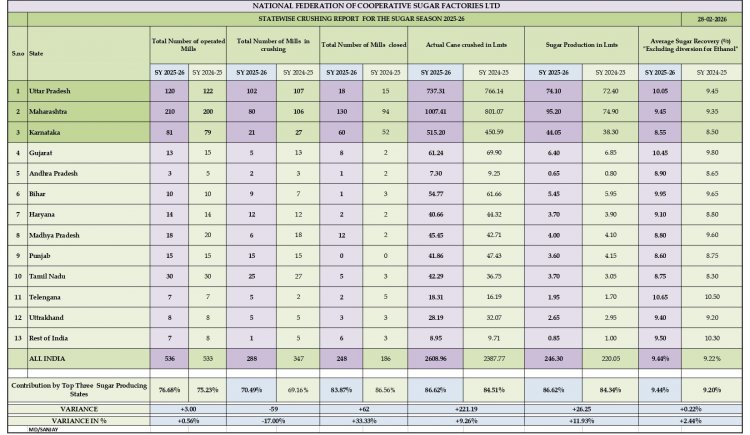
Out of 536 sugar mills that commenced crushing operations this season, 248 had already stopped operations by February-end. In comparison, only 186 mills had closed by the same time last year. Industry observers attribute the early shutdowns primarily to reduced cane availability, making it difficult for mills to sustain crushing.

 Join the RuralVoice whatsapp group
India’s sugar industry, which sustains the livelihoods of millions of sugarcane farmers, is facing mounting challenges as falling cane yields disrupt mill operations across the country. A sharp decline in sugarcane output has led to the early closure of 248 sugar mills by the end of February in the ongoing 2025–26 sugar season, raising concerns over supply stability and sectoral sustainability. Due to the decline in sugarcane yields, sugar mills are finding it difficult to secure adequate cane supplies.
According to the National Federation of Cooperative Sugar Factories (NFCSF), out of 536 sugar mills that commenced crushing operations this season, 248 had already stopped operations by February-end. In comparison, only 186 mills had closed by the same time last year. Industry observers attribute the early shutdowns primarily to reduced cane availability, making it difficult for mills to sustain crushing.
The sector was already under pressure after last year’s crop suffered from disease outbreaks and adverse weather conditions, which affected cane productivity in key producing regions.
Despite these constraints, cumulative sugar production as of 28 February stood at 24.6 million tonnes, 2.6 million tonnes higher than the 22 million tonnes recorded during the same period last year, as per NFCSF data. However, industry sources indicate that with mills shutting earlier than usual, the likelihood of total production reaching 29 million tonnes by the end of the season appears slim.
The Indian Sugar and Bio-energy Manufacturers Association (ISMA), representing private sugar mills, has projected gross sugar production at 32.4 million tonnes for 2025–26. Of this, around 3.1 million tonnes are expected to be diverted for ethanol production, leaving net sugar output at approximately 29.3 million tonnes. This would mark a 12 percent increase over last year’s net production of 26.1 million tonnes. ISMA had projected sugar production at 34.9 million tonnes at the beginning of the season.
However, with domestic consumption estimated at around 28.3 million tonnes and an export quota of 0.7 million tonnes, the current production outlook suggests that no significant surplus stock may remain at the end of the season. The opening stock for the next season is expected to hover around 5 million tonnes, roughly at the same level as last year’s carryover.
Uttar Pradesh Sees Lower Cane Output
In Uttar Pradesh, the country’s largest sugarcane producing state, sugarcane yields have fallen short of initial projections. The widely cultivated Co-0238 variety was hit by disease, and farmers reportedly did not receive suitable replacement varieties in time, affecting output.
Sugar mills in the state crushed 73.7 million tonnes of cane by 28 February, nearly 3 million tonnes less than during the same period last year. However, sugar recovery improved to 10.05 percent this season compared to 9.45 percent last year. As a result, sugar production in Uttar Pradesh reached about 7.4 million tonnes by February-end, slightly higher than 7.2 million tonnes in the corresponding period last year.
Out of 120 mills in the state, 18 have already closed, and several others may end operations by mid-March. Total sugar production in Uttar Pradesh is expected to remain broadly stable at around 9.2 million tonnes, similar to last year.
Maharashtra And Karnataka: Mixed Trends
In Maharashtra and Karnataka, key cane-producing states in western and southern India, production has also been lower than initial estimates due to disease incidence and adverse weather, including early flowering in cane crops.
As of 28 February, Maharashtra’s sugar production reached 9.5 million tonnes, compared to 7.5 million tonnes during the same period last year. However, 130 out of 210 mills in the state have already stopped crushing. Total production is projected to reach around 10.6 million tonnes by season-end.
Karnataka has produced 4.4 million tonnes of sugar so far, up from 3.8 million tonnes during the same period last year. Yet, 60 of its 81 mills have shut operations. Final production in the state is expected to touch approximately 4.8 million tonnes.
Ethanol Diversion And Export Headwinds
The ethanol blending programme, positioned as an additional revenue stream for sugar mills, is also showing signs of moderation. ISMA has revised its estimate of sugar diversion for ethanol from 3.5 million tonnes to 3.1 million tonnes for the current season.
On the export front, weak global sugar prices have made shipments less attractive. Although the central government permitted the export of one million tonnes of sugar, industry estimates suggest that only about 0.7 million tonnes may actually be exported by the end of the season.
With early mill closures, moderated ethanol diversion and subdued export prospects, the sugar sector faces a delicate balancing act. For millions of cane growers and mill operators alike, the coming months will be crucial in determining whether the industry can stabilize after successive seasons of climatic and agronomic stress.