
India’s Kharif Sowing Area Down 21% as Delayed Monsoon Hits Farming
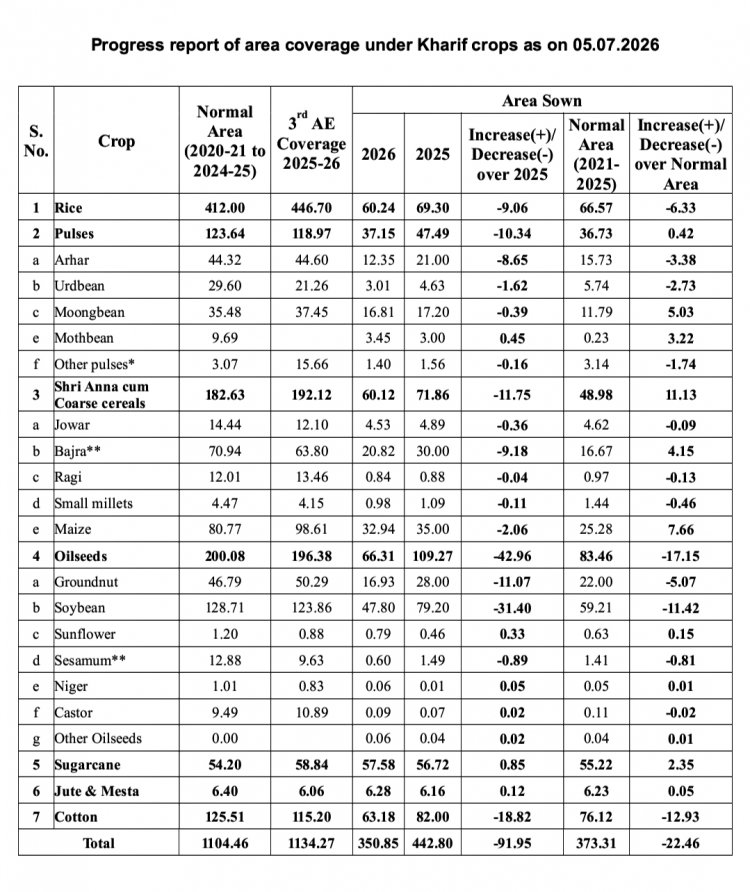
India’s kharif sowing area declined nearly 21 per cent to 350.85 lakh hectares as of July 5, 2026. Oilseeds, cotton, pulses, rice and coarse cereals recorded lower acreage, while sugarcane and jute and mesta posted marginal gains.

 Join the RuralVoice whatsapp group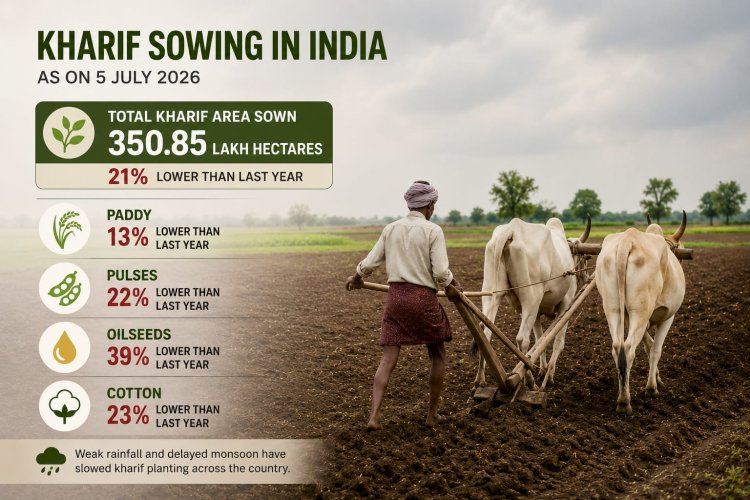
The area under kharif crops in India remained sharply lower than last year in early July, as delayed and uneven progress of the southwest monsoon slowed planting of major crops, including rice, pulses, oilseeds and cotton.
Total kharif sowing reached 350.85 lakh hectares as of July 5, 2026, down 20.8 per cent from 442.80 lakh hectares during the corresponding period last year, according to data from the Union Ministry of Agriculture and Farmers’ Welfare. In absolute terms, the area under kharif crops was lower by 91.95 lakh hectares.
The sowing lag reflects the impact of weak and delayed monsoon conditions during the early part of the season. Rainfall conditions have improved recently, but the cumulative monsoon rainfall deficit remained around 20 per cent by July 6 after having been as high as 40 per cent in June.
Paddy Acreage Falls 13%
The area under rice, the country’s most important kharif foodgrain crop, stood at 60.24 lakh hectares as of July 5, compared with 69.30 lakh hectares a year earlier. This represents a decline of 9.06 lakh hectares, or about 13.1 per cent.
Paddy acreage was also 6.33 lakh hectares below the normal area of 66.57 lakh hectares for the corresponding period.
Pulses sowing fell 21.8 per cent to 37.15 lakh hectares from 47.49 lakh hectares last year. However, the total area under pulses was marginally above the normal area of 36.73 lakh hectares for the period.
Among individual pulse crops, arhar acreage declined to 12.35 lakh hectares from 21 lakh hectares, while urad sowing fell to 3.01 lakh hectares from 4.63 lakh hectares. Moong acreage was relatively stable at 16.81 lakh hectares compared with 17.20 lakh hectares last year.
Oilseeds Record Sharpest Decline
Oilseeds recorded the steepest decline among major crop groups. The area under oilseeds fell 39.3 per cent to 66.31 lakh hectares from 109.27 lakh hectares in the year-ago period.
Soybean, the country’s largest kharif oilseed crop, accounted for most of the decline. Soybean acreage dropped to 47.80 lakh hectares from 79.20 lakh hectares last year, a reduction of 31.40 lakh hectares.
Groundnut sowing also fell sharply to 16.93 lakh hectares from 28 lakh hectares, while sunflower acreage increased to 0.79 lakh hectares from 0.46 lakh hectares.
Coarse Cereals, Cotton Lag Behind
The area under Shri Anna and coarse cereals declined to 60.12 lakh hectares from 71.86 lakh hectares last year, a fall of 16.3 per cent.
Bajra sowing declined to 20.82 lakh hectares from 30 lakh hectares, while maize acreage fell to 32.94 lakh hectares from 35 lakh hectares. Jowar sowing was marginally lower at 4.53 lakh hectares against 4.89 lakh hectares a year ago.
Cotton sowing also remained substantially behind last year’s level. The area under cotton declined 23 per cent to 63.18 lakh hectares from 82 lakh hectares, a shortfall of 18.82 lakh hectares.
In contrast, sugarcane and jute & mesta showed marginal gains. Sugarcane acreage increased to 57.58 lakh hectares from 56.72 lakh hectares, while the area under jute and mesta rose to 6.28 lakh hectares from 6.16 lakh hectares.
The pace of sowing in the coming weeks will depend heavily on the distribution and intensity of rainfall. Recent widespread rains have improved monsoon conditions and reduced the national rainfall deficit, but the early-season delay has left a substantial sowing gap compared with last year.