
Decision on Sugarcane Control Order Will Be Taken After Farmers’ Consent, Assures Food Minister Prahlad Joshi
Union Food Minister Prahlad Joshi assured farmers and jaggery industry representatives that no decision on the proposed Sugarcane Control Order, 2026 will be taken without extensive consultations and protecting farmers’ interests. Farmer groups and khandsari stakeholders have opposed several draft provisions, alleging they favour sugar mills over sugarcane growers and rural industries.

 Join the RuralVoice whatsapp group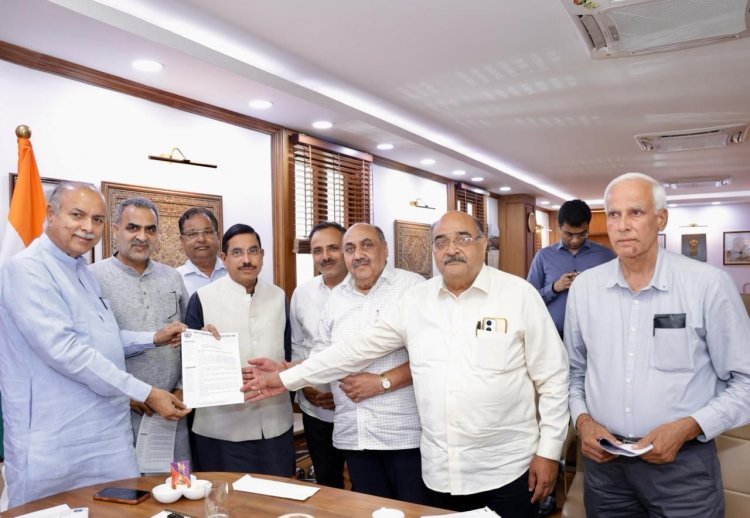
Any decision on the proposed Sugarcane Control Order, 2026, which is set to replace the Sugarcane Control Order, 1966 under the Essential Commodities Act, will be taken only after detailed discussions with farmers, the Union Ministry of Consumer Affairs, Food and Public Distribution has assured.
On Thursday, a delegation comprising farmers and representatives of the jaggery and khandsari industry, led by former Union Minister of State Dr. Sanjeev Balyan, met Union Consumer Affairs, Food and Public Distribution Minister Pralhad Joshi regarding concerns over the proposed Sugarcane Control Order, 2026. During the meeting, the Union Food Minister said that no decision on the proposed order would be taken without extensive consultations with farmers and ensuring the protection of their interests.
The proposed amendments in the draft Sugarcane Control Order, 2026 have triggered strong reactions from sugarcane farmers, farmer organisations, and stakeholders from the jaggery and khandsari industry. They have expressed concerns that several provisions in the draft are against the interests of sugarcane growers as well as the traditional jaggery and khandsari sector. Farmer organisations have also alleged that the proposed changes prioritise the interests of the sugar industry at the cost of sugarcane farmers.
After the meeting, Dr. Sanjeev Balyan told Rural Voice that most provisions of the proposed order are aligned with the interests of sugar mills. “We have said that when the order contains no provision in favour of farmers, then what is the need for such an order at all,” he said. He also clarified that the existing provision mandating a 15-kilometre distance between two sugar mills should continue.
He further stated that the current regulatory and licensing system for jaggery and khandsari units should remain unchanged, and no new provisions similar to those applicable to sugar mills should be imposed on them. If jaggery and khandsari units wish to pay sugarcane farmers prices higher than the Fair and Remunerative Price (FRP) or the State Advised Price (SAP), there should be no restrictions on them, he added.
The meeting was attended by National Convenor Yashpal Malik and other members of the Jaggery and Khandsari Manufacturers’ Association of India. Malik said that the provisions of the Sugarcane Control Order, 2026 favour sugar mills and could threaten the existence of the jaggery and khandsari industry, which plays a major role in generating employment and supporting economic activity in rural areas.
The memorandum submitted says, the term “Khandsari Sugar Syrup” used in the draft should be deleted and replaced with the term “Sugar Syrup,” as sugar mills do not produce khandsari. The definition of a khandsari factory is also unclear and should be properly clarified. In industry terminology, such units are often referred to as power kolhus or power crushers. There should be no restriction of reserved areas for sugarcane procurement by power kolhu/crusher and khandsari units.
The association further stated that the authority to grant licences to power kolhu/crusher units or khandsari units should remain with the state governments, and the central government should not interfere in the matter since sugarcane is a state subject. It also said that when state governments issue permits to power kolhu/crusher and khandsari units, there should be no provision for purchasing sugarcane through cooperative societies or agents, or for paying them commissions. At present, these units procure sugarcane directly from farmers, and the same system should continue.
The association has demanded that there should be no restrictions on operating time and working hours for these units, as they function according to local conditions and market demand. Their operations also depend on labour working hours, electricity supply, and availability of raw materials.
It has further said that these units should not be burdened with maintaining excessive documentation, as small units are not capable of handling extensive paperwork. There should also be no restriction on the distance between sugar mills and power kolhu/crusher units.
According to the association, jaggery and khandsari units provide employment to lakhs of people during the sugarcane season. It added that sugarcane cultivation has developed more rapidly in areas where power kolhu/crusher units and sugar mills coexist.