
Jayanti Special: Dr. B R Ambedkar, Constitution, Dalits and Panchayati Raj in India
The article examines Dr. B. R. Ambedkar’s evolving views on village governance, highlighting his skepticism of Panchayats due to caste dominance and exclusion of Dalits. While he supported decentralisation with safeguards, he later accepted Panchayats in the Directive Principles. Evidence shows his concerns remain relevant, with limited devolution and persistent inequalities in grassroots governance.
 Join the RuralVoice whatsapp group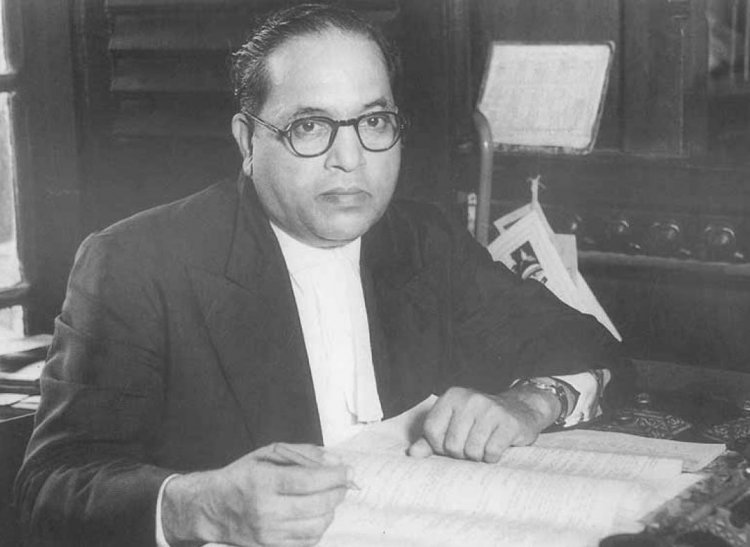
Dr. B. R. Ambedkar was one the greatest sons of India who was not only a parliamentarian, scholar of repute and constitutional expert but also a crusader for dalits in India. In this regard, how the Panchayats had become the part of the Directive Principles of State Policy after the debate in the Constituent Assembly and what were the views of Dr. B. R. Ambedkar on it. He opposed inclusion of Village Panchayats in the Constitution, while he was oratory of Panchayats when Bombay Panchayat Bill was debated in 1932. His views and development of local governance with dalits’ participation has been discussed in this piece.
On November 4, 1948 Dr. B R Ambedkar, while moving a motion in the Constituent Assembly for consideration of the Draft Constitution of India made certain observations about the village. He quoted Metcalfe who described the villages as "Dynasty after dynasty tumbles down. Revolution succeeds to revolution. Hindoo, Pathan, Mogul, Maharatha, Sikh, English are all masters in turn but the village communities remain the same. In times of trouble they arm and fortify themselves. A hostile army passes through the country. The village communities collect their cattle within their walls, and let the enemy pass unprovoked."
Further, he also commented "Such is the part the village communities have played in the history of their country. Knowing this, what pride can one feel in them? That they have survived through all vicissitudes may be fact. But mere survival has no value. The question is on what plane they have survived. Surely on a low, on a selfish level. I hold that these village republics have been the ruination of India. I am, therefore, surprised that those who condemn Provincialism and communalism should come forward as champions of the village. What is the village but a sink of localism, a den of ignorance, narrow-mindedness and communalism? I am glad that the Draft Constitution has discarded the village and adopted the individual as its unit”.
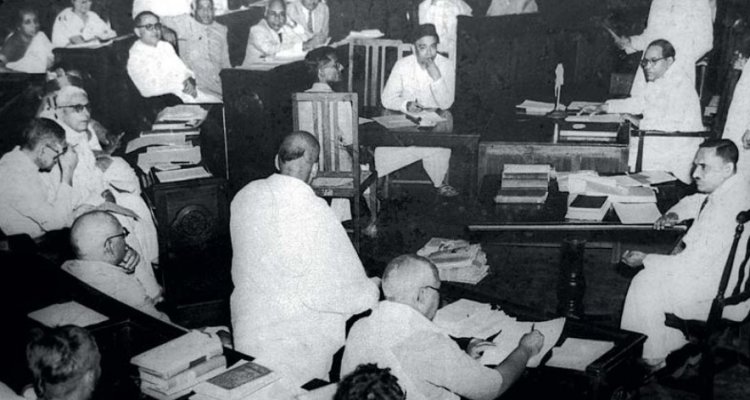
The pertinent question is that why he had not spoken for weaker sections' space in Panchayats in the Constituent Assembly debate in 1948 , while 16 years before the Constituent Assembly debate on 6 October, 1932, when the Bombay Village Panchayat Bill was discussed in the Bombay Assembly, he was in favour of the policy of devolution with special provisions for the depressed classes in the legislation.
To quote Dr. Ambedkar: "I should like to say at once that I have no objection in principle to the policy of devolution, if it is found that the local boards of this Presidency are overburdened by the functions which are placed upon by the Local Board Act and if by reason of that they are unable to discharge their functions efficiently, then I say by all means institute village Panchayats so as to disburden the local boards."
For depressed classes he commented : "The Bill provides that the village Panchayats shall be elected on the basis of adult suffrage both for males and females....but I should like to make it clear... that speaking for the depressed classes, I have not the slightest hesitation in saying that adult suffrage is not sufficient for us. The Hon'ble Minister has forgotten that the depressed classes are in a minority in every village, a miserable minority, and assuming that he adopts adult suffrage, he will readily admit I am sure that adult suffrage cannot convert a minority into a majority. Consequentially, I am bound to insist that if these Panchayats come, there shall be special representation for the minorities. At any rate, there shall be special representation for the depressed classes...I can never accept the principle of self-government for India unless I am satisfied that every self-governing institution has provision in it which gives the depressed classes special representation in order to protect their rights..."
Initially, Dr. Ambedkar opposed inclusion of Panchayats in the constitution. But when a number of Members of Constituent Assembly argued for Panchayats and when Shri Santhanan moved the motion for inclusion of Panchayats in the Directive Principles of State Policy, Dr. Ambedkar accepted Panchayats for their inclusion in Constitution. The reason for why Dr. Ambedkar accepted Village Panchayats in Directives Principles of State Policy might be that he might have read between the lines that since Panchayats would be on the wishes of the State Governments, these institutions would not be flourished or strengthened. And provisions of Article 40 would largely be confined to constitution. The experiences of the functioning of Panchayats after 1932 might have given enough experiences to Dr. Ambedkar that if Panchayats had been made the part of the Directive Principles of State Policy, they would not be strengthened by the political leaders and bureaucrats as they were not interested in making Panchayats strong and pulsating institutions.
It is evident from the functioning of the Panchayats after independence that they could not play any significant role in the development and planning of the life of villagers after 1947. The leaders who argued and shown enthusiasm for the development of village panchayats during debate in the Constituent Assembly had not shown any active participation in development of Panchayats for about a decade.
Dr. Ambedkar might have seen the plight of marginalised groups in the Panchayats in term of using their powers and authority by the dominant section of villages. So, he was averse to Panchayati Raj.
A Study of Uttar Pradesh gives adequate grassroots evidences what Dr. Ambedkar thought of long back about the Panchayati Raj. Siddhartha Mukerji’s study (2015 appeared in June 2018 Issue of the Economic and Political Weekly) of three Gram Panchayats of Gorakhpur district were headed by Dalits. Out of these, one GP was headed by SC woman. Panchayats elections have emerged abusiness deal among three stakeholders namely the dominant caste leaders, the proxy candidates , and the voters. Elections involve heavy investment with higher dividend. "A pradhan can survive in politics only if the pays commission at different levels of this chain. This includes the gram vikas secretary, the junior engineer, staff at the block level and zilla panchayat."
Above example endorsed the views of Dr. Ambedkar said in the constituent Assembly. A recent study ( 2024) on devolution to Panchayats was sponsored to IIPA by the Ministry of Panchayati Raj, Government of India revealed that the overall devolution index score at the national level is merely 43.89 per cent, which shows that out of 100per cent powers to be devolved to Panchayats merely 43.89 per cent was realised.
(Author is former Officer of the Indian Economic Services. He can be accessed to mpal1661@gmail.com )