
Where India Gains, Where Not: Everything You Want to Know About India-New Zealand FTA
India-New Zealand FTA offers duty-free access and services mobility gains but raises some concerns too. With most tariffs already low, export gains may be limited, while rising imports and trade deficit risks persist. Investment promises remain uncertain, making implementation and domestic reforms critical.

 Join the RuralVoice whatsapp group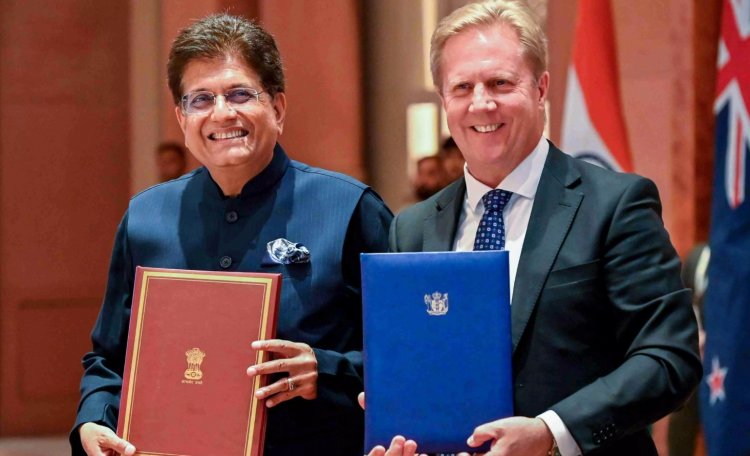
India and New Zealand signed an FTA on April 27, 2026 at Bharat Mandapam in New Delhi. Signing was done by India's commerce minister Piyush Goyal and New Zealand's trade minister Todd McClay. The FTA may be implemented in about 6 months after ratification by India's cabinet and New Zealand parliament.
This is India’s seventh FTA signed in the past five years, after agreements with Mauritius, the UAE, Australia, EFTA countries, the UK and Oman. Of these, the FTAs with the UK, Oman and New Zealand are yet to be implemented; the others are already operational. The India–New Zealand FTA talks began in 2010 but stalled in 2015 after nine rounds. They were revived in March 2025.
The agreement focuses on reducing tariffs on goods, improving market access in services and easing trade procedures, while protecting India’s policy space in sensitive areas, especially basic dairy products.
Tariff Concessions
Tariff asymmetry is central to the India-New Zealand FTA. According to a report by think tank Global Trade Research Initiative (GTRI), New Zealand’s average import tariff is only 2.3%, compared with India’s 16.2%, and 58.3% of New Zealand’s tariff lines are already duty-free. This means Indian exporters already had fairly wide access to the New Zealand market even before the FTA.
Under the agreement, New Zealand will eliminate tariffs on 100% of its tariff lines from the date the FTA enters into force. This will benefit Indian exports such as textiles and apparel, leather, ceramics, carpets, engineering goods and automotive components.
India will provide market access on about 70% of tariff lines that will cover about 95% of New Zealand’s exports, including products such as wool, coal, wood and wine. India has protected sensitive sectors. Products such as dairy, sugar and edible oils have been excluded from tariff concessions.
Sensitive farm products such as apples, kiwifruit, honey and albumins, including milk albumin, will be handled through tariff-rate quotas, minimum import prices and safeguard measures to protect Indian farmers.
India has offered tariff-rate quotas on four New Zealand product groups: apples, kiwifruit, albumins and Mānuka honey. These products get lower duties only within fixed quota limits and only if they meet the conditions set out in the agreement. Wine is treated separately. It does not get a TRQ, but receives phased tariff cuts based on import price.
New Zealand apples get limited concessional access
New Zealand apples get limited concessional access to India. The benefit applies only from April 1 to August 31 each year and only to apples priced at US$1.25 per kg or more on a CIF basis. Within the quota, India cuts duty from 50% to 25%. The quota begins at 32,500 tonnes in Year 1 and rises to 45,000 tonnes from Year 6 onward. Apples below the price threshold get no concession. Imports above the quota face normal MFN duty. The concession is also linked to New Zealand’s cooperation under the Apple Action Plan. If New Zealand fails to meet its commitments, India can suspend market access.
Apple imports already account for nearly one-fifth of India’s domestic production. New FTA concessions to New Zealand, along with pressure from the U.S., EU and other partners, could further increase the share of imported apples in India. Cheap apples from Iran and Turkey are already affecting lower-grade Indian apples. Lower-duty apples from New Zealand, the U.S. and the EU could soon compete in mid-premium and premium markets, especially in cities and during the off-season. This could hurt apple growers in Kashmir and Himachal Pradesh, who already face high transport costs, poor cold-chain facilities, weak marketing systems and unstable prices.
Without urgent reforms in storage, grading, transport, branding and market access, FTA concessions may steadily reduce the market share and earnings of Himalayan apple growers, even as Indian consumers continue to pay high prices for imported fruit.
Tariff on Albumins to become half
India’s base duty is 22%, but within the quota the duty falls to 11%. The quota starts at 1,000 tonnes in Year 1, rises each year, and reaches 3,000 tonnes from Year 5 onward. Imports outside the quota get no concession.
TRQ administration. The quota system gives New Zealand the main allocation role. New Zealand will allocate TRQs to its exporters or producers through export certificates, specifying the product, quantity and Indian importer. India’s role is mainly to issue TRQ authorisations to importers once a valid export certificate is presented, receive allocation information from New Zealand, and ensure the system works fairly. India can raise concerns if Indian importers, especially small firms, do not get quota access in a transparent and non-discriminatory manner. In effect, New Zealand controls quota allocation at the exporter end, while India validates, authorises and monitors imports at the entry end.
Price-based tariff cuts on wine
New Zealand wine gets price-based tariff cuts, not a TRQ. Wine priced below US$5 per 750 ml bottle gets no concession and stays at 150% duty. Wine priced between US$5 and US$15 gets duty reduced to 100% at entry into force, and then gradually to 50% by Year 10. Wine priced at US$15 or more gets a sharper cut, from 150% to 75% at entry into force, and then to 25% by Year 10.
Services: What are on offers
The India-New Zealand FTA includes significant commitments in services and mobility. New Zealand has offered commitments in 118 services sectors and MFN treatment in 139 sectors. India has offered services market access in 106 sectors and MFN treatment in 45 sectors.
The agreement also creates new mobility pathways for Indian students, professionals and young workers.
• Indian students in New Zealand will be allowed to work 20 hours per week.
• STEM bachelor’s and master’s graduates will get three-year post-study work visas, while doctorate holders will get four years.
• A new temporary employment pathway will allow 5,000 skilled Indian professionals to work in New Zealand at any time for up to three years, especially in sectors such as IT, healthcare and education.
• In addition, a Work and Holiday visa scheme will allow 1,000 young Indians each year to live and work in New Zealand for 12 months.
Investment with conditions
New Zealand’s proposed US$20 billion FDI commitment over 15 years is one of the headline features of the India–New Zealand FTA. However as New Zealand’s existing investment in India is less than US$1 billion over the past 25 years, reaching US$20 billion will require a major increase in investment.
The commitment comes with conditions:
“The Parties recognise that India’s economic development over the last two decades was accompanied by a sustained increase of nominal FDI into India, reflecting a confidence of foreign investors in the potential of the Indian economy. Based on this observation, and on estimated nominal GDP growth rate of India over the next 15 years, in line with the past growth rates, New Zealand aims to strengthen its FDI footprint in India, leveraging a full implementation of this Agreement by the Parties”.
“In case of occurrence of any unforeseen circumstances including global pandemic, war, geopolitical disruptions, financial crisis or sustained economic underperformance, or other similar factors beyond New Zealand’s control which have had a material bearing on the progress to achieve the objective, the Parties may adjust the investment objective by mutual agreement of the Parties, accordingly through an amendment of Article 9.2.”
In the India-EFTA TEPA, EFTAs US$100 billion investment target comes with tough assumptions, including India maintaining around 9.5% annual nominal GDP growth in U.S. dollar terms. With current GDP growth below this level, such commitments are useful signals, but not guaranteed inflows.
FTA Subject coverage
The agreement covers 20 chapters, including trade in goods, rules of origin, services, customs and trade facilitation, SPS, TBT, trade remedies, dispute settlement and legal provisions. It also includes newer areas such as investment promotion, sustainable development, MSME cooperation, competition, intellectual property rights, economic cooperation and technical assistance, and cultural and traditional knowledge.
Significance of the agreement
Given the modest scale of bilateral trade, about US$2.1 billion in CY2025, the India-New Zealand FTA is less a major trade breakthrough and more a framework for deeper cooperation. For India, it improves access to a small but high-income and rules-based Pacific market. For New Zealand, it offers more secure entry into one of the world’s fastest-growing large economies amid rising global trade uncertainty.
The FTA will bring more predictability in goods, services, mobility and investment, but its real impact will depend on follow-up action. Both countries must move beyond tariff cuts and build stronger links in supply chains, education, tourism, aviation training, fintech, forestry and agriculture.
New Zealand’s Indian diaspora of over 300,000 people, about 5% of its population, can become a strong bridge for trade and investment. Easier visas, direct flights and mutual recognition of qualifications would help. Both sides should aim to double trade by 2031.
Services to gain the most
Ajay Srivastava of GTRI says, the India-New Zealand FTA gives India better access to a small but wealthy Pacific market, but goods export gains may be limited. India exported US$711.1 million worth of goods to New Zealand. Since nearly 60% of New Zealand’s tariff lines are already duty-free, many Indian exports will not get a new benefit. Gains will mainly come in products that still face duties and will now become duty-free, such as textiles, garments, leather, carpets, ceramics, engineering goods and auto components.
Services may offer bigger gains. New Zealand has created new visa pathways for Indian students, STEM graduates, young workers and up to 5,000 skilled professionals. This could help India in IT, healthcare, education support, financial services and telecom-linked services. The Indian diaspora of over 300,000 people can also support stronger trade, tourism, education and investment links.
Apples are a concern. India imported US$38.4 million worth of apples from New Zealand in CY2025. Even limited tariff cuts, with quotas, minimum prices and seasonal limits, could hurt apple growers in Himachal Pradesh and Kashmir. They already face rising competition from apples from the U.S., EU, Iran and Turkey.
New Zealand data also show that it has a large services surplus with India, mainly because Indian students and tourists spend heavily there. In FY2025, India’s services imports from New Zealand were US$550 million, against services exports of US$255.8 million. India’s total trade deficit with New Zealand is projected to rise from US$170.2 million in 2025 to US$353.6 million in 2026.