
India’s Farms Go Digital as AI Drives Shift to Smart Agriculture
In its report tabled on Monday, the Standing Committee on Communications and Information Technology outlined how AI is enabling a structural shift in agricultural decision-making, with data, analytics and predictive tools replacing conventional reliance on fertilisers, water and manual interventions.

 Join the RuralVoice whatsapp group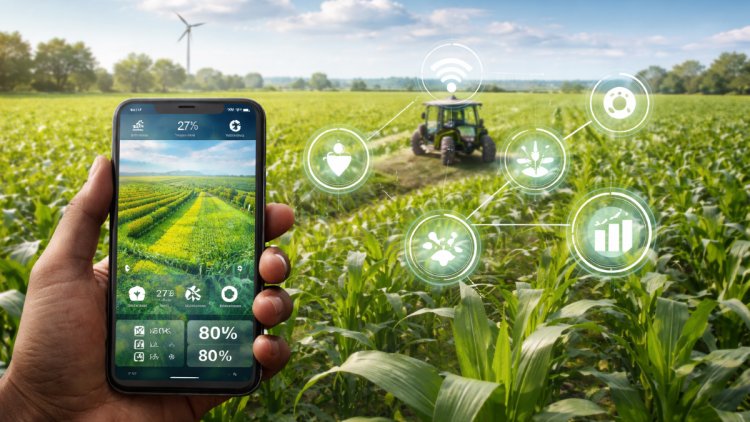
Artificial Intelligence (AI) is poised to fundamentally recast India’s agriculture sector—from one historically driven by inputs to a future anchored in intelligence-led governance—offering a pathway to higher productivity, sustainability and income security, a Parliamentary panel has said.
In its report tabled on Monday, the Standing Committee on Communications and Information Technology outlined how AI is enabling a structural shift in agricultural decision-making, with data, analytics and predictive tools replacing conventional reliance on fertilisers, water and manual interventions.
Looking ahead, the transformation is expected to be both deep and system-wide. AI-powered technologies—ranging from crop monitoring and soil diagnostics to weather forecasting—are already equipping farmers with real-time, actionable insights. By analysing satellite imagery and sensor-based data, these systems can anticipate pest attacks, optimise irrigation and guide planting cycles with far greater precision.
The report projects that such interventions could lift agricultural productivity by 8–10%, while also helping reduce the nearly 30% losses India faces across its food supply chain. The shift, it suggests, is not merely technological but structural—moving agriculture towards a predictive, risk-managed ecosystem.
At the policy level, AI is expected to play a central role in governance. The government’s IndiaAI Mission, with an outlay of ₹10,371.92 crore, is designed to build the backbone for such transformation by strengthening data platforms, compute infrastructure and application development across sectors, including agriculture.
Through initiatives like the IndiaAI Datasets Platform, policymakers aim to create high-quality, interoperable datasets that can support precision agriculture, targeted subsidies and real-time crop assessments. This could enable more efficient allocation of resources and sharper policy interventions, particularly in areas such as disaster management and climate resilience.
The report also highlights growing momentum in the agri-tech ecosystem. AI-driven startups are expected to play a pivotal role in delivering last-mile solutions—from market intelligence and price forecasting to supply chain optimisation. Over time, this could help farmers move from price-takers to informed market participants.
Crucially, the committee links the future of agriculture with broader economic goals. With AI projected to add up to $967 billion to the Indian economy by 2035, its integration into agriculture—still the country’s largest employer—will be central to inclusive growth.
Yet, the transition is not without challenges. The panel flagged issues such as digital access, data quality and skill gaps, particularly for small and marginal farmers. Addressing these will require sustained investment in rural digital infrastructure and capacity-building.
Even so, the trajectory is clear. As AI scales across the agricultural value chain, India is moving towards a future where farming is no longer dictated by inputs alone, but guided by intelligence—reshaping not just how food is grown, but how the sector is governed.