
Below-Normal Monsoon Forecast Raises Concerns Over Kharif Output, Inflation
IMD has forecast a below-normal monsoon at 92% of LPA, raising concerns over kharif output, especially pulses and oilseeds. El Niño risks, coupled with West Asia tensions, may push food inflation higher, impact farm incomes, and dampen rural demand, despite possible relief from a positive Indian Ocean Dipole.

 Join the RuralVoice whatsapp group
India is likely to witness a below-normal southwest monsoon this year, raising concerns about agricultural production, food inflation and the broader rural economy. The India Meteorological Department (IMD) has projected that rainfall during the June-September season will be around 92% of the long-period average (LPA), which falls in the ‘below normal’ category.
According to the IMD, the seasonal rainfall is expected to be 8% below the LPA of 87 cm, with a model error margin of plus or minus 5%. The forecast assumes significance as the monsoon season is crucial for India’s agriculture, particularly the kharif crop cycle that begins in June and contributes over half of the country’s total foodgrain production.
A week back, private weather forecasting agency Skymet had also projected a below-normal southwest monsoon at 94% of the long-period average (LPA) of 868.6 mm. While rainfall in June may remain near normal at 101% of LPA, it is expected to weaken progressively to 95% in July, 92% in August and 89% in September.
The IMD’s probability forecast indicates a 31% chance of below-normal rainfall and a 35% likelihood of deficient rainfall, suggesting a higher risk of significantly weaker monsoon conditions. The impact is expected to be more pronounced in the monsoon core zone, which includes large parts of central and western India that heavily depend on rainfall for agriculture.
One of the key factors influencing this outlook is the possible development of El Niño conditions after June. El Niño, a climate phenomenon associated with warming of ocean surface temperatures in the Pacific, is historically linked to weak monsoons in India. Data suggests that nearly 70% of El Niño years since 1980 have coincided with poor summer rainfall in the country.
The IMD has warned that El Niño conditions could particularly affect rainfall during the latter half of the monsoon season, especially in August and September. Erratic rainfall patterns due to El Niño had earlier reduced India’s foodgrain production by 6.1% in the 2023-24 crop year.
However, there may be some mitigating factors. The IMD noted that a positive phase of the Indian Ocean Dipole (IOD), expected to develop towards the latter part of the monsoon, could partially offset the adverse impact of El Niño. A positive IOD typically supports enhanced rainfall over India, although its behaviour remains difficult to predict.
The below-normal monsoon forecast has raised concerns among economists and policymakers, particularly in the context of rising geopolitical tensions in West Asia. The ongoing conflict has disrupted global supply chains, leading to higher input costs, including fertilisers and energy, which are critical for agriculture.
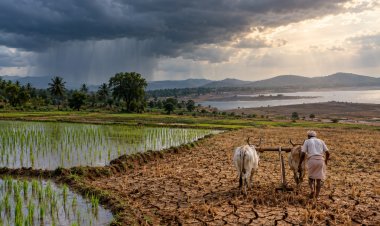
For farmers, the dual challenge of deficient rainfall and rising input costs could affect sowing decisions, crop yields and overall farm income. Crops such as pulses and oilseeds are especially vulnerable to rainfall variability, and any shortfall in production could trigger higher prices in domestic markets.
While the government may be less worried about paddy production due to ample buffer stocks, a decline in output of other crops could put upward pressure on food inflation. Experts warn that higher food prices, combined with a low base effect, could push inflation upwards in the coming months.
The impact may also extend beyond agriculture. Lower farm incomes could dampen rural demand for consumer goods such as two-wheelers, tractors, and daily-use products, affecting overall economic growth.
Additionally, reduced rainfall can strain water resources, impacting irrigation, drinking water supply, reservoir levels and hydropower generation, particularly in arid and semi-arid regions.
Although India has made strides in improving drought resilience in recent years, the evolving climate risks underscore the continued dependence of the farm sector on monsoon performance. With more detailed forecasts expected later in May, policymakers and farmers alike will closely monitor rainfall trends to assess the potential impact on agriculture and inflation.