
World Trade Organization MC14 Ends in Deadlock; E-Commerce Pact Collapses, Fisheries Talks Advance Amid India’s Push
The World Trade Organization MC14 ended without consensus, deferring key decisions to Geneva as divisions deepened over e-commerce, agriculture, and reforms. The lapse of key safeguards marked a setback, while fisheries subsidies talks progressed, with Piyush Goyal advocating equity, policy space, and protections for small-scale fishers.

 Join the RuralVoice whatsapp group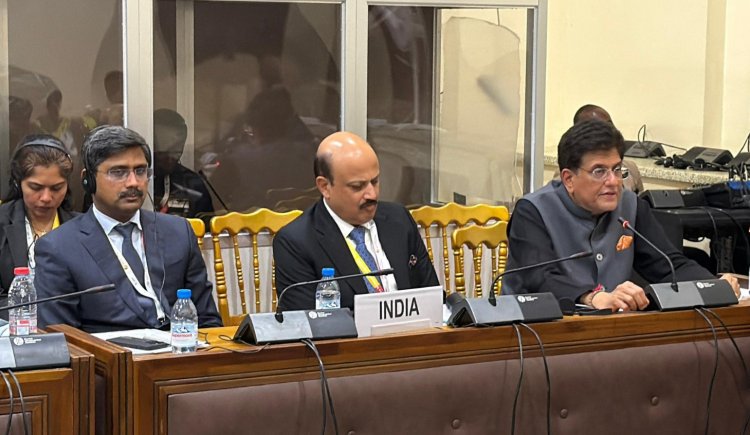
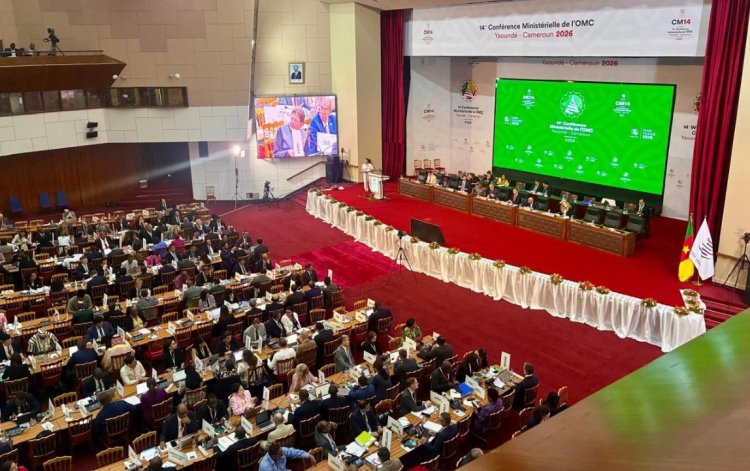
The World Trade Organization’s 14th Ministerial Conference (MC14), held in Yaoundé, Cameroon from March 26-29, ended in a stalemate, with key decisions on e-commerce, reforms, and agriculture deferred to Geneva, exposing deep divisions in the multilateral trading system. While existing safeguards like the e-commerce moratorium lapsed, discussions on fisheries subsidies remained central, particularly on overcapacity and overfishing. India, led by Piyush Goyal, played an active role, emphasizing policy space and equitable outcomes. Goyal’s intervention shaped the roadmap for Phase II fisheries negotiations, even as broader consensus eluded members.
Director-General Ngozi Okonjo-Iweala acknowledged how close members had come to a deal, but conceded failure to reach consensus. “We are very close to a Yaoundé package… but we are not all the way there yet,” she said, adding that members would preserve draft outcomes- including decisions on WTO reform, electronic commerce, TRIPS non-violation complaints and an LDC package - as the basis for future negotiations in Geneva. The outcome makes MC14 one of the most inconclusive ministerials in recent years, highlighting deep divisions over the future of the multilateral trading system.
E-Commerce Moratorium Expires
At the heart of the deadlock was the WTO’s moratorium on customs duties on electronic transmissions, in place since 1998. The U.S., supported by the EU and Japan, pushed for a long-term or permanent extension. India and other developing countries opposed this, arguing it would lock in revenue losses and limit policy space in a rapidly growing digital economy. Brazil played a decisive role in blocking compromise proposals, including a four-year extension, citing lack of progress in agriculture talks. With no agreement, the moratorium lapsed for the first time in 26 years, opening the door for countries to impose tariffs on digital transmissions.
TRIPS Safeguard Also Lapses
Think Tank Global Trade Research Initiative (GTRI) in a report said, the failure to extend the e-commerce moratorium also led to the expiry of the safeguard against non-violation complaints under the TRIPS Agreement. Developing countries had relied on this safeguard to protect policy space, especially in areas like public health. Without it, even WTO-compliant measures, such as compulsory licensing, can be challenged by developed countries for affecting their expected commercial gains. For India, this increases the risk of disputes over its intellectual property rules, including provisions like Section 3(d) of its patent law.
Reform Talks Stall
Efforts to agree on a WTO reform roadmap also failed. A draft proposal to work toward reforms by 2028 could not gain consensus. The divide is clear: advanced economies want quicker decision-making and stricter rules, while developing countries want to protect policy flexibility and the consensus-based system. As a result, reform talks- like other issues- have been pushed back to Geneva with no immediate progress.
IFDA Blocked, Plurilateral Path Advances
The Investment Facilitation for Development Agreement (IFDA), backed by most members, remains blocked due to India’s opposition. India argues that bringing such plurilateral deals into the WTO would weaken its multilateral nature and allow smaller groups to shape rules. India’s stance has helped safeguard the WTO’s core principle of consensus-based decision-making, preventing a shift toward fragmented, coalition-driven rule-making. Meanwhile, 66 members moved ahead with a separate e-commerce deal outside the WTO, reflecting a growing shift toward rule-making outside the consensus system.
Agriculture Spillover and Broader Failure
The breakdown was driven in part by frustration over stalled agriculture talks- a long-standing priority for developing countries. Brazil linked progress on e-commerce to movement on agriculture, making deadlock inevitable. This shows how unresolved old issues continue to block progress in newer areas like digital trade.
A More Consequential Breakdown
MC14 stands out not just for failing to deliver new agreements, but for letting existing pillars collapse. The closest precedent is MC11 (Buenos Aires, December 10-13, 2017), which ended without a declaration due to divisions over new rules, while an earlier breakdown at MC5 (Cancún, September 10-14, 2003) was triggered by disputes over new issues like investment and competition policy. But MC14 goes further- and worse. It is the only ministerial where core moratoria, including those on e-commerce and TRIPS non-violation complaints, were allowed to expire. Unlike MC11, where the fight was over future rule-making, MC14 reflects a failure to even preserve the status quo. Unlike Cancún, where new issues caused the collapse, here unresolved legacy issues such as agriculture derailed progress in unrelated areas like e-commerce. The result is a more serious breakdown- not just stalled negotiations, but erosion of existing disciplines, exposing how deeply the WTO’s consensus-based system is now strained.
MC14 marks a turning point for the WTO- not because it failed to deliver new deals, but because it failed to preserve existing ones. The lapse of the e-commerce moratorium and TRIPS safeguard signals a deeper institutional drift, with old compromises breaking down. The divide is now structural: between those pushing coalition-driven rule-making and those defending consensus and policy space.
Small-scale fishermen no problem: Goyal
Keeping sustainability concerns at the forefront and in line with Sustainable Development Goal 14.6, India emphasised that Phase II negotiations must reflect core principles of equity, including Special and Differential Treatment (S&DT) for developing countries and Least Developed Countries, as well as the principles of Common but Differentiated Responsibilities and Respective Capabilities (CBDR-RC) and the Polluter Pays Principle. Consistent with these principles, Piyush Goyal highlighted key priorities such as a 25-year transition period for developing countries, stronger disciplines on distant-water industrial fishing fleets, a permanent carve-out for small-scale and artisanal fishers, and subsidy disciplines based on per capita intensity, thereby broadening the scope of Phase II discussions.
In the Ministerial discussions held on the issue, Goyal emphasised that the fisheries sector play a key role in securing India’s food security and ensuring livelihood, supporting more than 9 million fisher families largely comprising small, traditional, and artisanal fishermen practising sustainable methods. He also highlighted that India is not a heavily industrialized fishing nation and does not have large-scale, distant-water fleets or heavily mechanized operations. Further, India’s fisheries subsidies are among the lowest in the world- barely about USD 15 per fisher family annually- compared to tens of thousands elsewhere.