
Government Says Wheat Production Remains Resilient in 2025–26 Despite Weather Stress
India’s wheat crop for 2025–26 is expected to remain resilient despite heat stress and unseasonal weather, with the government citing higher acreage, early sowing, and improved varieties as key buffers. However, industry estimates suggest actual output may fall below official projections.

 Join the RuralVoice whatsapp group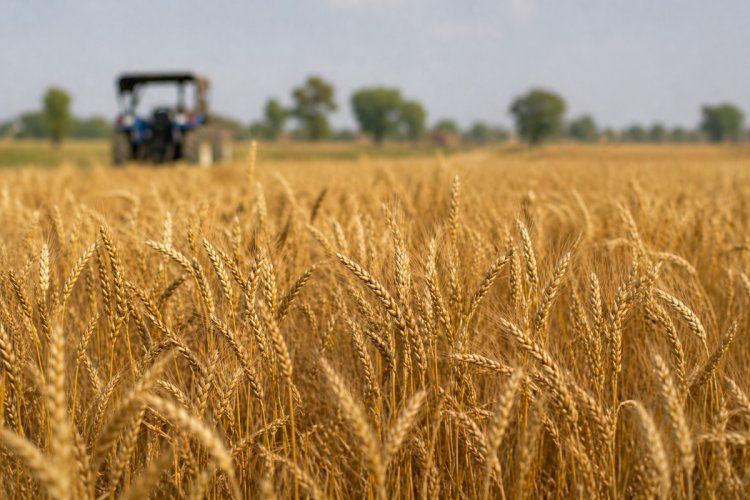
The central government has clarified that India’s wheat production in 2025–26 will remain “mixed but resilient”, shaped by both climatic adversities as well as strong adaptive measures undertaken by farmers.
Unusually high temperatures in February exposed the crop to heat stress, reducing the grain-filling duration and yields. Further, untimely rainfall and hailstorms at maturity in some areas have likely caused localised damage to grain quality and output.
However, the Ministry of Agriculture & Farmers Welfare believes that these weather-related impacts will be largely offset by increased acreage, early sowing, and the adoption of improved varieties.
According to a statement issued by the Ministry of Agriculture & Farmers Welfare, the wheat crop was sown across an estimated 33.4 million hectares, marking an increase over the previous year due to timely sowing. Importantly, no major incidents of insect pests or diseases were reported during the season, and weed infestation remained low, supporting healthy crop growth.
The Union Agriculture Ministry has estimated a record wheat production of 120.21 million tonnes for 2025–26, compared with last year’s estimate of 117.94 million tonnes. However, due to adverse weather conditions this year, actual production is expected to fall short of the government’s estimate. According to a survey by the Roller Flour Millers Federation of India (RFFI), wheat production is estimated at 110.65 million tonnes in 2025–26.
High temperatures in February shortened the grain-filling period and impacted yields. In addition, unseasonal rainfall and hailstorms in some regions during the maturity stage caused localised damage to grain quality and output.
Despite these setbacks, the government has maintained a cautiously optimistic outlook, citing several compensatory factors. Increased early sowing helped the crop escape peak heat stress, while an additional 0.6 million hectares under cultivation is expected to offset localised losses. The adoption of improved, climate-resilient, and disease-resistant wheat varieties has also strengthened crop performance.
“The adverse effects of weather anomalies are likely to be largely compensated by increased area, improved agronomic practices, and enhanced varietal adoption,” the Ministry said, adding that overall production is expected to remain stable compared with the 2024–25 season.
The government reiterated that while localised weather-related impacts have been observed, the overall wheat production scenario remains stable, supported by higher acreage, improved farming practices, and wider adoption of advanced seed varieties.