
Is the Prime Minister's Call for Austerity a Sign of Weakness in the Economy?
Prime Minister Narendra Modi’s appeal to save fuel, reduce foreign travel and avoid buying gold has heightened concerns over the economy amid the Iran war. Rising import costs of crude oil, gas and fertilisers are expected to push up inflation and slow GDP growth. Crisil Intelligence has warned of increasing economic risks in the current financial year. Experts believe the Prime Minister’s call for austerity will be meaningful only if supported by long-term policy measures.

 Join the RuralVoice whatsapp group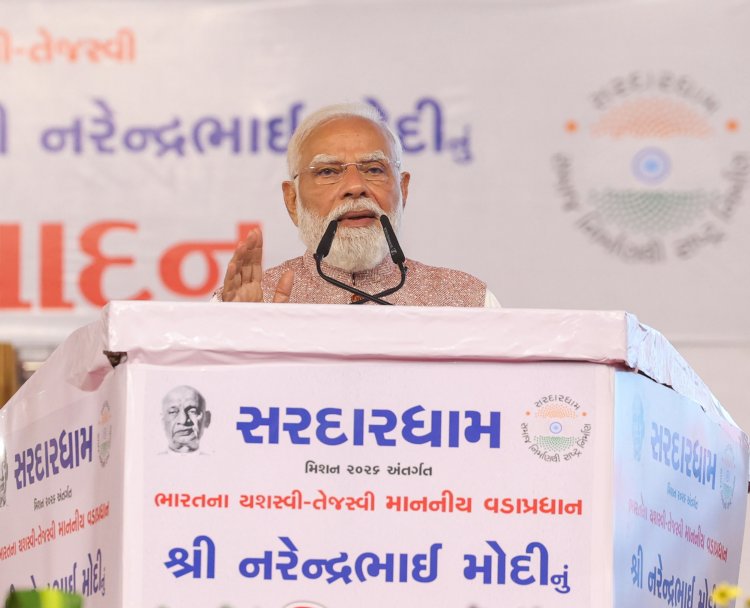
Amid the crisis triggered by the Iran war in West Asia, Prime Minister Narendra Modi’s appeal to citizens for austerity over two consecutive days has raised fresh concerns about the economy. His suggestions to reduce petrol and diesel consumption, avoid foreign travel, refrain from buying gold jewellery and cut the use of other imported goods are being seen as signs of the government’s growing economic anxiety.
In fact, international prices of crude oil, gas and fertilisers have surged sharply after the war, while the weakening rupee has made imports even more expensive. Experts fear that inflation could rise in the coming months, economic growth may come under pressure and the government’s revenue targets could also be affected. Various agencies have started warning about higher inflation, a widening current account deficit and slower GDP growth. Experts believe that appeals to adopt indigenous products and practice austerity will be effective only if backed by a long-term policy and proper implementation.
What the Prime Minister Said
The Prime Minister made this appeal to the people first in Hyderabad on May 10 and then again in Vadodara on May 11. Referring to the West Asia crisis, he urged citizens to reduce the use of petrol and diesel, adopt carpooling, use metro trains in cities, transport goods through railways instead of roads, and revive work-from-home arrangements, virtual meetings, and online classes in schools as seen during the Covid period. He also appealed to people to avoid foreign travel for a year, refrain from holding destination weddings abroad, and even avoid buying gold jewellery.
India depends on imports for nearly 90 percent of its petroleum requirements. Due to the West Asia crisis that has continued for the past two-and-a-half months, crude oil prices have risen by nearly 50 percent. Almost all newly consumed gold in the country (excluding recycled gold) is imported. India is also significantly dependent on imports for edible oils, pulses, and fertilizers. Out of the annual urea consumption of 40 million tonnes, nearly 10 million tonnes are imported. DAP is almost entirely imported. The country is also heavily dependent on imports for raw materials used in fertilizer production.
In this context, the Prime Minister’s statement reflects the government’s concern over the economy. If the situation does not improve soon, there are fears of slower economic growth and rising inflation. FMCG companies have already increased product prices once and are now preparing for another round of price hikes.
Fear of Rising Inflation and Slowing GDP Growth
Research firm CRISIL Intelligence, in its latest report, has warned of rising inflation and slowing GDP growth. According to the report, economic risks have been increasing due to tensions in West Asia. The Strait of Hormuz is almost shut, and its impact is already visible on supply chains and trade. Even after the route reopens, it will take time for oil and gas supplies to return to normal because much of the infrastructure has been severely damaged during the war.
CRISIL has projected Brent crude prices to remain between $90 and $95 per barrel during FY 2026-27, compared with its earlier estimate of $82 to $87 per barrel. This would be 32% higher than the average price in FY 2025-26. In other words, if import volumes do not decline, India’s crude oil import bill could rise by at least one-third. The agency has also warned that risks could intensify further in the coming months.
The report estimates that retail inflation this year will remain above the Reserve Bank of India target of 4%, at around 5.1%. In FY 2025-26, average retail inflation was about 2%. The current account deficit (CAD) is also expected to rise to 2.5%, compared with 0.8% last year. Due to these factors, CRISIL has cut its GDP growth forecast for FY 2026-27 to 6.6%. India’s growth in FY 2025-26 is estimated at 7.6%.
Impact on Crude Oil Imports and Oil Companies
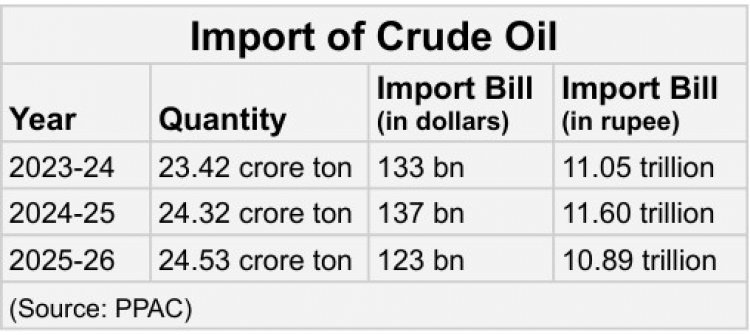
India’s biggest concern is crude oil, which accounts for the largest share of the country’s import bill. Data from the past three years show that the import volume has remained stable at around 240 million tonnes. However, fluctuations in global prices and changes in the rupee’s value against the dollar have significantly affected the import bill.
Before the Iran war, Brent crude was trading at around $70 per barrel in the international market. Since the conflict began, prices have consistently remained at $100 per barrel or higher. If crude prices continue to stay at these elevated levels, India’s crude oil import bill, currently around Rs 11 lakh crore, could rise sharply.
Apart from crude oil, India also imports LPG on a large scale. LPG imports were worth Rs 86,361 crore in 2023-24, Rs 1,05,679 crore in 2024-25 and Rs 99,243 crore in 2025-26.
Despite the sharp rise in international crude oil prices, retail prices of petrol and diesel have not been increased in India. It is being claimed that this is causing heavy losses to government-owned oil marketing companies. However, it is also important to note that in financial year 2024-25, public sector oil marketing companies - Indian Oil Corporation (IOCL), Bharat Petroleum Corporation (BPCL) and Hindustan Petroleum Corporation (HPCL) - together posted a profit of Rs 36,522 crore (Source: BSE). Among upstream companies, Oil and Natural Gas Corporation (ONGC) reported a profit of Rs 35,610 crore in 2024-25, while Oil India earned Rs 6,114 crore.
During the first nine months of 2025-26 (April-December), the three oil marketing companies together earned an estimated profit of around Rs 57,788 crore. During the same period, ONGC and Oil India reported a combined profit of Rs 28,909 crore.
How Will Weddings Take Place Without Gold?
Gold is the second-largest component of India’s import bill. According to the Global Trade Research Initiative (GTRI), India imported gold bars worth $36.5 billion in 2022. This increased to $42.6 billion in 2023 and further to $58.9 billion in 2025. The Prime Minister has appealed to people not to buy gold jewellery for one year.
Every year, millions of weddings take place in India, and families buy jewellery according to their financial capacity. Some demand is met through recycling old gold, while the rest comes from newly purchased jewellery. India’s fresh gold demand is largely fulfilled through imports. The question is whether weddings in India can take place without any jewellery at all. And what will happen to thousands of small and large jewellery shops and their employees?
Fertiliser Subsidy Set to Rise
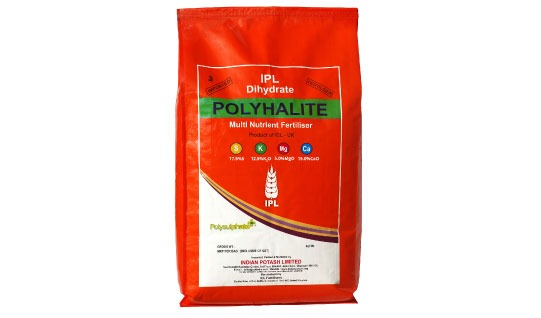
Referring to chemical fertilisers, the Prime Minister said, “They are causing significant damage to the soil. Therefore, it is necessary for us to cut chemical fertiliser consumption by half and move towards natural farming.” He also stated that “a bag of fertiliser (urea) was being sold globally for Rs 3,000, while Indian farmers are getting the same bag for less than Rs 300.” According to Trading Economics, international urea prices remained below $500 per tonne until February in FY 2025-26. However, after the Iran war began, prices surged above $900 per tonne.
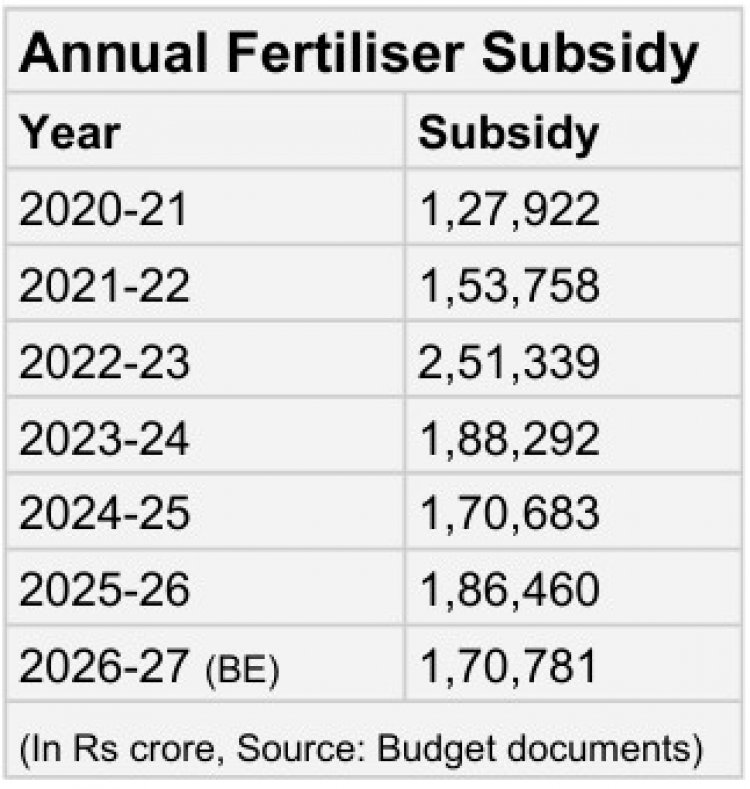
With global fertiliser prices rising, India’s fertiliser subsidy bill is also expected to increase sharply. The subsidy stood at Rs 1.28 lakh crore during the Covid year 2020-21 and rose to a record Rs 2.51 lakh crore in 2022-23. In FY 2025-26, the fertiliser subsidy was Rs 1.86 lakh crore, while the Union Budget presented on February 1, before the Iran war, had projected it at Rs 1.70 lakh crore for 2026-27. Under current circumstances, this amount could rise significantly.
The Prime Minister has acknowledged that “because of the war, the prices of petrol, diesel, gas and fertilizers have risen sharply across the world. To ensure that Indian citizens are not burdened, the government is bearing the entire burden itself.” However, he also said that “when supply chains continue to face disruptions, difficulties keep increasing no matter how many measures we take.” His statement is being interpreted as an indication that price hikes may happen soon.
How Dependence on Imports Can Be Reduced
Senior Professor at Delhi School of Economics Dr. Surendra Kumar told Rural Voice that the Prime Minister’s statement should be viewed in two parts. The appeal to adopt Swadeshi is not merely about austerity. It is aimed at strengthening domestic manufacturing capacity. He said that after the economic reforms of 1991, India’s dependence on imports increased, but domestic production capacity did not expand proportionately. Today, India cannot claim complete self-reliance in any major product category.
He said short-term economic gains often come with long-term risks because other countries take advantage of such dependence. For instance, China exploited this dependence during the Covid period, while the United States frequently imposes sanctions to serve its own interests. Increasing the use of indigenous products would boost domestic manufacturing, but policies must also ensure that Indian companies do not become overprotected. Their products should remain globally competitive.
According to Dr. Surendra, India’s dependence on West Asia for energy is extremely high, and nearly one-fourth of the country’s trade also passes through this route. India can focus more on electrification because the country has abundant coal reserves. He added that India has largely followed Western-style supply-side policies while neglecting demand-side growth. Measures to increase domestic demand are needed. Along with this, India must also mobilize domestic capital through higher savings, as the country cannot rely solely on foreign capital.