
Argentina and India Strengthen Cooperation in Agricultural Research and Technology Exchange
India and Argentina deepen partnerships on oilseeds, pulses, mechanisation, and plant-animal health under ICAR-INTA agreement.

 Join the RuralVoice whatsapp group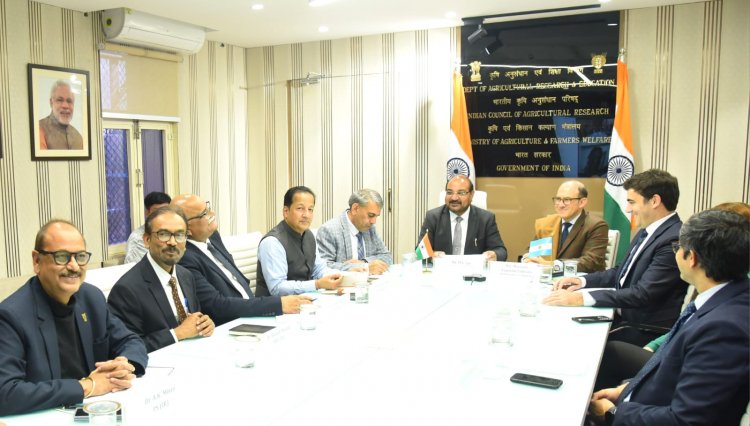
The Indian Council of Agricultural Research (ICAR) and Argentina’s National Institute of Agricultural Technology (INTA) have signed a Work Plan for 2025–2027 to strengthen bilateral cooperation in agricultural research, capacity building, and technology exchange.
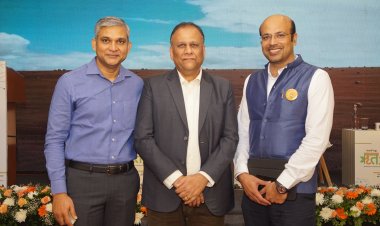
Dr M. L. Jat, Secretary, Department of Agricultural Research and Education (DARE) and Director General, ICAR, and Mariano Augustín Caucino, Ambassador of the Argentine Republic to India, exchanged the signed ICAR–INTA Work Plan today, marking a significant step forward in strengthening bilateral agricultural collaboration.
The Work Plan establishes collaboration across natural resource management, mechanisation, micro-irrigation and fertigation, crop and animal biotechnology, livestock improvement, production technologies for temperate and tropical crops, digital agriculture, biosafety and phytosanitary measures, and value chain development. Implementation will be through joint research, germplasm exchange, expert engagements, and structured training and study visits.
Planned study visits and training programmes will cover greenhouse vegetable production, floriculture and temperate fruits, post-harvest physiology, veterinary diagnostics, precision livestock farming, waste-to-wealth technologies, digital agriculture, and sanitary and phytosanitary systems. Germplasm exchange will include soybean, sunflower, maize, blueberry, citrus, wild papaya species, guava, and selected vegetable crops.
India and Argentina are also deepening cooperation in oilseeds and pulses value chains, agricultural mechanisation, including zero-tillage practices, cotton harvesting machinery, and drones, and horticulture value chain development, including infrastructure creation and planting material exchange.
In the area of plant and animal health, the Work Plan envisages region-specific Foot-and-Mouth Disease (FMD) elimination strategies, along with enhanced collaboration on locust surveillance and management through technical exchanges and best-practice sharing.
Both sides reaffirmed their commitment to the India–Argentina scientific partnership and agreed to annual monitoring and review mechanisms to ensure effective implementation and sustained progress.